
What Is a Parallel Resistor Calculator?
A parallel resistor calculator finds the equivalent resistance of resistors connected in parallel. In a parallel circuit, all resistors share the same voltage across their terminals, but current splits between them based on each resistor's value.
The tool simplifies a parallel resistor network into a single equivalent resistor. This is essential for circuit analysis because once you know the equivalent resistance, you can use Ohm's Law to find total current, voltage, and power.
Whether you're solving physics homework, designing an electronics circuit, or troubleshooting a resistor network, this calculator automates the reciprocal arithmetic that makes parallel resistance calculations error-prone by hand.
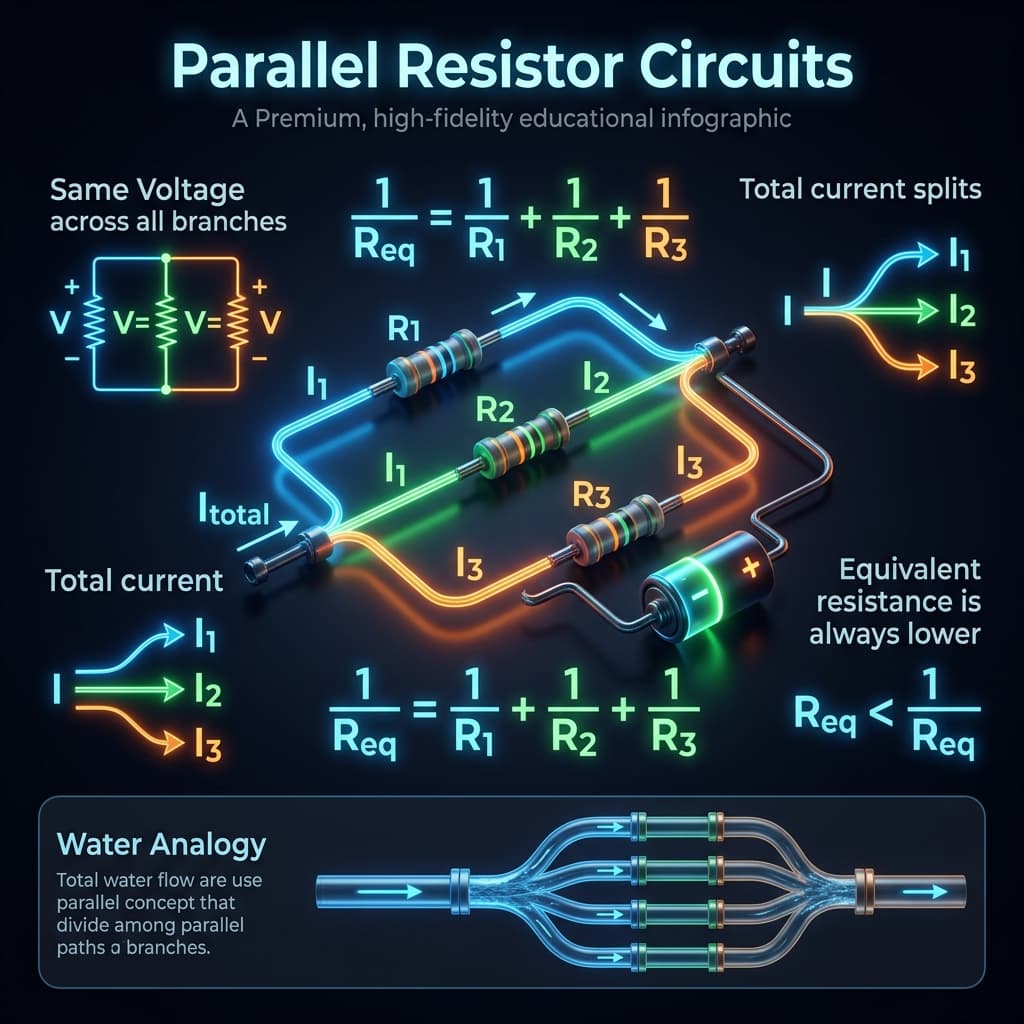
Parallel Circuit Schematic
In a parallel circuit, all resistors share the same two nodes. Current splits among the branches, and each branch carries I = V/R.
Parallel Resistor Formula
Resistors in parallel combine using reciprocal values. The general formula works for any number of parallel resistors.
General parallel resistor formula: add the reciprocals of each resistance, then take the reciprocal of the sum.
For exactly two resistors, a simpler shortcut avoids the reciprocal steps entirely:
Two-resistor parallel shortcut: product divided by sum.
Conductance (G = 1/R) adds directly in parallel, which is why parallel resistance decreases as you add branches:
Total conductance is the sum of individual conductances. Conductance is measured in siemens (S).
How to Use the Parallel Resistor Calculator
- 1Enter at least two resistor values in the input fields.
- 2Select the unit for each resistor (Ω, kΩ, MΩ, or mΩ).
- 3Click Add resistor to include more parallel branches.
- 4Optionally expand the voltage section and enter an applied voltage to see branch currents and power.
- 5Click Calculate to see the equivalent resistance, formula breakdown, and conductance table.
- 6Use Copy result to save the output or Reset to start over.
Example Calculations
Two resistors in parallel
R1 = 100 Ω, R2 = 200 Ω. Using the two-resistor shortcut: Req = (100 × 200)/(100 + 200) = 20,000/300 = 66.67 Ω.
Three resistors in parallel
R1 = 100 Ω, R2 = 220 Ω, R3 = 330 Ω. Using the reciprocal formula: 1/Req = 1/100 + 1/220 + 1/330 = 0.01 + 0.004545 + 0.003030 = 0.01773. Req ≈ 56.41 Ω.
Equal resistors in parallel
Three 300 Ω resistors in parallel: Req = 300/3 = 100 Ω. For N equal resistors: Req = R/N.
Branch current with voltage
V = 12 V applied across 100 Ω and 200 Ω in parallel. I1 = 12/100 = 0.12 A, I2 = 12/200 = 0.06 A. Total current Itotal = 0.18 A, which equals V/Req = 12/66.67 ≈ 0.18 A.
Why Parallel Resistance Is Lower
Adding a resistor in parallel provides an additional path for current. The total conductance of the circuit increases because conductance adds directly:
Gtotal = G1 + G2 + …
Since resistance is the inverse of conductance (R = 1/G), higher total conductance means lower equivalent resistance. Think of it like adding lanes to a highway: more lanes let more traffic flow, reducing the overall “resistance” to flow.
This is why the equivalent parallel resistance is always less than the smallest individual resistor in the network. Even adding a very large resistor in parallel will reduce the total resistance slightly.
Parallel vs Series Resistors
| Feature | Series | Parallel |
|---|---|---|
| Resistance formula | Req = R1 + R2 + … | 1/Req = 1/R1 + 1/R2 + … |
| Current | Same through all resistors | Splits between branches |
| Voltage | Divides across resistors | Same across all resistors |
| Adding more resistors | Increases total resistance | Decreases total resistance |
| Common uses | Voltage dividers, current limiting | Current sharing, reducing resistance |
Where Parallel Resistor Calculations Are Used
Parallel resistor calculations appear throughout electronics and physics. Common applications include designing resistor networks for current sharing, simplifying complex circuits into equivalent resistance for analysis, creating precise resistance values from standard components, LED and sensor circuits where branches share a supply voltage, physics homework and exam problems, circuit troubleshooting, and equivalent circuit simplification in introductory electrical engineering courses.
Common Mistakes
- • Using the series formula for parallel resistors — series resistors add directly (Rtotal = R1 + R2), but parallel resistors use the reciprocal formula. Mixing these up is the most frequent error.
- • Expecting the result to be larger — parallel resistance is always less than the smallest individual resistor. If your answer is larger, the formula was applied incorrectly.
- • Including a zero-ohm branch — a 0 Ω resistor in parallel short-circuits the entire network, making Req = 0 regardless of other branches.
- • Forgetting unit conversion — mixing kΩ and Ω without converting leads to results that are off by factors of 1000.
- • Ignoring power ratings — when two resistors are placed in parallel to halve the resistance, each carries a fraction of the total current. Verify that each branch stays within its power rating.
Accuracy and Limitations
This calculator assumes ideal resistors with exact values. Real resistors have manufacturing tolerance (typically 1–10%), temperature coefficients, and power ratings that affect performance.
Very low equivalent resistance can produce high currents that exceed component ratings. Always verify power dissipation and current limits in real circuits. For power-critical or safety-critical designs, consult qualified engineering guidance. This tool is intended for educational and basic circuit calculations.
Frequently Asked Questions
What does a parallel resistor calculator do?›
It calculates the equivalent resistance of two or more resistors connected in parallel. The result is a single resistance value that behaves identically to the parallel combination in a circuit.
What is the formula for resistors in parallel?›
The general formula is 1/Req = 1/R1 + 1/R2 + 1/R3 + … For exactly two resistors, the shortcut Req = (R1 × R2)/(R1 + R2) is often easier.
Why is parallel resistance less than the smallest resistor?›
Each parallel branch adds another path for current. More paths increase total conductance, which is the inverse of resistance, so the equivalent resistance decreases below the smallest branch.
How do you calculate two resistors in parallel?›
Use Req = (R1 × R2)/(R1 + R2). For example, 100 Ω and 200 Ω in parallel give Req = (100 × 200)/(100 + 200) = 66.67 Ω.
How do you calculate three or more resistors in parallel?›
Use the reciprocal formula: 1/Req = 1/R1 + 1/R2 + 1/R3 + … Then take the reciprocal of the sum to get Req.
Do parallel resistors have the same voltage?›
Yes. All resistors in a parallel combination share the same voltage across them, which is why current divides according to each branch’s resistance.
Does current split in parallel circuits?›
Yes. Total current entering the junction divides among the parallel branches. Lower-resistance branches carry more current.
What happens when you add more resistors in parallel?›
The equivalent resistance decreases because each additional path allows more current to flow, increasing total conductance.
Can I mix Ω, kΩ, and MΩ values?›
Yes. The calculator converts all values to ohms internally before calculating. You can use any supported unit for each resistor independently.
Is parallel resistance the same as conductance?›
Not exactly. Conductance (G = 1/R) adds directly in parallel, while resistance requires the reciprocal formula. However, total parallel conductance equals the sum of individual conductances.
What is the shortcut for N identical resistors in parallel?›
Req = R/N. For example, three 300 Ω resistors in parallel give 100 Ω.
How do I find the power dissipated in each branch?›
Enter an applied voltage in the calculator. It shows each branch’s current (I = V/R) and power (P = V²/R). Lower-resistance branches dissipate more power.
What happens when one parallel branch has much lower resistance than the others?›
The low-resistance branch dominates. It carries most of the current and the equivalent resistance approaches that branch’s value. For example, 10 Ω in parallel with 10 kΩ gives Req ≈ 9.99 Ω — essentially the 10 Ω resistor alone.
How do I combine N identical resistors in parallel?›
For N identical resistors of value R, the equivalent resistance is simply Req = R/N. This is widely used to create non-standard resistance values or to increase the total power rating by a factor of N.
Sources / References

Author & technical reviewer
Manish Kumar
PhysicsCalcs tools are reviewed with an educational focus: clear formulas, transparent assumptions, and practical context for students and science learners.
Learn more about Manish