
What Is a Current Divider?
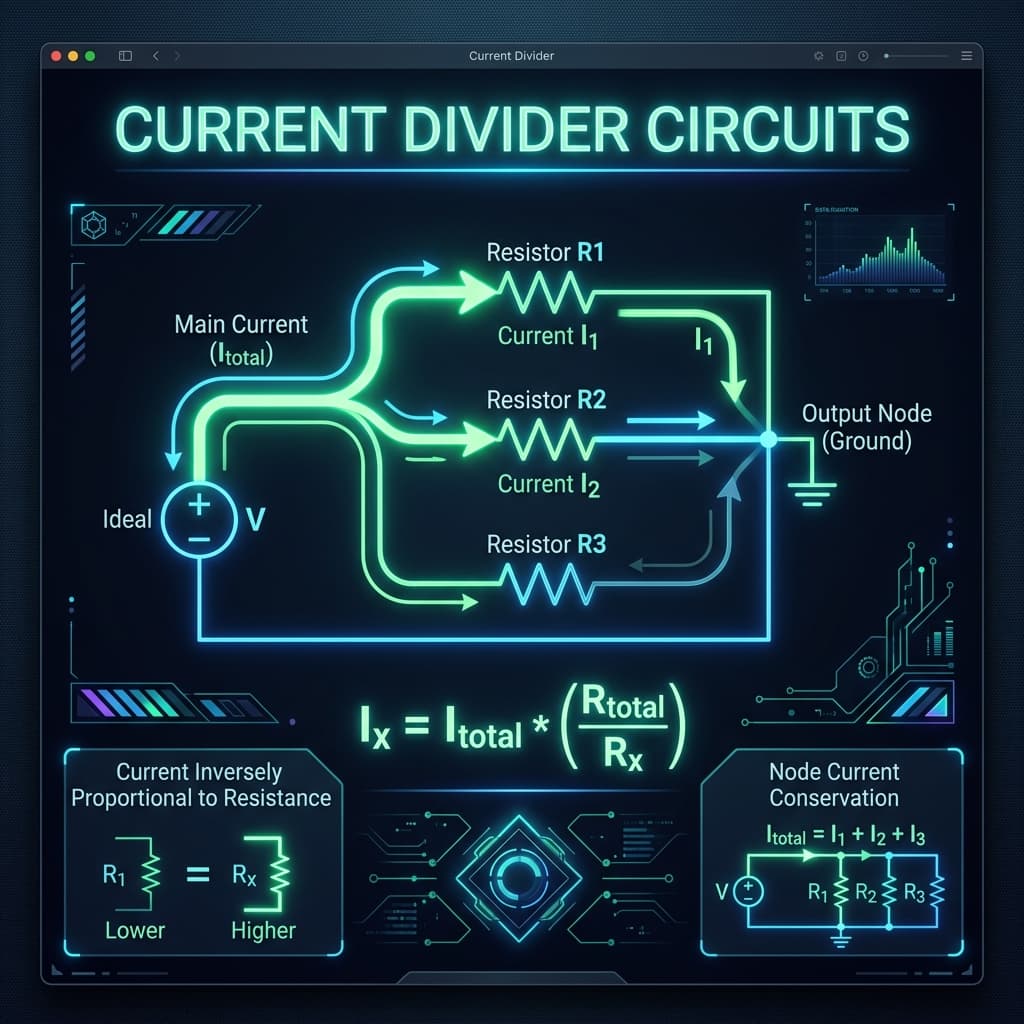
A current divider is a parallel resistor circuit where total current splits between branches. Each branch carries a portion of the total current determined by its resistance relative to the other branches. The concept is the complement of a voltage divider.
Current Divider Formula
For two resistors, the formula uses the opposite branch resistance:
Current through R1 (two-resistor case).
General formula using conductance.
Current Divider Schematic
In a current divider, parallel branches share the same voltage. Total current entering the node splits among the branches, with lower-resistance branches carrying more current.
How Current Divides in Parallel
Total current enters a node and splits among the parallel branches. Each branch has the same voltage (V = Itotal × Req). Current in each branch follows Ohm's Law: In = V/Rn. The sum of all branch currents equals the total current.
How to Use the Current Divider Calculator
- 1Choose a calculation mode.
- 2Enter total current or branch voltage.
- 3Enter at least two branch resistances.
- 4Add more branches if needed.
- 5Click Calculate.
- 6Review the branch current table with share percentages.
Example Calculations
Two resistors
Itotal = 3 A, R1 = 6 Ω, R2 = 3 Ω. I1 = 3 × 3/(6+3) = 1 A. I2 = 3 × 6/(6+3) = 2 A. The 3 Ω branch carries twice as much current.
Three branches
Itotal = 10 mA, R1 = 1 kΩ, R2 = 2 kΩ, R3 = 5 kΩ. Using the conductance formula, branch currents are approximately 6.45, 3.23, and 1.29 mA.
From voltage
V = 12 V, R1 = 100 Ω, R2 = 200 Ω. I1 = 12/100 = 0.12 A. I2 = 12/200 = 0.06 A. Itotal = 0.18 A.
Current Divider vs Voltage Divider
| Feature | Current Divider | Voltage Divider |
|---|---|---|
| Circuit type | Parallel branches | Series resistors |
| What divides | Current | Voltage |
| What stays the same | Voltage across branches | Current through resistors |
| Key formula idea | Lower R gets more I | Higher R gets more V |
Common Current Divider Mistakes
- • Using the voltage divider formula instead of the current divider formula.
- • Forgetting that lower resistance gets more current, not less.
- • Adding parallel resistors as if they were in series.
- • Assuming current splits equally when resistors are unequal.
- • Ignoring unit conversion between mA, A, and μA.
Where Current Dividers Are Used
Current dividers are used in parallel resistor circuits, current sharing, current measurement shunts, sensor and load circuits, electronics learning, physics homework, equivalent circuit simplification, and electrical engineering fundamentals.
Accuracy and Limitations
This calculator assumes ideal resistors. Real resistors have tolerance and temperature effects. Current sharing can change if resistance changes with heat. Power ratings must be checked in real circuits. This tool is for educational and basic circuit analysis.
Frequently Asked Questions
What does a current divider calculator do?›
It calculates how total current splits between parallel resistor branches, showing each branch’s current, share percentage, voltage, and power.
What is the current divider formula?›
For two resistors: I1 = Itotal × R2/(R1+R2). For multiple branches: In = Itotal × (1/Rn) / Σ(1/R).
How does current split in parallel resistors?›
Current splits inversely proportional to resistance. Lower resistance branches carry more current because they have higher conductance.
Which branch gets more current?›
The branch with the lowest resistance gets the most current, as it has the highest conductance.
Do parallel branches have the same voltage?›
Yes. All branches in a parallel circuit share the same voltage across their terminals.
Is current divider the same as voltage divider?›
No. Current dividers use parallel branches and divide current, while voltage dividers use series resistors and divide voltage.
Can current split equally?›
Yes, when all parallel branches have equal resistance. Each branch carries Itotal/N of the total current.
How do I calculate current through one resistor in parallel?›
Use In = V/Rn where V is the shared voltage, or In = Itotal × (1/Rn) / Σ(1/R).
Can I add more than two branches?›
Yes. The calculator supports dynamic branch inputs. Use the general formula for any number of parallel branches.
Why does lower resistance carry more current?›
Lower resistance means higher conductance (G = 1/R). Since all branches share the same voltage, more conductance allows more current: I = V × G.
How is the current divider used in shunt-based current measurement?›
A low-value shunt resistor is placed in parallel with a higher-value meter resistance. Most of the current flows through the shunt while a small, proportional fraction flows through the meter, enabling safe high-current measurement.
What happens when one parallel branch opens?›
The total current redistributes among the remaining branches. Each remaining branch carries more current. If the circuit source is constant-current, the voltage across the network increases.
Sources / References

Author & technical reviewer
Manish Kumar
PhysicsCalcs tools are reviewed with an educational focus: clear formulas, transparent assumptions, and practical context for students and science learners.
Learn more about Manish