
What Is a Series Parallel Resistor Calculator?
A series parallel resistor calculator finds the total equivalent resistance of networks that contain both series and parallel connections. Instead of solving the entire network at once, it breaks the circuit into smaller groups, simplifies each group, and then combines the group equivalents.
This is more advanced than a single series or parallel calculator because real circuits often mix both connection types. The tool helps students and electronics builders understand the step-by-step simplification process.
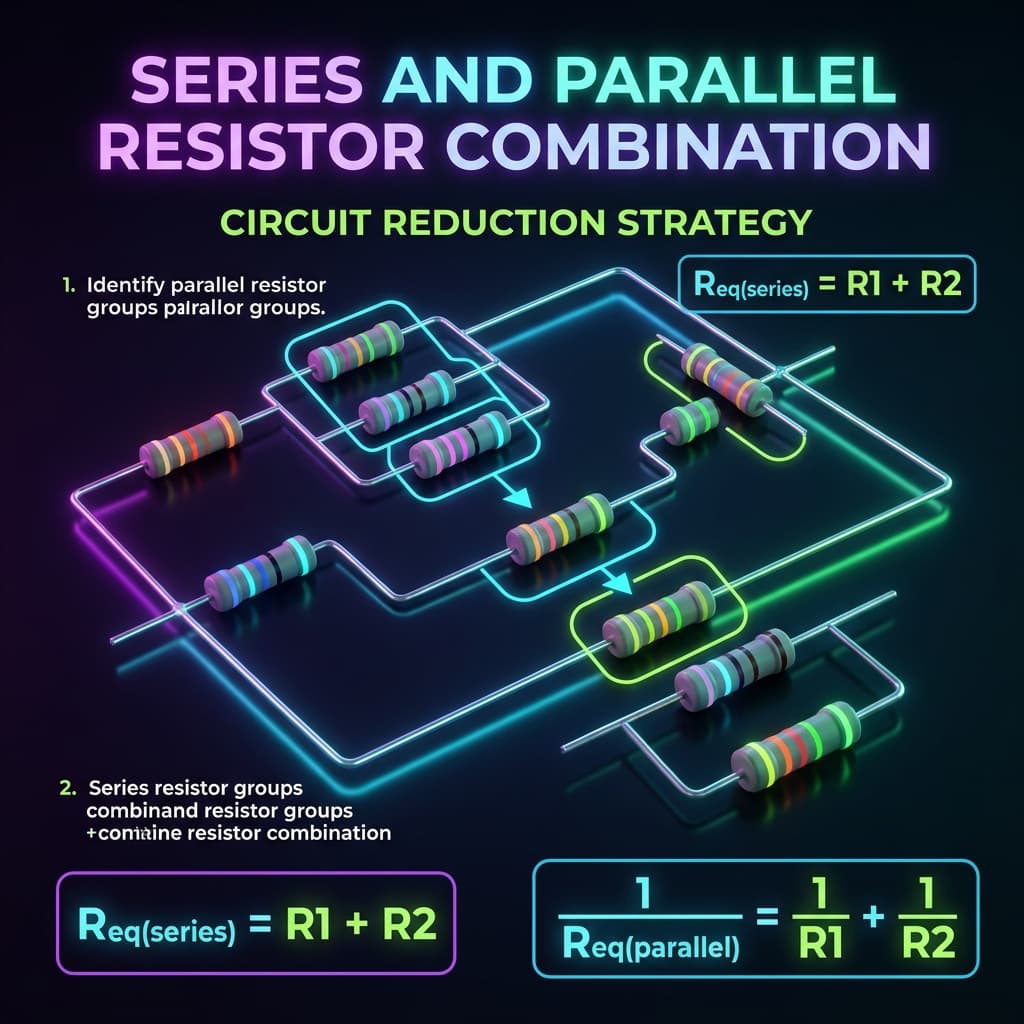
Series-Parallel Network Diagram
A series-parallel network is simplified group by group. This diagram shows two parallel groups connected in series, which is a common topology.
Series and Parallel Resistor Formulas
Series: resistances add directly.
Parallel: reciprocals add, then take the reciprocal.
For two parallel resistors the shortcut is R = (R1 × R2)/(R1 + R2).
How Mixed Resistor Networks Are Simplified
- 1Identify simple series groups (resistors that share the same single-path current).
- 2Identify simple parallel groups (resistors that share the same two nodes).
- 3Replace each group with its equivalent resistance.
- 4Repeat until one equivalent resistance remains.
Not all circuit topologies can be reduced this way. Bridge circuits and networks with multiple independent sources may require Kirchhoff's laws or simulation.
How to Use the Series Parallel Resistor Calculator
- 1Choose a network mode: Series of Parallel Groups, Parallel of Series Groups, or Custom.
- 2Add groups and enter resistor values with units.
- 3In Custom mode, set each group type and choose the outer connection.
- 4Optionally enter a supply voltage for current and power.
- 5Click Calculate to see group equivalents and the final result.
- 6Review the step-by-step breakdown and explanation.
Example Calculations
Series of parallel groups
Group A: 100 Ω || 200 Ω → RA = 66.67 Ω. Group B: 330 Ω + 470 Ω = 800 Ω (series). Total in series: Req = 66.67 + 800 = 866.67 Ω.
Parallel of series groups
Group A: 100 Ω + 200 Ω = 300 Ω. Group B: 330 Ω + 470 Ω = 800 Ω. Groups in parallel: 1/Req = 1/300 + 1/800 → Req ≈ 218.18 Ω.
With supply voltage
Req = 866.67 Ω, V = 12 V. I = V/R = 12/866.67 ≈ 0.0138 A = 13.8 mA.
Series vs Parallel Behavior
| Feature | Series | Parallel |
|---|---|---|
| Resistance | Adds directly | Reciprocals add |
| Current | Same through all | Splits between branches |
| Voltage | Divides across | Same across all |
| Adding more | Increases R | Decreases R |
| Common use | Voltage dividers | Current sharing |
Common Mistakes When Solving Mixed Circuits
- • Adding parallel resistors directly instead of using the reciprocal formula.
- • Forgetting to take the final reciprocal after summing 1/R values.
- • Treating all resistors as series when some share two common nodes.
- • Ignoring circuit grouping and trying to solve everything in one step.
- • Mixing units without converting to a common unit first.
- • Assuming every network can be simplified by grouping — bridge circuits require other methods.
Where Series-Parallel Resistor Calculations Are Used
Mixed resistor networks appear in physics homework, electronics circuits, equivalent circuit simplification, voltage dividers, current splitting, circuit troubleshooting, and introductory electrical engineering coursework.
Accuracy and Limitations
This calculator assumes ideal resistors. Real resistors have tolerance, temperature effects, and power limitations. The calculator supports common grouped networks, not arbitrary bridge networks or complex circuit topologies. Complex networks may require Kirchhoff's laws, nodal analysis, or circuit simulation. This tool is for educational and basic circuit calculations.
Frequently Asked Questions
What does a series parallel resistor calculator do?›
It calculates the total equivalent resistance of resistor networks that contain both series and parallel connections by simplifying each group step by step.
How do you solve series-parallel resistors?›
Identify simple series and parallel groups, calculate each group’s equivalent resistance, then combine the group equivalents according to their outer connection.
What is the formula for resistors in series?›
R_total = R1 + R2 + R3 + … Series resistances add directly.
What is the formula for resistors in parallel?›
1/R_total = 1/R1 + 1/R2 + 1/R3 + … For two resistors: R = (R1 × R2)/(R1 + R2).
Can every resistor network be simplified by grouping?›
No. Some networks like Wheatstone bridges or lattice circuits require Kirchhoff’s laws, nodal analysis, or circuit simulation to solve.
Why is parallel resistance lower than the smallest resistor?›
Each parallel branch adds conductance. More conductance means lower equivalent resistance.
Do series resistors have the same current?›
Yes. In a series path, the same current flows through each resistor because there is only one path.
Do parallel resistors have the same voltage?›
Yes. All parallel branches share the same voltage across their terminals.
Can I see voltage and current for each group?›
Yes. Enter a supply voltage and the calculator shows total current and power, plus per-group voltage drops (series outer) or branch currents (parallel outer).
What is the Custom Group Builder mode?›
Custom mode lets you set each group independently as series or parallel, then choose how groups connect (series or parallel outer). This handles any two-level grouped network.
Can I mix Ω, kΩ, and MΩ values?›
Yes. The calculator converts all values to ohms internally before calculating.
When should I use Kirchhoff’s laws instead?›
Use Kirchhoff’s laws when the circuit cannot be reduced using simple series-parallel grouping, such as bridge circuits, circuits with multiple sources, or complex mesh networks.
How do I identify series and parallel sections in a complex schematic?›
Start from the load and trace the current path. Components carrying the same current are in series. Components sharing the same two nodes (same voltage across them) are in parallel. Simplify innermost groups first and work outward.
What is a resistor ladder network?›
A ladder (R-2R) network is a repeating series-parallel pattern used in digital-to-analog converters (DACs). Each rung uses one R and one 2R resistor to split the signal by a factor of two, enabling binary-weighted voltage division.
Sources / References

Author & technical reviewer
Manish Kumar
PhysicsCalcs tools are reviewed with an educational focus: clear formulas, transparent assumptions, and practical context for students and science learners.
Learn more about Manish