
What Is an Electricity Calculator?
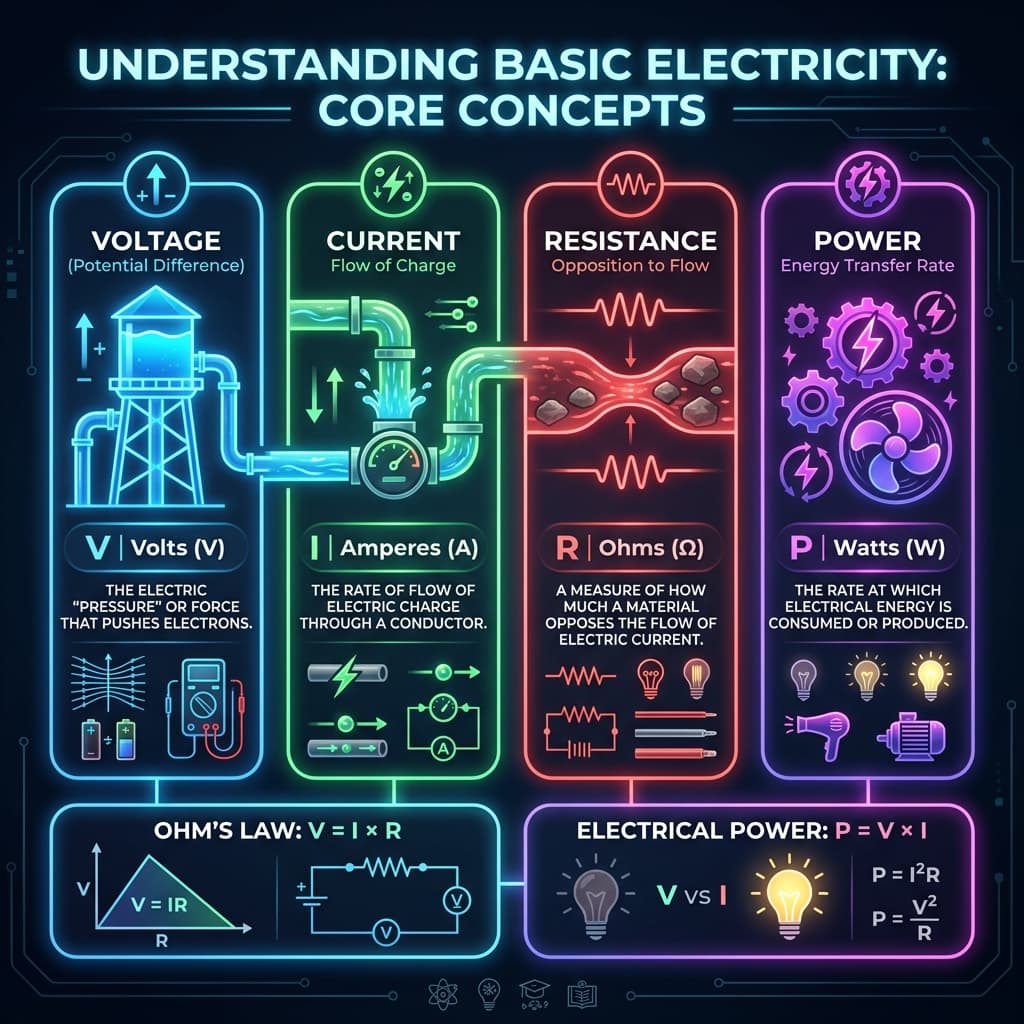
An electricity calculator helps solve common basic electricity relationships using standard formulas from circuits and introductory physics. It can calculate voltage, current, resistance, power, energy, charge, and time from various combinations of known values.
Ohm’s Law Wheel
The Ohm's Law Wheel (also called the Power Wheel) shows all 12 basic formulas relating voltage (V), current (I), resistance (R), and power (P). Each quadrant belongs to one quantity, and the three formulas in that quadrant are ways to calculate it from the other two known values.
Basic Electricity Formulas
The calculator supports Ohm's Law, power formulas, energy, and charge relationships.
Ohm's Law: voltage from current and resistance.
Power from voltage and current.
Energy from power and time.
Power from current and resistance.
Power from voltage and resistance.
Charge from current and time.
Where V = voltage, I = current, R = resistance, P = power, E = energy, Q = electric charge, and t = time.
How to Use the Electricity Calculator
- 1Select what you want to calculate.
- 2Enter the known values.
- 3Choose the correct units.
- 4Click Calculate.
- 5Review the result, formula, and explanation.
Example Calculations
Find current
V = 12 V, R = 6 Ω. I = V/R = 12/6 = 2 A.
Find power
V = 120 V, I = 2 A. P = V × I = 240 W.
Find energy
A 100 W device runs for 3 hours. E = P × t = 100 × 10800 = 1,080,000 J = 300 Wh = 0.3 kWh.
Find charge
I = 2 A for 10 s. Q = I × t = 2 × 10 = 20 C.
Voltage vs Current vs Resistance vs Power
| Quantity | Symbol | Unit | Meaning |
|---|---|---|---|
| Voltage | V | Volt | Electrical potential difference |
| Current | I | Ampere | Rate of charge flow |
| Resistance | R | Ohm | Opposition to current |
| Power | P | Watt | Rate of energy transfer |
| Energy | E | Joule / Wh | Total work or energy used |
| Charge | Q | Coulomb | Amount of electric charge |
Electrical Units Reference
A comprehensive table of SI units used in basic electricity and their relationships.
| Quantity | Symbol | SI Unit | Abbr. | Defined As |
|---|---|---|---|---|
| Voltage | V | Volt | V | 1 V = 1 W / 1 A = 1 J / 1 C |
| Current | I | Ampere | A | 1 A = 1 C / 1 s |
| Resistance | R | Ohm | Ω | 1 Ω = 1 V / 1 A |
| Conductance | G | Siemens | S | 1 S = 1 / 1 Ω |
| Power | P | Watt | W | 1 W = 1 J / 1 s = 1 V × 1 A |
| Energy | E | Joule | J | 1 J = 1 W × 1 s |
| Charge | Q | Coulomb | C | 1 C = 1 A × 1 s |
| Time | t | Second | s | SI base unit |
Where This Calculator Is Useful
This calculator helps with physics homework, basic circuit problems, electronics learning, resistor and power calculations, battery and device estimates, electrical energy understanding, and school and college science practice.
Accuracy and Limitations
This is an educational calculator for basic electricity relationships assuming ideal simple circuit conditions.
Real circuits can involve AC power factor, efficiency losses, temperature effects, non-ohmic loads, and safety constraints. For household wiring, high voltage, or professional electrical work, consult a qualified professional. Important results should be independently verified.
Frequently Asked Questions
What does an electricity calculator do?›
It helps you solve common basic electricity relationships. Enter two known values and the calculator uses the appropriate formula to find the unknown quantity.
What is the basic formula for electricity?›
The most fundamental is Ohm’s Law: V = I × R. Power, energy, and charge formulas build on this.
How do I calculate electrical power?›
Use P = V × I, P = I²R, or P = V²/R depending on the known values.
How do I calculate current?›
Use I = V/R from Ohm’s Law, or I = Q/t from charge and time.
What is the difference between watts and volts?›
Watts measure power (energy per second), volts measure electrical potential difference. They are related through current: P = V × I.
What is the difference between current and charge?›
Current is the rate of charge flow (amperes), while charge is the total amount of electricity moved (coulombs). Q = I × t.
Can this calculator calculate energy use?›
Yes. Use the E = P × t mode to find energy from power and time.
Can I use this calculator for AC circuits?›
This calculator uses DC-style formulas. For simple resistive AC loads, results give educational estimates. Full AC analysis requires power factor and RMS values.
Is this the same as an Ohm’s Law calculator?›
It includes Ohm’s Law modes but adds power, energy, charge, and time modes for broader electricity calculations.
Are the results exact?›
Results are mathematically exact given the inputs. Real circuits may differ due to temperature, tolerances, and non-ideal components.
Sources / References

Author & technical reviewer
Manish Kumar
PhysicsCalcs tools are reviewed with an educational focus: clear formulas, transparent assumptions, and practical context for students and science learners.
Learn more about Manish