
What Is Resistivity?
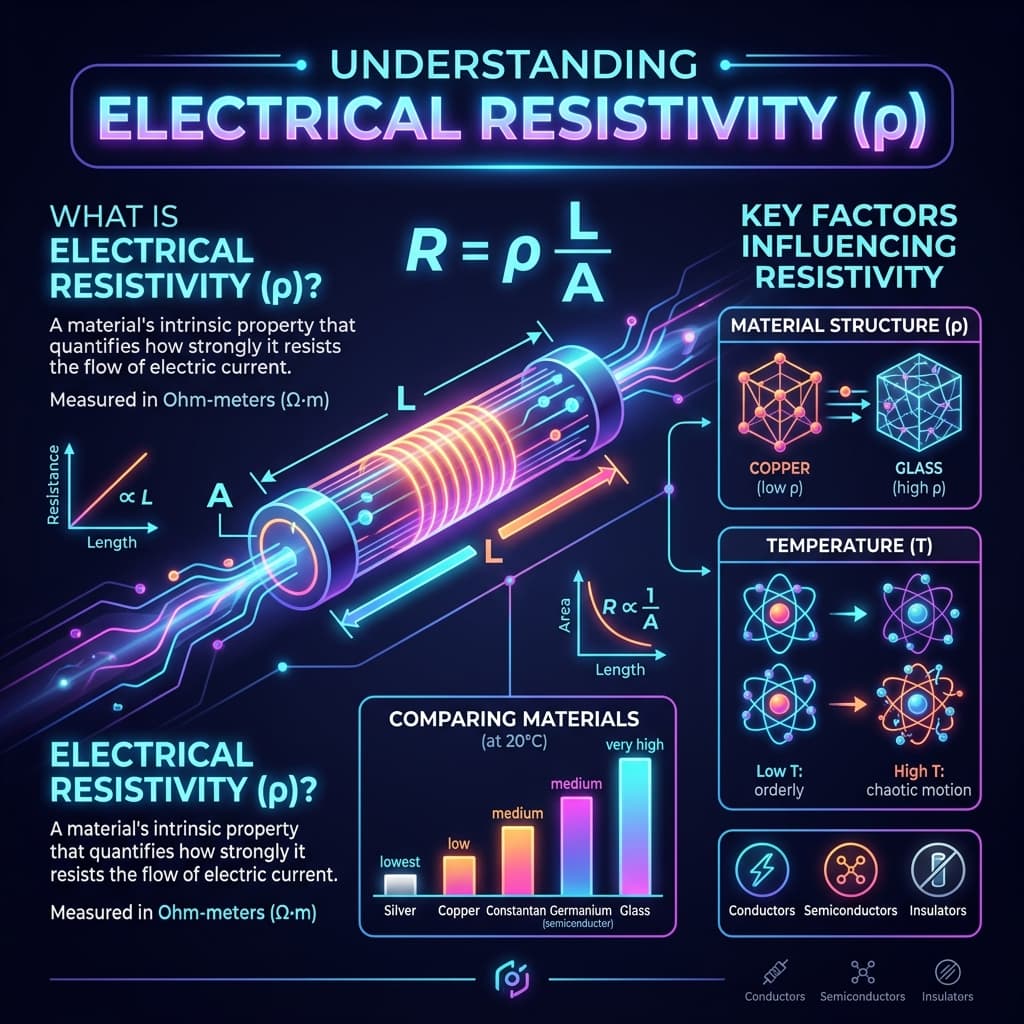
Resistivity is an intrinsic property of a material that describes how strongly it opposes the flow of electric current. Unlike resistance, which depends on the dimensions of a conductor, resistivity depends only on the material itself and temperature.
Materials with low resistivity (like copper) are good conductors. Materials with high resistivity (like rubber) are insulators.
Resistivity Formula
Resistivity from resistance, area, and length.
Resistance from resistivity, length, and area.
Conductivity as the reciprocal of resistivity.
Resistivity from conductivity.
Where ρ = resistivity (Ω·m), R = resistance (Ω), A = cross-sectional area (m²), L = length (m), and σ = conductivity (S/m).
How to Use the Resistivity Calculator
- 1Select what to calculate from the dropdown.
- 2Enter the known values.
- 3Choose units.
- 4Click Calculate.
- 5Review the result and steps.
Common Material Resistivities
Reference values at approximately 20 °C.
| Material | Resistivity | Unit |
|---|---|---|
| Silver | 1.59 × 10⁻⁸ | Ω·m |
| Copper | 1.68 × 10⁻⁸ | Ω·m |
| Gold | 2.44 × 10⁻⁸ | Ω·m |
| Aluminium | 2.65 × 10⁻⁸ | Ω·m |
| Tungsten | 5.60 × 10⁻⁸ | Ω·m |
| Iron | 9.70 × 10⁻⁸ | Ω·m |
| Nichrome | 1.10 × 10⁻⁶ | Ω·m |
| Graphite | 3–6 × 10⁻⁵ | Ω·m |
Example Calculations
Find wire resistance
Copper wire, L = 100 m, A = 1 mm². R = 1.68×10−&sup8; × 100 / 10−&sup6; = 1.68 Ω.
Find resistivity
R = 5 Ω, A = 2 mm², L = 50 m. ρ = 5 × 2×10−&sup6; / 50 = 2×10−&sup7; Ω·m.
Resistivity vs Resistance
Resistivity is a material property, independent of shape. Resistance is a property of a specific conductor and depends on its resistivity, length, and cross-sectional area (R = ρL/A). Two wires of the same material but different sizes have the same resistivity but different resistances.
Resistivity vs Conductivity
Conductivity (σ) is the inverse of resistivity: σ = 1/ρ. High conductivity means low resistivity and better current flow. Conductivity is measured in siemens per metre (S/m).
Where This Calculator Is Useful
Resistivity calculations help with wire sizing, material selection, physics problems, electronics design, power transmission analysis, and understanding conduction in different materials.
Accuracy and Limitations
This calculator uses the standard resistivity formula for uniform conductors at a constant temperature.
Limitations: resistivity changes with temperature, impurities and alloy composition affect values, skin effect at high frequencies, and real conductors may have non-uniform cross-sections.
Frequently Asked Questions
What is resistivity?›
Resistivity (ρ) is an intrinsic material property that quantifies how strongly a material opposes the flow of electric current. It does not depend on the shape or size of the sample.
What is the formula for resistivity?›
ρ = R × A / L, where R is resistance, A is cross-sectional area, and L is length.
What are the units of resistivity?›
Ohm-metres (Ω·m) in SI. Micro-ohm-centimetres (μΩ·cm) are also common for metals.
What is the difference between resistivity and resistance?›
Resistivity is a material property (independent of geometry). Resistance depends on resistivity, length, and area: R = ρL/A.
What is conductivity?›
Conductivity (σ) is the reciprocal of resistivity: σ = 1/ρ. High conductivity means the material conducts well.
Which material has the lowest resistivity?›
Among common materials, silver has the lowest resistivity at about 1.59 × 10⁻⁸ Ω·m at 20 °C.
Does resistivity change with temperature?›
Yes. For most metals, resistivity increases with temperature. Semiconductors show the opposite trend.
Can I calculate wire resistance with this?›
Yes. Use the R = ρL/A mode with the material’s resistivity, wire length, and cross-sectional area.
What is the resistivity of copper?›
Approximately 1.68 × 10⁻⁸ Ω·m at 20 °C.
Can I convert resistivity to conductivity?›
Yes. Use the σ = 1/ρ mode in the calculator.
Sources / References

Author & technical reviewer
Manish Kumar
PhysicsCalcs tools are reviewed with an educational focus: clear formulas, transparent assumptions, and practical context for students and science learners.
Learn more about Manish