
How Ohm’s Law Works
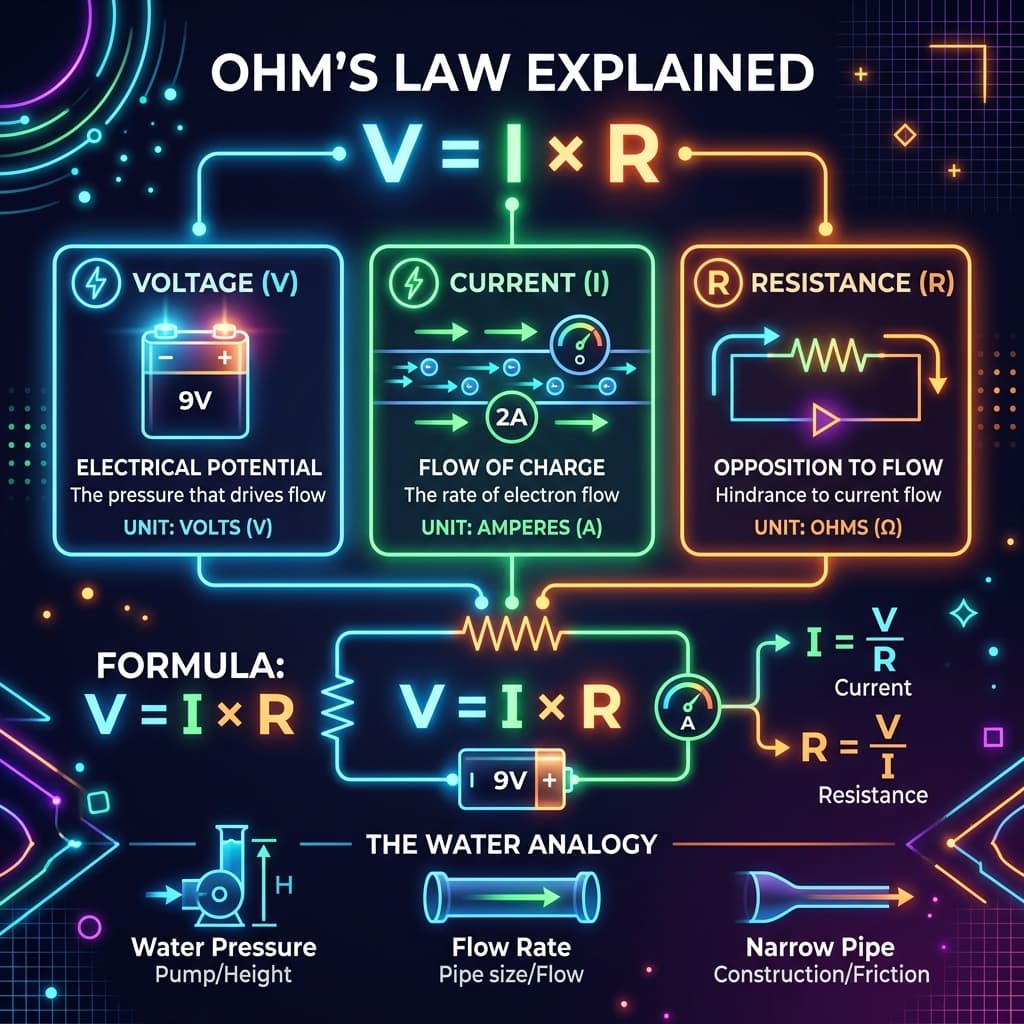
Ohm's Law is one of the most useful relationships in basic electricity. It says that, for many ohmic conductors and resistors, current increases when voltage increases and decreases when resistance increases.
The main formula is V = I × R. Voltage is measured in volts, current in amperes, and resistance in ohms. If you know any two of these values, you can calculate the third.
This matters because simple circuits are built from the balance between electrical push, charge flow, and opposition to that flow. Ohm's Law gives students and technicians a quick way to reason about that balance before moving into more detailed circuit models.
Enter Any Two Values
A voltage current resistance calculator is most useful when it matches the way physics problems are written. Most Ohm's Law questions give you two known quantities and ask for the missing relationship.
Enter any two values among voltage, current, resistance, and power. The calculator converts your units to SI units first, uses the matching Ohm's Law formula, and then shows all four related values so you can check the whole circuit.
Basic Circuit Diagram
A simple DC circuit consists of a voltage source (battery) pushing current through a resistor. The current flowing through the resistance creates a voltage drop equal to I × R.
Ohm’s Law Formula
Find voltage from current and resistance.
Find current from voltage and resistance.
Find resistance from voltage and current.
Find electric power from voltage and current.
Find resistive power from current and resistance.
Find resistive power from voltage and resistance.
How to Use the Ohm’s Law Calculator
- 1Enter exactly two known values among voltage, current, resistance, and power.
- 2Select the units that match your measurements.
- 3Click Calculate to see the derived values, formulas, substitution, and SI values.
- 4Open Show steps if you want a short formula breakdown.
- 5Use Reset to clear the fields or Copy to reuse the result with the page URL.
Example Calculations
Find voltage
If current is 2 A and resistance is 6 Ω, then V = 2 × 6 = 12 V.
Find current
If voltage is 12 V and resistance is 4 Ω, then I = 12 / 4 = 3 A.
Find resistance
If voltage is 24 V and current is 3 A, then R = 24 / 3 = 8 Ω.
Find power
If voltage is 12 V and current is 2 A, then P = 12 × 2 = 24 W.
Where Ohm’s Law Is Used
Ohm's Law appears in school physics problems, introductory electronics, resistor selection, battery-powered projects, wiring checks, and basic troubleshooting. It is especially helpful when a circuit can be simplified to a voltage source and a resistance.
Engineers and technicians also use the same relationships as a first estimate before moving into more detailed models that include temperature, tolerances, AC impedance, and component behavior.
Accuracy and Limitations
This calculator assumes standard Ohm's Law relationships and simple linear resistance in DC-style resistor problems.
Real systems may include temperature effects, non-ohmic materials, AC impedance and phase, contact resistance, component tolerances, or safety limits. Verify important engineering and household electrical calculations independently.
Frequently Asked Questions
What is Ohm’s Law?›
Ohm’s Law describes the relationship between voltage, current, and resistance in many simple electrical circuits. In its common form, voltage equals current multiplied by resistance.
What does V mean in Ohm’s Law?›
V stands for voltage, or electric potential difference. It tells you how much electrical energy is available per unit charge between two points.
What is the unit of resistance?›
Resistance is measured in ohms, written with the symbol Ω. One ohm is equal to one volt per ampere.
Can this calculator find power too?›
Yes. It can calculate electric power from voltage and current, current and resistance, or voltage and resistance using P = VI, P = I²R, and P = V²/R.
How many values do I need for Ohm’s Law?›
For this calculator, enter exactly two known values. Any two compatible values among voltage, current, resistance, and power are enough to solve the remaining quantities for a simple ohmic circuit.
Why do different power formulas give the same answer?›
The power formulas are connected by Ohm’s Law. For an ohmic resistor, P = VI, P = I²R, and P = V²/R are equivalent ways to describe the same electrical power when the inputs describe the same circuit.
Is Ohm’s Law valid for all materials?›
No. Ohm’s Law works well for ohmic materials where resistance stays approximately constant. Devices such as diodes, filament lamps, and some semiconductors may be non-ohmic.
What is the difference between voltage and current?›
Voltage is the electrical push or potential difference between two points. Current is the flow rate of electric charge through a circuit.
Can I use this for household circuits?›
You can use it for educational estimates and simple checks, but household wiring can involve AC behavior, safety codes, heat limits, breakers, and component ratings. Verify safety-critical work with a qualified professional.
What is a non-ohmic device?›
A non-ohmic device does not keep a constant resistance as voltage or current changes. Its current-voltage graph is not a straight line.
Sources / References

Author & technical reviewer
Manish Kumar
PhysicsCalcs tools are reviewed with an educational focus: clear formulas, transparent assumptions, and practical context for students and science learners.
Learn more about Manish