
What Is a Voltage Drop Calculator?
This calculator determines how much voltage is lost across resistance in a conductor or circuit path, estimating the voltage available at the load. It is useful for physics homework, electronics circuits, DC wiring examples, and electrical learning.
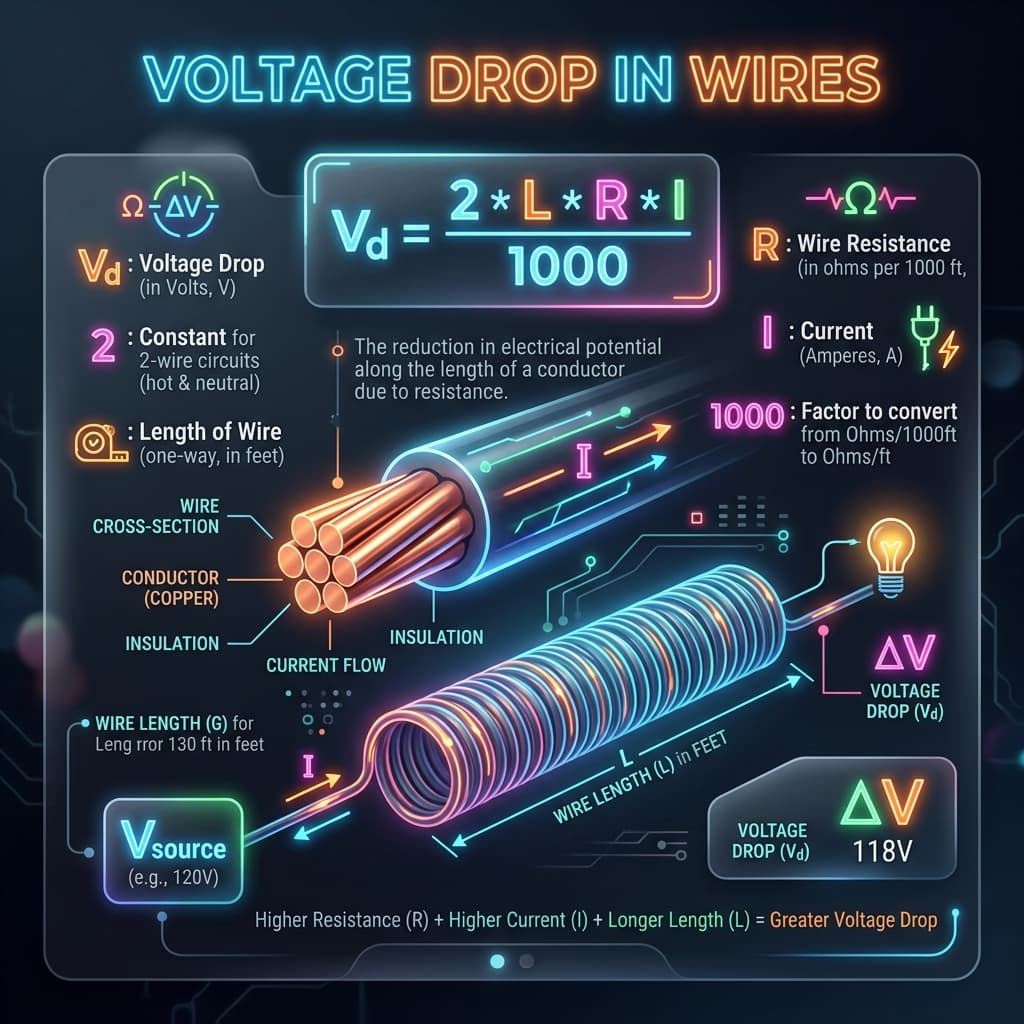
Voltage Drop Formulas
Basic voltage drop from current and resistance.
Conductor resistance from material properties.
DC round-trip wire voltage drop.
Load Voltage and Voltage Drop Percentage
Voltage remaining at the load.
Percentage of supply lost in the conductor.
Power Loss from Voltage Drop
Power lost as heat in the conductor. Higher current creates much larger losses because current is squared.
How to Use the Voltage Drop Calculator
- 1Choose calculation mode.
- 2Enter current and resistance, or wire length, area, and material.
- 3Choose one-way or round-trip path.
- 4Enter supply voltage for load voltage and drop %.
- 5Click Calculate.
- 6Review voltage drop, load voltage, power loss, and explanation.
Example Calculations
Basic V = IR
I = 5 A, R = 0.4 Ω. V_drop = 2 V. If supply is 12 V: V_load = 10 V, drop = 16.7%.
Copper wire
10 m copper wire, 2.5 mm², 10 A, round-trip. V_drop = 2 × 10 × 1.68×10−8 × 10 / 2.5×10⁻⁶ ≈ 1.34 V.
Power loss
I = 10 A, R = 0.2 Ω. P_loss = 100 × 0.2 = 20 W.
AWG Wire Gauge Reference
American Wire Gauge (AWG) sizes for solid copper conductors at 20 °C. Use this table to look up cross-sectional area when calculating voltage drop for common wire sizes.
| AWG | Diameter (mm) | Area (mm²) | Resistance (Ω/km) |
|---|---|---|---|
| 10 | 2.588 | 5.261 | 3.277 |
| 12 | 2.053 | 3.309 | 5.211 |
| 14 | 1.628 | 2.081 | 8.286 |
| 16 | 1.291 | 1.309 | 13.17 |
| 18 | 1.024 | 0.8231 | 20.95 |
| 20 | 0.8118 | 0.5176 | 33.31 |
| 22 | 0.6438 | 0.3255 | 52.96 |
| 24 | 0.5106 | 0.2047 | 84.22 |
| 26 | 0.4049 | 0.1288 | 133.9 |
| 28 | 0.3211 | 0.08098 | 212.9 |
| 30 | 0.2546 | 0.05093 | 338.6 |
AWG diameter follows the formula d = 0.127 × 92(36−AWG)/39 mm. Each 6-gauge increase roughly doubles the resistance and halves the cross-sectional area. Resistance values are for solid copper at 20 °C.
Why Voltage Drop Happens
Every conductor has resistance. Current through resistance causes voltage loss. Longer conductors, thinner wires, and higher current all increase voltage drop.
Common Voltage Drop Mistakes
- Forgetting round-trip length in DC circuits.
- Mixing mm² and m².
- Ignoring material resistivity and temperature effects.
- Assuming wire has zero resistance.
- Treating educational estimates as code-compliant wire sizing.
Where Voltage Drop Calculations Are Used
Physics homework, electronics circuits, DC power circuits, battery-powered systems, LED strips, solar/DC cable learning, low-voltage systems, and conductor resistance problems.
Accuracy and Limitations
This calculator uses idealized resistance formulas. Resistivity varies with temperature and material composition. Real installations may require electrical codes, derating, insulation ratings, and safety rules. AC circuits may require power factor and reactance corrections. This tool is educational and should not replace licensed electrical design.
Frequently Asked Questions
What does a voltage drop calculator do?›
It calculates how much voltage is lost across resistance in a conductor or circuit, helping estimate the voltage available at the load.
What is the formula for voltage drop?›
V_drop = I × R for basic circuits, or V_drop = IρL/A using wire resistivity, length, and area.
How do I calculate voltage drop in a wire?›
Use V_drop = 2IρL/A for a DC round-trip path, where L is one-way length, A is cross-sectional area, and ρ is material resistivity.
Why do long wires have more voltage drop?›
Longer conductors have more total resistance, which causes a larger voltage drop for the same current.
How does wire size affect voltage drop?›
Larger cross-sectional area means lower resistance per unit length, reducing voltage drop.
What is voltage drop percentage?›
It is (V_drop / V_supply) × 100%. It shows how much of the supply voltage is lost in the conductor.
What is load voltage?›
V_load = V_supply − V_drop. It is the voltage actually available at the load after accounting for conductor losses.
Why do I need round-trip length for DC circuits?›
In a DC circuit, current flows through both the outgoing and return conductors, so both contribute to voltage drop.
Does voltage drop waste power?›
Yes. Voltage drop across conductor resistance creates power loss as heat: P_loss = I²R.
Can this calculator be used for house wiring?›
It provides educational estimates only. Professional wiring requires code compliance, derating, and licensed design.
Does AC voltage drop need different formulas?›
AC circuits may require power factor and reactance corrections. This calculator focuses on DC/resistive voltage drop.
What is the acceptable voltage drop percentage for most installations?›
For educational reference, a common guideline is 3% for branch circuits and 5% total (feeder plus branch). For 12 V DC systems like automotive or solar, even 3% (0.36 V) can matter. Always verify against the applicable electrical code for your jurisdiction.
How does temperature affect wire voltage drop?›
Copper resistivity increases about 0.4% per °C above 20 °C. At 75 °C (a common conductor operating temperature), resistance is roughly 22% higher than at 20 °C. For long runs in hot environments, this can significantly increase the calculated voltage drop.
Sources / References

Author & technical reviewer
Manish Kumar
PhysicsCalcs tools are reviewed with an educational focus: clear formulas, transparent assumptions, and practical context for students and science learners.
Learn more about Manish