
What Is Conductance?
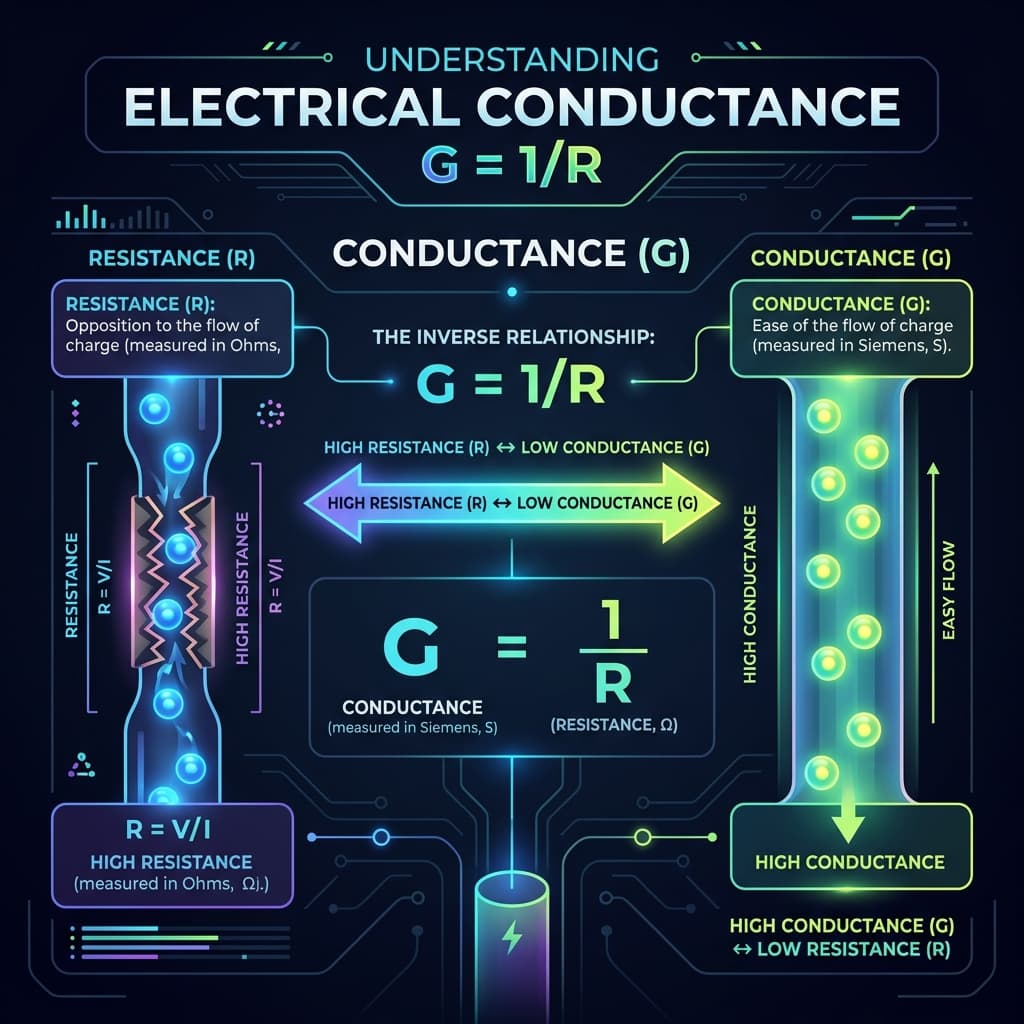
Conductance is a measure of how easily electric current flows through a component or material. It is the reciprocal of resistance: a component with high conductance allows current to pass easily, while low conductance means high resistance.
Conductance is measured in siemens (S). One siemens equals one ampere per volt, or equivalently, one reciprocal ohm.
Conductance Formulas
Conductance from resistance.
Conductance from current and voltage.
Current from conductance and voltage.
Conductance from material conductivity, area, and length.
Also: σ = 1 / ρ converts between conductivity and resistivity.
How to Use the Conductance Calculator
- 1Select what to calculate.
- 2Enter the known values.
- 3Choose units.
- 4Click Calculate.
- 5Review the result.
Example Calculations
Conductance from resistance
R = 100 Ω. G = 1/100 = 0.01 S = 10 mS.
Current from conductance
G = 5 mS, V = 12 V. I = 0.005 × 12 = 0.06 A = 60 mA.
Conductance from material
Copper wire, σ = 5.96×10&sup7; S/m, A = 1 mm², L = 10 m. G = 5.96×10&sup7; × 10−&sup6; / 10 = 5.96 S.
Conductance vs Resistance
Conductance and resistance are reciprocals. Doubling the resistance halves the conductance. Conductance is especially convenient for parallel circuits, where total conductance is simply the sum of individual conductances.
Conductance vs Conductivity
Conductivity (σ) is a material property measured in S/m. Conductance (G) is a component property that depends on conductivity, cross-sectional area, and length: G = σA/L. Two wires of the same material but different dimensions have the same conductivity but different conductances.
The Siemens Unit
The siemens (S) is the SI unit of electrical conductance, named after Ernst Werner von Siemens. One siemens equals one ampere per volt, or one reciprocal ohm. The older name "mho" (ohm spelled backwards) is equivalent.
Ohm’s Law in Conductance Form
The standard Ohm's Law V = IR can be rewritten as I = GV, where G = 1/R. This form is natural when working with conductances, especially in parallel circuit analysis and some physics contexts.
Where This Calculator Is Useful
Conductance calculations help with parallel circuit analysis, material characterization, physics and electrical engineering courses, biosensor and electrolyte studies, and converting between resistance and conductance descriptions.
Accuracy and Limitations
This calculator uses standard conductance relationships for linear ohmic components.
Limitations: non-ohmic devices, frequency-dependent impedance, temperature effects on conductivity, and real-world measurement uncertainties.
Frequently Asked Questions
What is conductance?›
Conductance (G) is a measure of how easily electric current flows through a component. It is the reciprocal of resistance: G = 1/R.
What is the unit of conductance?›
The SI unit is the siemens (S), named after Werner von Siemens. 1 S = 1/Ω.
What is the formula for conductance?›
G = 1/R, or equivalently G = I/V. From material properties: G = σA/L.
What is the difference between conductance and conductivity?›
Conductance (G) depends on a component’s geometry and material. Conductivity (σ) is a material property. G = σA/L.
What is the difference between conductance and resistance?›
They are reciprocals. High conductance means low resistance and vice versa. G = 1/R.
Why use conductance instead of resistance?›
Conductance simplifies calculations for parallel circuits (total G = G₁ + G₂ + ...) and is natural in some physics and biology contexts.
Can I convert conductance to resistance?›
Yes. R = 1/G. The calculator includes this mode.
What is the conductance form of Ohm’s Law?›
I = GV, where G is conductance and V is voltage.
What are common conductance values?›
A 1 Ω resistor has G = 1 S. A 1 kΩ resistor has G = 1 mS.
Can I use this for parallel resistor calculations?›
Yes. For parallel resistors, total conductance is the sum: Gₜₒₜₐₗ = G₁ + G₂. Convert the result back to resistance if needed.
Does conductivity change with temperature?›
Yes. For metals, conductivity decreases as temperature increases. For semiconductors, conductivity increases.
Is siemens the same as mho?›
Yes. The mho (ohm spelled backwards) is an older name for the siemens. Both mean 1/Ω.
Sources / References

Author & technical reviewer
Manish Kumar
PhysicsCalcs tools are reviewed with an educational focus: clear formulas, transparent assumptions, and practical context for students and science learners.
Learn more about Manish