
What Is Electrical Power?
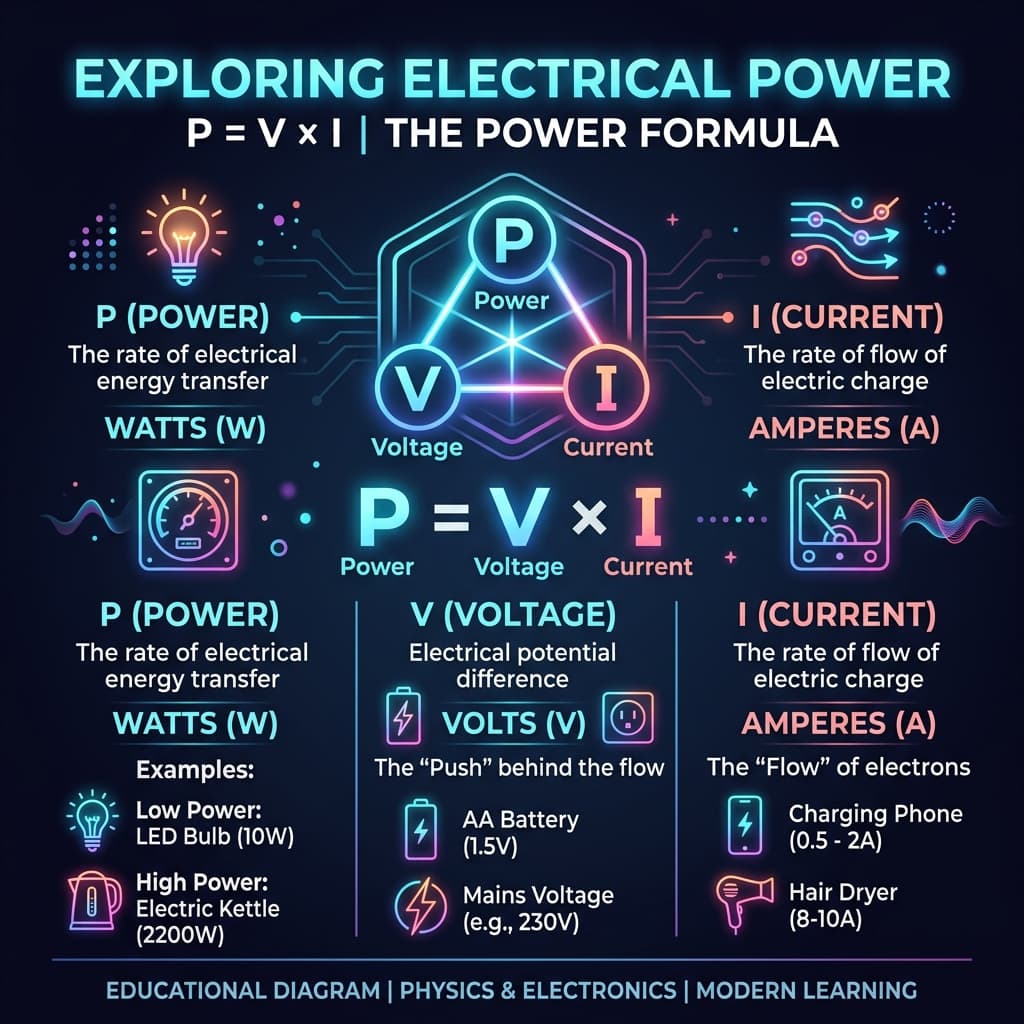
Electrical power is the rate at which electrical energy is transferred, used, or converted in a circuit. It is measured in watts. A higher wattage means energy is being transferred faster.
In circuits, power depends on voltage, current, and resistance. A 100 W bulb converts 100 joules of electrical energy into light and heat every second.
One watt equals one joule per second.
Power Triangle
The power triangle is a visual aid for remembering the relationship between power (P), voltage (V), and current (I). Cover the quantity you need to find: P on top means multiply V × I; V or I on the bottom means divide P by the other.
Electrical Power Formula
Three equivalent formulas let you calculate power from different pairs of known values.
Use when voltage and current are known.
Use when current and resistance are known.
Use when voltage and resistance are known.
Rearranged forms for voltage, current, and resistance:
Find voltage from power and current.
Find current from power and voltage.
Find resistance from voltage and power.
Find resistance from power and current.
How to Use the Electrical Power Calculator
- 1Select what you want to calculate from the dropdown.
- 2Enter the known values in the input fields.
- 3Choose the correct unit for each value.
- 4Click Calculate to see the result.
- 5Review the formula, substitution, and explanation.
Example Calculations
Power from voltage and current
V = 12 V, I = 2 A. P = V × I = 12 × 2 = 24 W.
Power from current and resistance
I = 3 A, R = 4 Ω. P = I²R = 9 × 4 = 36 W.
Power from voltage and resistance
V = 120 V, R = 60 Ω. P = V²/R = 14400/60 = 240 W.
Current from power and voltage
P = 60 W, V = 12 V. I = P/V = 60/12 = 5 A.
Electrical Power vs Voltage vs Current vs Resistance
| Quantity | Symbol | Unit | Meaning |
|---|---|---|---|
| Power | P | W | Rate of energy transfer |
| Voltage | V | V | Electrical potential difference |
| Current | I | A | Rate of charge flow |
| Resistance | R | Ω | Opposition to current |
Household Breaker Ratings
Common residential circuit breaker sizes and their maximum power at typical voltages.
| Breaker | Voltage | Max Power (P = V×I) | Typical Use |
|---|---|---|---|
| 15 A | 120 V | 1,800 W | General lighting, outlets |
| 20 A | 120 V | 2,400 W | Kitchen, bathroom outlets |
| 30 A | 240 V | 7,200 W | Dryer, large appliance |
| 40 A | 240 V | 9,600 W | Range, cooktop |
| 50 A | 240 V | 12,000 W | EV charger, large range |
NEC recommends loading circuits to no more than 80% of the breaker rating for continuous loads.
Where Electrical Power Calculations Are Useful
Electrical power calculations help with physics homework, electronics learning, simple DC circuits, resistor power-rating checks, battery-powered device estimates, power supply sizing, appliance power understanding, and basic electrical troubleshooting.
Accuracy and Limitations
This calculator assumes standard DC power relationships for ideal ohmic circuits.
Real systems may involve AC power factor, RMS values, efficiency losses, heating, non-ohmic loads, and safety regulations. For household wiring, high voltage, or professional electrical work, consult a qualified professional. Important calculations should be independently verified.
Frequently Asked Questions
What is electrical power?›
Electrical power is the rate at which electrical energy is transferred, used, or converted. It is measured in watts (W). One watt equals one joule per second.
What is the formula for electrical power?›
The three main formulas are P = V × I, P = I²R, and P = V²/R.
How do you calculate watts from volts and amps?›
Multiply voltage by current: P = V × I. For example, 12 V × 2 A = 24 W.
How do you calculate watts using resistance?›
Use P = I²R if current and resistance are known, or P = V²/R if voltage and resistance are known.
Are watts and volts the same?›
No. Watts measure power, while volts measure electrical potential difference. They are related through P = V × I.
What is the difference between watts and amps?›
Watts measure energy transfer rate, amps measure charge flow rate. The relationship is P = V × I.
Can this calculator find voltage or current too?›
Yes. You can calculate voltage from power and current (V = P/I) or current from power and voltage (I = P/V), along with resistance.
Can I use this calculator for AC circuits?›
This calculator uses DC-style formulas. AC circuits involve power factor and RMS values. For simple resistive AC loads, results give educational estimates.
Why does power increase when current increases?›
In a resistive circuit, P = I²R. Doubling the current quadruples the power.
Is this the same as a Watts Calculator?›
They are very similar. The Electrical Power Calculator also includes an energy mode (E = P × t) and focuses on power as the central concept.
Sources / References

Author & technical reviewer
Manish Kumar
PhysicsCalcs tools are reviewed with an educational focus: clear formulas, transparent assumptions, and practical context for students and science learners.
Learn more about Manish