
What Is Electric Potential?
Electric potential at a point is the amount of electric potential energy that a unit positive charge would have at that location. It is a scalar quantity measured in volts (V). One volt equals one joule per coulomb.
Unlike the electric field (which is a vector), electric potential has no direction — only a magnitude and sign. Positive charges create positive potentials; negative charges create negative potentials.
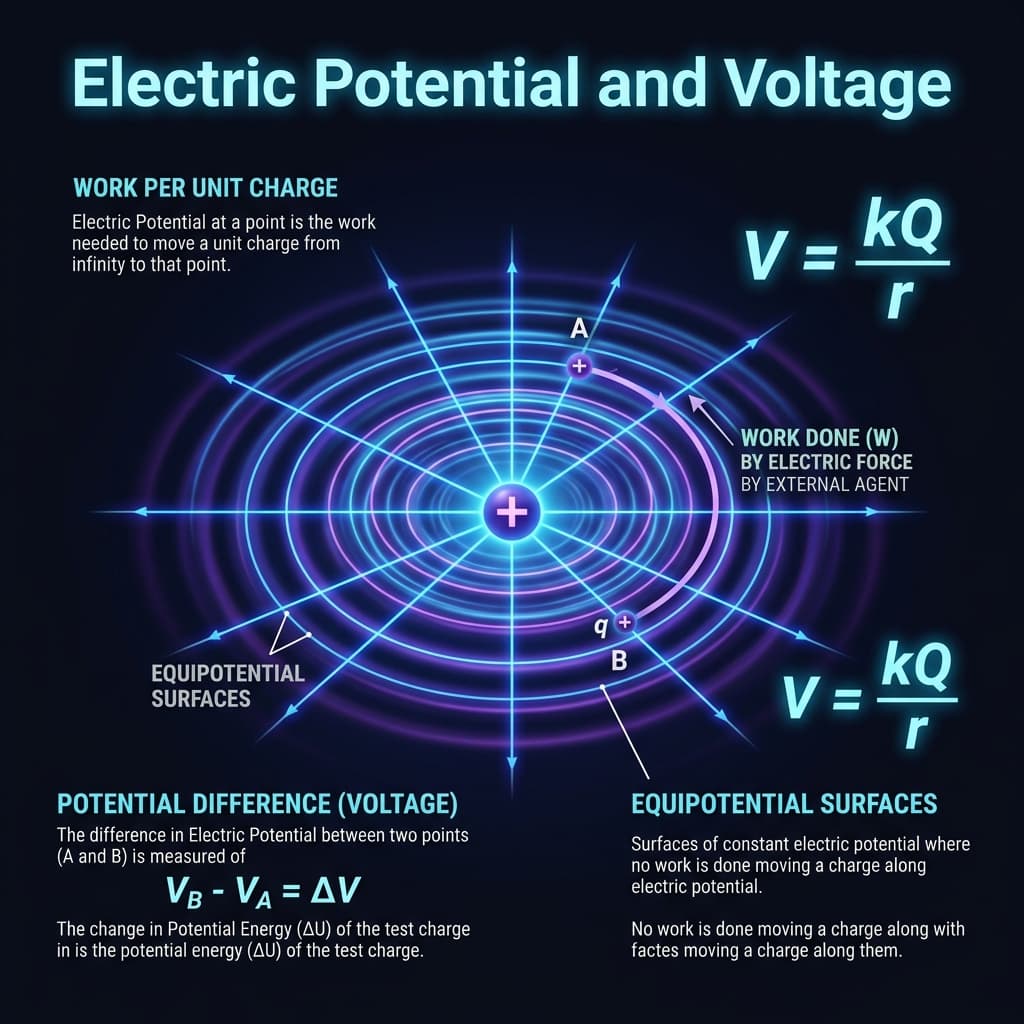
Equipotential Lines Diagram
Equipotential lines connect points of equal electric potential around a charge. They are always perpendicular to electric field lines. For a positive point charge, potential decreases with distance.
Electric Potential Formulas
Potential from a point charge at distance r.
Potential from potential energy and charge.
Potential energy of charge q at potential V.
Potential difference from work and charge.
How to Use the Electric Potential Calculator
- 1Select what to calculate.
- 2Enter the known values (charges and potentials can be negative).
- 3Choose units.
- 4Click Calculate.
- 5Review the result and sign interpretation.
Example Calculations
Potential from point charge
Q = +2 μC at r = 0.5 m. V = 8.99×10&sup9; × 2×10−&sup6; / 0.5 = 35,960 V (positive).
Potential energy
q = 3 μC at V = 1000 V. U = 3×10−&sup6; × 1000 = 0.003 J = 3 mJ.
Work done
ΔV = 12 V, q = 0.5 C. W = 0.5 × 12 = 6 J.
Potential vs Electric Field
Electric potential is a scalar; electric field is a vector. The field is related to the rate of change of potential: E = −dV/dx (in one dimension). The field points from regions of higher potential to lower potential.
Potential vs Potential Energy
Potential (V) is energy per unit charge and exists at every point regardless of what charges are nearby. Potential energy (U = qV) depends on the specific charge placed at that point.
Sign Interpretation
A positive potential means a positive test charge would have positive potential energy there. A negative potential means the test charge would have negative potential energy. Work is positive when the field moves a charge in the direction that lowers its potential energy.
Where This Calculator Is Useful
Electric potential calculations are used in physics education, circuit analysis, capacitor problems, energy calculations, potential mapping, and understanding voltage in electronics.
Common Voltage References
| Source | Typical Voltage |
|---|---|
| AA battery | 1.5 V |
| USB port | 5 V |
| Car battery | 12 V |
| Household mains (US) | 120 V AC |
| Household mains (EU/Asia) | 230 V AC |
| Transmission line | 110–765 kV |
| Lightning | ∼100–300 MV |
Common Mistakes
- • Confusing potential (scalar, in volts) with electric field (vector, in V/m). They are related but distinct.
- • Ignoring the sign of the source charge — negative charges produce negative potentials.
- • Using vector addition for potentials — electric potential is a scalar and adds algebraically.
- • Confusing potential (V) with potential energy (U = qV). Potential exists at a point regardless of whether a charge is there.
- • Forgetting that potential difference (ΔV) is what drives current, not absolute potential.
- • Applying V = kQ/r for non-point charge distributions without integrating.
Accuracy and Limitations
This calculator uses classical electrostatic potential formulas.
Limitations: applies to point charges, scalar superposition for multiple charges, no dynamic or relativistic effects, and infinite reference at r → ∞.
Frequently Asked Questions
What is electric potential?›
Electric potential at a point is the electric potential energy per unit positive charge placed there. It is measured in volts (V).
Is electric potential the same as voltage?›
Voltage usually refers to the potential difference (ΔV) between two points. Electric potential is the value at a single point, measured relative to a reference (often infinity or ground).
What is the formula for electric potential?›
For a point charge: V = kQ/r. From energy: V = U/q. Potential difference: ΔV = W/q.
Can electric potential be negative?›
Yes. A negative charge creates a negative potential. The sign carries physical meaning about the direction of energy change.
What is the difference between potential and potential energy?›
Potential (V) is energy per unit charge at a point. Potential energy (U) is the actual energy a specific charge q has at that point: U = qV.
What is the relationship between potential and electric field?›
The electric field is related to the spatial rate of change of potential. In one dimension, E = −dV/dx. The field points from high to low potential.
What is a potential difference?›
The difference in electric potential between two points: ΔV = V₂ − V₁. It determines the work done moving a charge between those points.
Can I use this for multiple charges?›
For multiple point charges, calculate V from each charge separately and add them (scalars add directly, no vector addition needed).
What is work done by an electric field?›
W = qΔV. Positive work means the field does work on the charge; negative work means external work is needed.
Is potential the same as electric field?›
No. Potential is a scalar measured in volts. Electric field is a vector measured in V/m or N/C. They are related but distinct quantities.
How do I find the potential energy of two charges?›
Use U = kQ₁Q₂/r. A positive U means repulsion (like charges); negative U means attraction (unlike charges). This mode is included in the calculator.
What is the potential difference between two points near a charge?›
ΔV = kQ(1/r₁ − 1/r₂). The calculator includes this mode for finding voltage differences at two radial distances.
Is electric potential always measured relative to infinity?›
For point charges, the convention sets V = 0 at infinity. In circuits, ground is the reference. The choice of reference does not affect potential differences.
What voltage levels are dangerous to humans?›
Voltages above roughly 50 V DC or 30 V AC (RMS) can drive lethal currents through the human body under unfavorable conditions. The actual hazard depends on current path, skin resistance (dry: ~100 kΩ, wet: ~1 kΩ), and contact duration.
How do voltmeters measure potential difference?›
A voltmeter is connected in parallel across two points and draws negligible current due to its very high internal resistance (typically ≥10 MΩ). It measures the voltage difference ΔV between those points without significantly disturbing the circuit.
Sources / References

Author & technical reviewer
Manish Kumar
PhysicsCalcs tools are reviewed with an educational focus: clear formulas, transparent assumptions, and practical context for students and science learners.
Learn more about Manish