
What Is a Wheatstone Bridge?
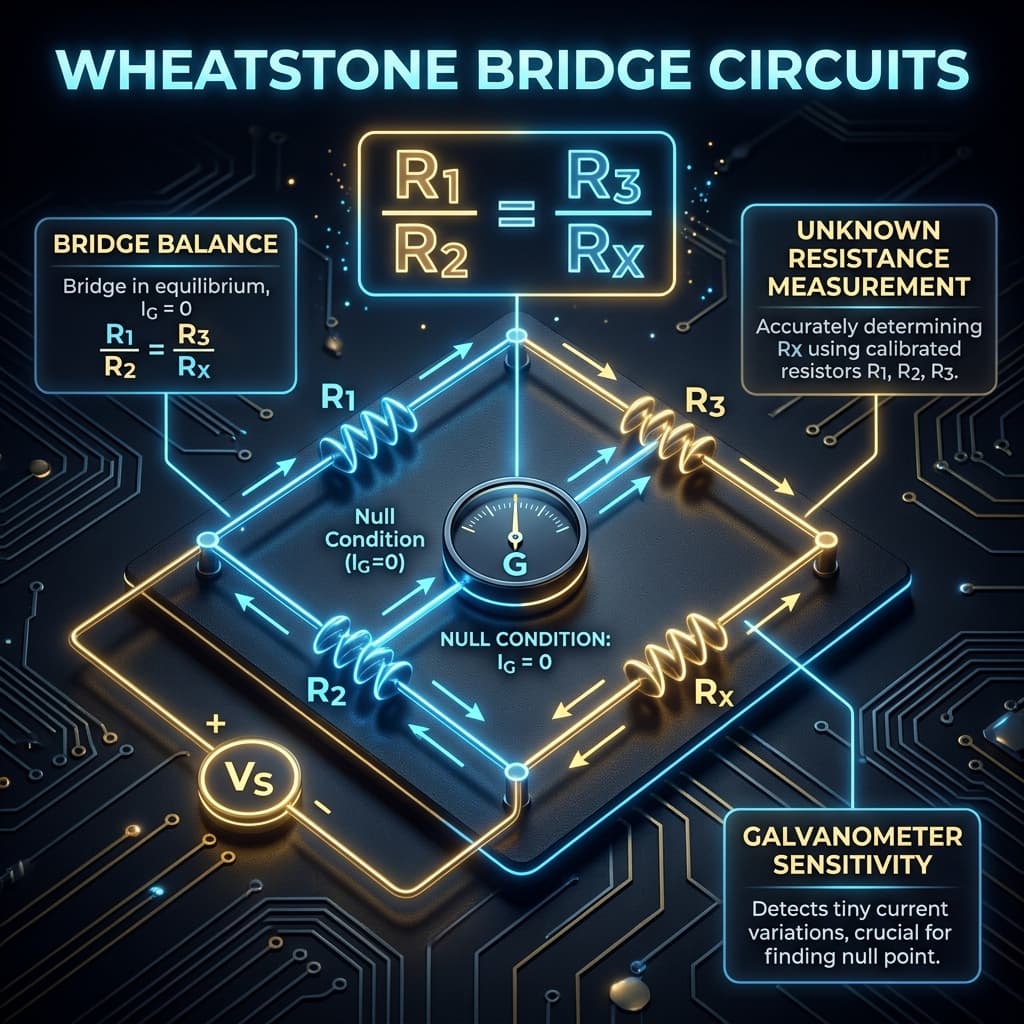
A Wheatstone bridge is a circuit with four resistors arranged in a diamond (or H) configuration with a voltage source and a detector. It was popularized by Sir Charles Wheatstone in 1843 for precise resistance measurement.
The bridge compares two voltage divider ratios. When the ratios are equal, the bridge is “balanced” and the voltage between the midpoints is zero. This null-detection technique enables very accurate resistance measurement.
Wheatstone Bridge Formulas
Balance condition: the ratios must be equal for zero output voltage.
Solve for an unknown resistor when the bridge is balanced.
Output voltage of an unbalanced bridge.
Bridge Circuit Diagram
The Wheatstone bridge has four resistors in a diamond configuration. Voltage is applied across the top and bottom nodes. The output is the voltage difference between the left and right midpoint nodes.
When R1/R2 = R3/R4, the bridge is balanced and Vout = 0. Any imbalance produces a measurable output voltage.
Bridge Balance Condition
At balance, R1/R2 = R3/R4. The two voltage dividers produce the same output voltage, so the potential difference between them is zero. A galvanometer connected across the bridge shows no deflection.
This is the basis for precision resistance measurement: adjust one known resistor until the galvanometer reads zero, then calculate the unknown from the balance equation.
How to Use the Wheatstone Bridge Calculator
- 1Select a mode.
- 2Enter the resistor values with appropriate units.
- 3For voltage/current modes, enter the input voltage.
- 4Click Calculate.
- 5Review the result alongside the bridge diagram.
Example Calculations
Balance check
R1 = 100 Ω, R2 = 200 Ω, R3 = 150 Ω, R4 = 300 Ω. R1/R2 = 0.5, R3/R4 = 0.5. Balanced!
Find unknown R4
R1 = 100 Ω, R2 = 220 Ω, R3 = 330 Ω. R4 = R2×R3/R1 = 220×330/100 = 726 Ω.
Output voltage
Vin = 5 V, R1 = 100 Ω, R2 = 200 Ω, R3 = 100 Ω, R4 = 300 Ω. Vleft = 3.33 V, Vright = 3.75 V. Vout = −0.42 V.
Where Wheatstone Bridges Are Used
Wheatstone bridges are used in precision resistance measurement, strain gauge sensors, temperature measurement (RTD), pressure sensors, load cells, instrumentation amplifiers, physics labs, and electrical engineering coursework.
Common Wheatstone Bridge Mistakes
- • Labeling resistors incorrectly in the diamond/H configuration.
- • Forgetting that the balance condition is a ratio, not a sum.
- • Ignoring the galvanometer's internal resistance (assumed zero here).
- • Using the bridge for very low or very high resistances without modification.
Wheatstone Bridge vs Voltage Divider
A Wheatstone bridge is essentially two voltage dividers in parallel, with the output measured as the difference between their midpoints. A single voltage divider cannot measure resistance with the same precision as a balanced bridge.
Accuracy and Limitations
This calculator assumes ideal resistors and zero galvanometer resistance. Real bridges have lead resistance, contact resistance, and thermal effects. The simplified branch current analysis ignores current through the bridge output. For complex bridge analysis, use circuit simulation. This tool is for educational and introductory use.
Frequently Asked Questions
What does a Wheatstone bridge calculator do?›
It checks whether a bridge circuit is balanced, finds an unknown resistance from three known values, and calculates the bridge output voltage and branch currents.
What is the Wheatstone bridge balance condition?›
R1/R2 = R3/R4. When this ratio holds, no current flows through the bridge output and Vout = 0.
How do you calculate unknown resistance?›
At balance: Rx = (Rknown1 × Rknown2) / Rknown3. The specific formula depends on which resistor is unknown.
What is the output voltage of an unbalanced bridge?›
Vout = Vin × [R2/(R1+R2) − R4/(R3+R4)]. It’s the difference between the two voltage divider midpoints.
Why is a Wheatstone bridge more accurate than a simple ohmmeter?›
The bridge compares ratios rather than absolute values, which cancels out many sources of error.
Can a Wheatstone bridge measure any resistance?›
It works best for medium-range resistance. Very low or very high resistance requires modified bridge circuits (Kelvin bridge, etc.).
What does negative Vout mean?›
It means the right node is at a higher potential than the left node. The polarity depends on which side has the higher voltage divider ratio.
Can I use this bridge for AC circuits?›
The basic concept applies, but AC bridges use impedance (Z) instead of resistance. This calculator is for DC resistance.
What is a null detector?›
A sensitive device (galvanometer or voltmeter) connected across the bridge output. At balance, it reads zero.
How does temperature affect the bridge?›
Temperature changes resistance values. Precision measurements require temperature compensation or controlled environments.
What is the Thévenin equivalent of a Wheatstone bridge?›
Looking into the output terminals with Vin replaced by a short, Rth = R1||R2 + R3||R4. The Thévenin voltage is Vout. This equivalent circuit predicts loading by a galvanometer or ADC input.
How are strain gauges used in a Wheatstone bridge?›
A strain gauge replaces one or more bridge arms. When strain changes its resistance, the bridge unbalances proportionally, producing a voltage output that is linearly related to the applied strain.
Sources / References

Author & technical reviewer
Manish Kumar
PhysicsCalcs tools are reviewed with an educational focus: clear formulas, transparent assumptions, and practical context for students and science learners.
Learn more about Manish