
What Are SMD Resistor Codes?
Surface-mount device (SMD) resistors are tiny chip components used on modern printed circuit boards (PCBs). Unlike through-hole resistors that use color bands, SMD resistors use compact numeric or alphanumeric markings printed directly on the component body to indicate their resistance value.
Several standardized coding systems exist because SMD packages come in different sizes and tolerance classes. Lower-tolerance 5% parts (E24 series) typically use 3-digit codes, while higher-precision 1% parts (E96 series) use 4-digit or EIA-96 codes. Very small packages (0201, 01005) may carry no marking at all.
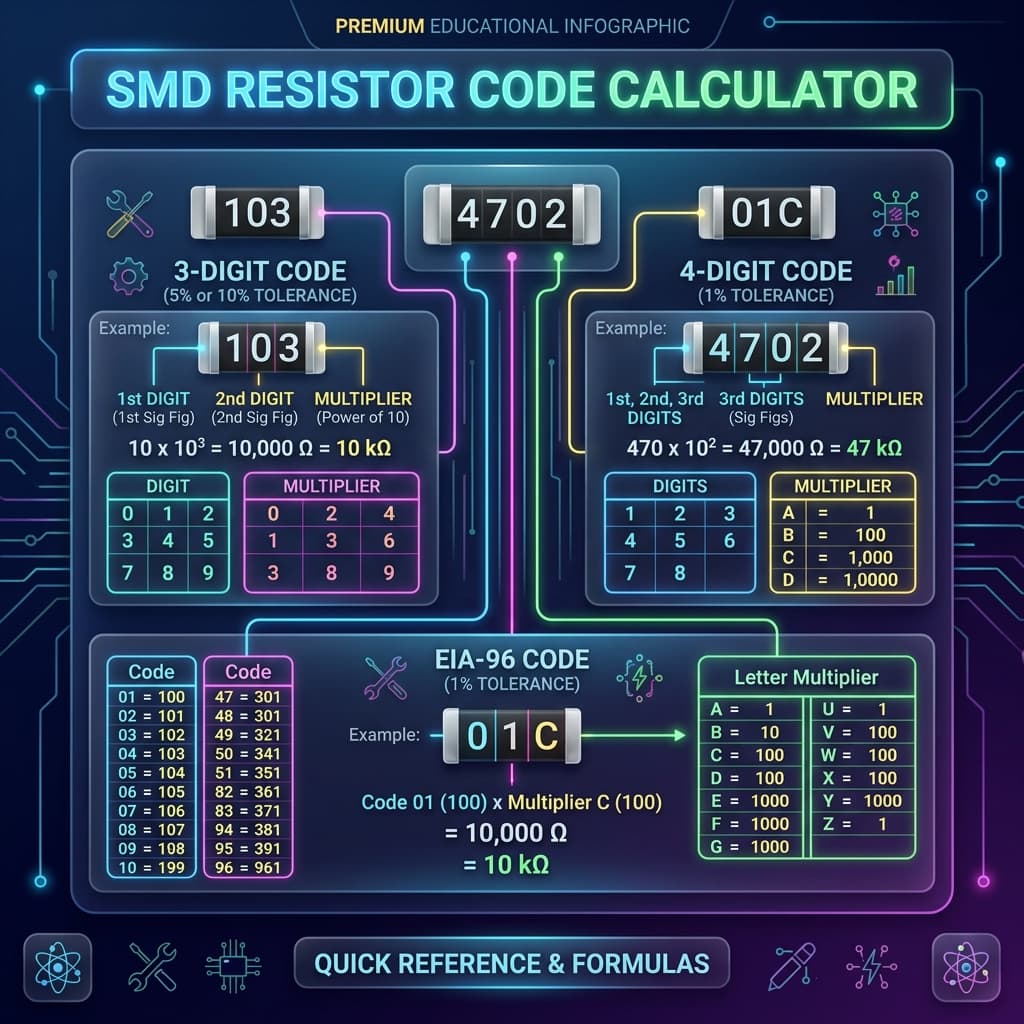
Code Formats Explained
| Format | Pattern | Example | Value | Tolerance |
|---|---|---|---|---|
| 3-digit | AB×10C | 472 | 4.7 kΩ | 5% (E24) |
| 4-digit | ABC×10D | 4701 | 4.7 kΩ | 1% (E96) |
| R-notation | R = decimal point | 4R7 | 4.7 Ω | 1–5% |
| EIA-96 | 2 digits + letter | 01C | 10 kΩ | 1% (E96) |
| Zero-ohm | 000 or 0 | 000 | 0 Ω (jumper) | — |
The 3-digit system is used for 5% tolerance (E24 series) resistors. The 4-digit and EIA-96 systems are used for 1% tolerance (E96 series) parts, where three significant digits are needed for adequate precision.
EIA-96 System
The EIA-96 system is used for 1% tolerance (E96 series) resistors. It combines a two-digit code (01–96) that maps to a specific significant-figure value from a 96-entry lookup table, with a letter suffix that indicates the multiplier:
| Letter | Multiplier |
|---|---|
| Z | ×0.001 |
| Y (or R) | ×0.01 |
| X (or S) | ×0.1 |
| A | ×1 |
| B | ×10 |
| C | ×100 |
| D | ×1,000 |
| E | ×10,000 |
| F | ×100,000 |
For example, code 68C: lookup 68 → 499, multiplier C → ×100, so 499 × 100 = 49,900 Ω = 49.9 kΩ.
How to Use
- 1Choose Decode or Encode mode.
- 2For Decode: type the SMD code printed on the resistor.
- 3For Encode: enter the desired resistance in ohms.
- 4Click the button to see the result.
- 5View the chip visualization and code table for reference.
Example Decodes
3-Digit: 472
47 × 10² = 4700 Ω = 4.7 kΩ.
4-Digit: 1002
100 × 10² = 10,000 Ω = 10 kΩ.
R-Notation: 4R7
4.7 Ω. The R replaces the decimal point.
EIA-96: 01C
01 → 100, C → ×100. 100 × 100 = 10,000 Ω = 10 kΩ.
Applications
- PCB repair & rework — identify a failed resistor’s value before ordering a replacement.
- Component identification — quickly decode markings during board-level troubleshooting.
- BOM & inventory management — translate codes into standard resistance values for parts databases.
- Electronics prototyping — verify that the correct value is populated on a hand-assembled prototype.
- Education — learn how SMD marking standards work in electronics courses and labs.
Common Mistakes
- Reading the code upside down. SMD resistors are symmetric — check the orientation dot or band (usually near pin 1) to ensure correct reading direction.
- Confusing 3-digit and EIA-96 codes. A code like "10A" is EIA-96 (lookup 10 = 124, A = ×1 → 124 Ω), not a 3-digit code with a letter. If the last character is a letter, assume EIA-96.
- Forgetting that R marks the decimal point. In R-notation, "R" replaces the decimal. 4R7 = 4.7 Ω, not 4 × R × 7.
- Assuming all packages use the same coding system. Different manufacturers and package sizes may use different systems. A 0402-size 1% resistor likely uses EIA-96, while a 0805-size 5% part uses 3-digit codes.
- Mixing up 4-digit codes and 3-digit codes. The 4-digit code "4701" (470 × 10¹ = 4.7 kΩ) is different from the 3-digit code "470" (47 × 10&sup0; = 47 Ω).
Accuracy and Limitations
- This calculator covers the four most common SMD coding systems (3-digit, 4-digit, R-notation, EIA-96). Some manufacturers use proprietary or non-standard markings.
- Very small packages (0201 and smaller) are typically unmarked. Identification requires a multimeter or known BOM placement data.
- The tool decodes to exact nominal values. Actual resistance depends on the component’s tolerance class (typically ±1% or ±5%).
- Codes are identified by format: 3 all-digit characters → 3-digit, 4 all-digit characters → 4-digit, 2 digits + 1 letter → EIA-96, contains “R” → R-notation. When in doubt about the physical component’s coding system, verify with a multimeter.
Frequently Asked Questions
What is a 3-digit SMD resistor code?›
A 3-digit code like 472 means 47 × 10² = 4700 Ω = 4.7 kΩ. The first two digits are the significant figures, and the third is the power of 10 multiplier.
What is a 4-digit SMD code?›
A 4-digit code like 4702 means 470 × 10² = 47000 Ω = 47 kΩ. Three significant digits give better precision (1% tolerance).
What does R mean in SMD codes?›
R marks the decimal point. 4R7 = 4.7 Ω. R47 = 0.47 Ω. This notation is used for values under 10 Ω where a decimal point would be hard to read.
What is the EIA-96 system?›
EIA-96 uses a two-digit number (01–96) mapping to a value from the E96 preferred number series, plus a letter multiplier: Z=×0.001, Y=×0.01, X=×0.1, A=×1, B=×10, C=×100, D=×1000, E=×10000, F=×100000. Used for 1% tolerance resistors.
What does 000 mean?›
000 is a zero-ohm resistor, used as a wire jumper on PCBs. It has near-zero resistance and is used for routing convenience.
How do I tell 3-digit from EIA-96?›
If the code has two digits followed by a letter, it’s EIA-96. If it’s three digits (all numbers), it’s a 3-digit code. This calculator auto-detects the format.
Can I encode a resistance value?›
Yes. Switch to Encode mode, enter a resistance in ohms, and the calculator will show the corresponding 3-digit, 4-digit, and R-notation codes.
Sources / References

Author & technical reviewer
Manish Kumar
PhysicsCalcs tools are reviewed with an educational focus: clear formulas, transparent assumptions, and practical context for students and science learners.
Learn more about Manish