
What Is a Resistor?
A resistor is a passive electrical component that opposes the flow of electric current. It is one of the most fundamental components in electronics and is measured in ohms (Ω). Resistors are used to control current, divide voltage, set bias points, and protect other components.
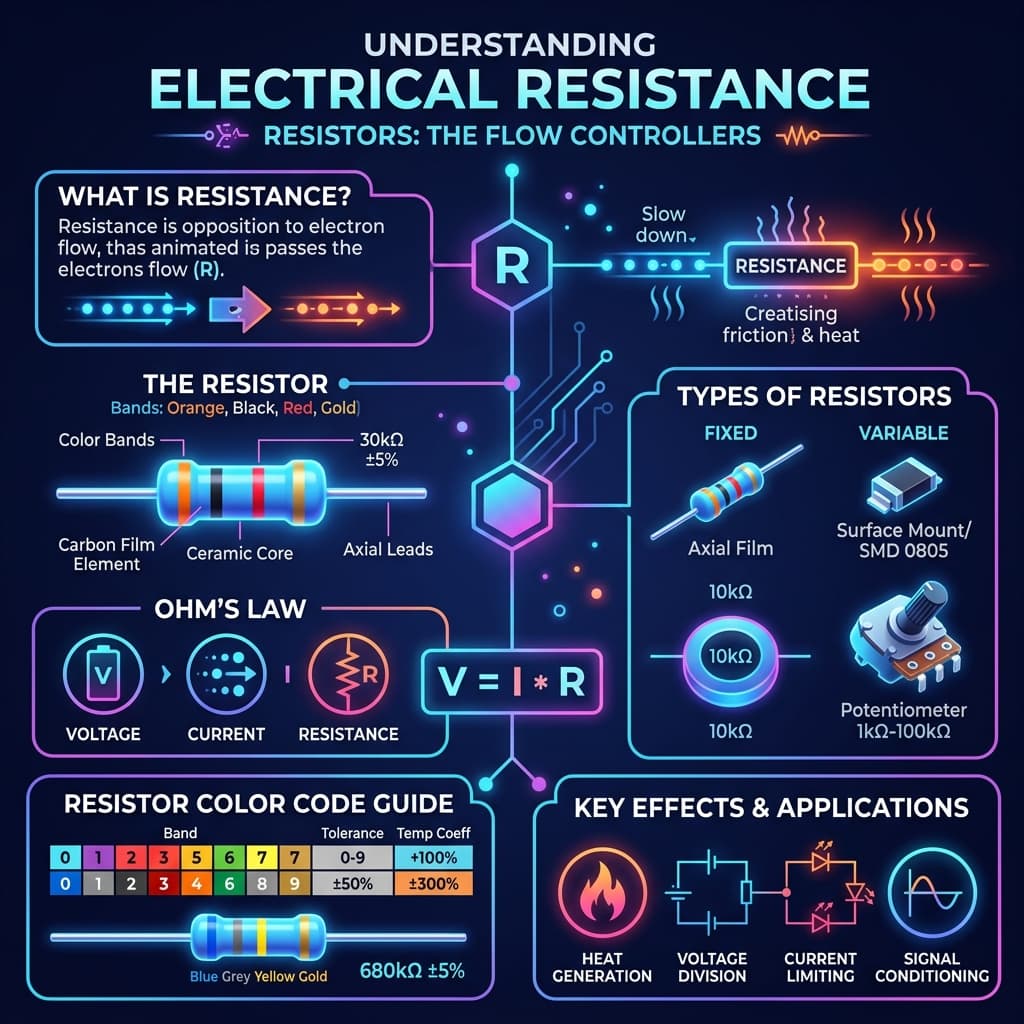
Most through-hole resistors use a colour-band system printed on their body to indicate their resistance value and tolerance.
Resistor Color Code Table
Each colour band on a resistor represents a digit, multiplier, or tolerance value.
| Color | Digit | Multiplier | Tolerance |
|---|---|---|---|
| Black | 0 | ×1 | — |
| Brown | 1 | ×10 | ±1% |
| Red | 2 | ×100 | ±2% |
| Orange | 3 | ×1k | — |
| Yellow | 4 | ×10k | — |
| Green | 5 | ×100k | ±0.5% |
| Blue | 6 | ×1M | ±0.25% |
| Violet | 7 | ×10M | ±0.1% |
| Grey | 8 | ×100M | ±0.05% |
| White | 9 | ×1G | — |
| Gold | — | ×0.1 | ±5% |
| Silver | — | ×0.01 | ±10% |
Series & Parallel Diagrams
Series Circuit
Parallel Circuit
In a series circuit, resistors are connected end-to-end and share the same current. In a parallel circuit, resistors share the same voltage across their terminals. Most practical circuits combine both arrangements.
Series Resistance Formula
In series, resistances add directly. Total resistance is always greater than the largest individual resistance.
Parallel Resistance Formula
In parallel, reciprocals add. Total resistance is always less than the smallest individual resistance.
For two resistors in parallel, the shortcut formula is Rtotal = (R1 × R2) / (R1 + R2).
Wire Resistance Formula
Resistance depends on resistivity (ρ), length (L), and cross-sectional area (A).
How to Use the Resistor Calculator
- 1Select the calculator tab: Color Code, Series, Parallel, or Wire.
- 2For Color Code: choose 4-band or 5-band and select each band colour.
- 3For Series/Parallel: add resistor values and see the total.
- 4For Wire: choose a material, enter length and area.
- 5Review the calculated result.
Example Calculations
Color code: Brown-Black-Red-Gold
1, 0, ×100 = 1000 Ω = 1 kΩ, tolerance ±5%.
Series: 100 Ω + 220 Ω + 470 Ω
Rtotal = 100 + 220 + 470 = 790 Ω.
Parallel: 100 Ω || 100 Ω
1/R = 1/100 + 1/100 = 0.02 ⇒ R = 50 Ω.
Wire: 100 m copper, 1 mm²
R = 1.68×10−&sup8; × 100 / 10−&sup6; = 1.68 Ω.
Series vs Parallel
In a series circuit, current is the same through all resistors and total resistance increases. In a parallel circuit, voltage is the same across all resistors and total resistance decreases. Most real circuits combine both arrangements.
AWG Wire Gauge Table
American Wire Gauge (AWG) sizes with diameter and resistance per metre for copper wire at 20 °C.
| AWG | Diameter (mm) | Area (mm²) | Resistance (Ω/m) |
|---|---|---|---|
| 10 | 2.588 | 5.261 | 0.00328 |
| 12 | 2.053 | 3.309 | 0.00521 |
| 14 | 1.628 | 2.081 | 0.00828 |
| 16 | 1.291 | 1.309 | 0.01317 |
| 18 | 1.024 | 0.823 | 0.02095 |
| 20 | 0.812 | 0.518 | 0.03331 |
| 22 | 0.644 | 0.326 | 0.05296 |
| 24 | 0.511 | 0.205 | 0.08420 |
| 26 | 0.405 | 0.129 | 0.13388 |
E-Series Standard Resistor Values
The E12 and E24 series define preferred resistance values used in electronics manufacturing. Multiply any value by powers of 10 to get standard resistor values across decades.
| Series | Tolerance | Values per Decade |
|---|---|---|
| E12 | ±10% | 1.0, 1.2, 1.5, 1.8, 2.2, 2.7, 3.3, 3.9, 4.7, 5.6, 6.8, 8.2 |
| E24 | ±5% | 1.0, 1.1, 1.2, 1.3, 1.5, 1.6, 1.8, 2.0, 2.2, 2.4, 2.7, 3.0, 3.3, 3.6, 3.9, 4.3, 4.7, 5.1, 5.6, 6.2, 6.8, 7.5, 8.2, 9.1 |
For example, E12 values in the 1 kΩ decade are: 1.0k, 1.2k, 1.5k, 1.8k, 2.2k, 2.7k, 3.3k, 3.9k, 4.7k, 5.6k, 6.8k, 8.2k.
Where This Calculator Is Useful
The resistor calculator helps with reading colour codes quickly, designing circuits with specific resistance values, estimating wire resistance for power distribution, physics and electronics coursework, and hobby electronics projects.
Accuracy and Limitations
This calculator assumes ideal resistors and standard colour codes (IEC 60062).
Real resistors have manufacturing tolerances, temperature coefficients, and power ratings that may affect performance. Wire resistance calculations assume uniform cross-section and constant temperature.
Frequently Asked Questions
How do I read a 4-band resistor?›
Band 1 is the first digit, band 2 is the second digit, band 3 is the multiplier, and band 4 is the tolerance. For example, Brown-Black-Red-Gold = 10 × 100 = 1,000 Ω ±5%.
How do I read a 5-band resistor?›
Bands 1–3 are digits, band 4 is the multiplier, band 5 is the tolerance. For example, Brown-Black-Black-Brown-Brown = 100 × 10 = 1,000 Ω ±1%.
What is the formula for series resistance?›
Rₜₒₜₐₗ = R₁ + R₂ + R₃ + … Series resistance is always greater than the largest individual resistance.
What is the formula for parallel resistance?›
1/Rₜₒₜₐₗ = 1/R₁ + 1/R₂ + 1/R₃ + … Parallel resistance is always less than the smallest individual resistance.
Why is parallel resistance less than any single resistor?›
Adding parallel paths gives current more ways to flow, reducing the overall opposition to current.
What does tolerance mean?›
Tolerance is the maximum expected deviation from the marked value. A 1kΩ ±5% resistor can be anywhere from 950Ω to 1,050Ω.
What is wire resistance?›
Wire resistance depends on material resistivity (ρ), length (L), and cross-sectional area (A): R = ρL/A.
Which band is band 1?›
Band 1 is typically the band closest to one end of the resistor. The tolerance band (gold or silver) is usually on the opposite end.
Can I calculate resistor power rating?›
This calculator focuses on resistance values. For power calculations, use the Watts Calculator or Electrical Power Calculator.
What materials are available for wire resistance?›
The calculator includes copper, aluminium, silver, gold, iron, tungsten, and nichrome.
Sources / References

Author & technical reviewer
Manish Kumar
PhysicsCalcs tools are reviewed with an educational focus: clear formulas, transparent assumptions, and practical context for students and science learners.
Learn more about Manish