
What Are Kirchhoff’s Laws?
Kirchhoff's laws are two fundamental principles for analyzing electrical circuits. Gustav Kirchhoff formulated them in 1845. They apply to any circuit at any instant and form the basis for all circuit analysis methods.
Kirchhoff's Current Law (KCL) deals with currents at a junction. Kirchhoff's Voltage Law (KVL) deals with voltages around a closed loop. Together, they provide enough equations to solve any circuit.
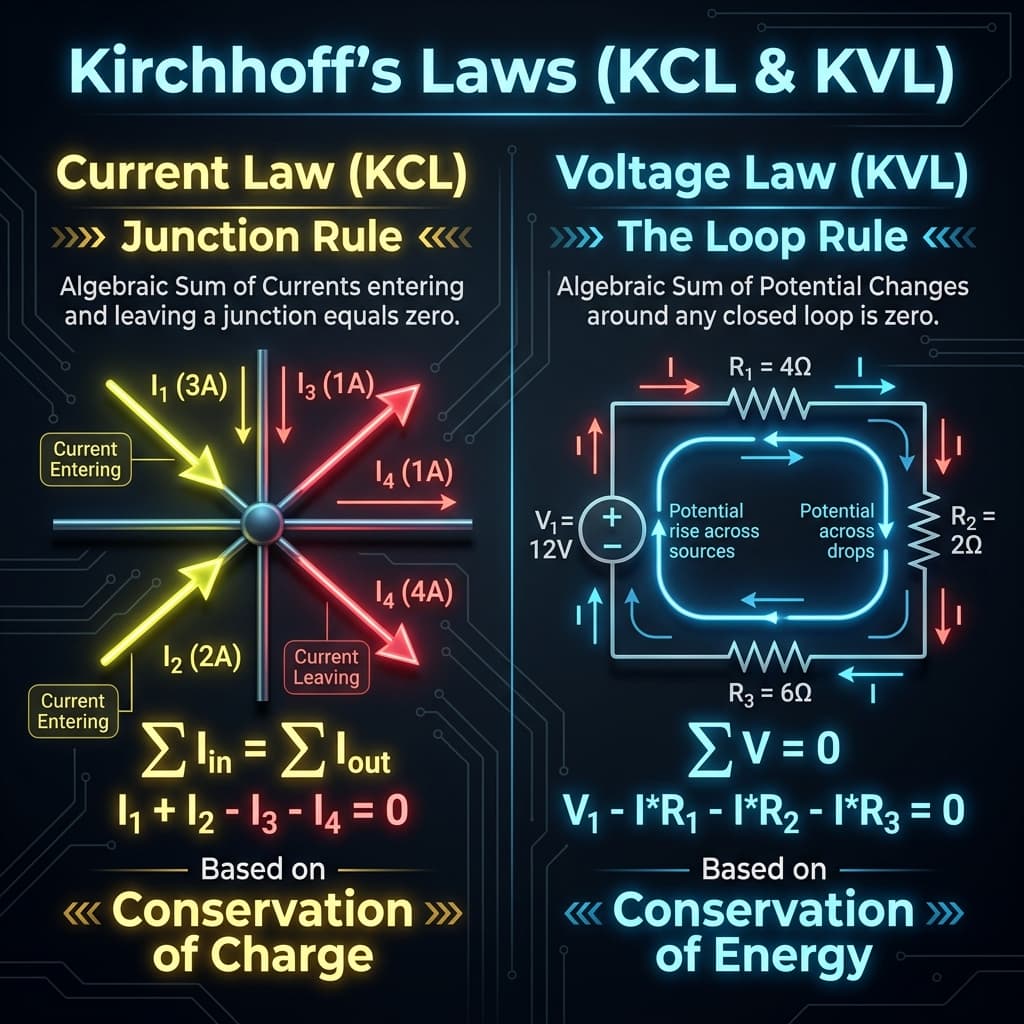
Kirchhoff’s Current Law (KCL)
The sum of currents entering a junction equals the sum leaving. Based on conservation of charge.
At any node in a circuit, charge is neither created nor destroyed. Whatever current flows in must flow out. If three wires meet at a node with 5 A entering and 2 A leaving one wire, the other wire must carry 3 A leaving.
KCL Junction Diagram
At any node, all currents entering must equal all currents leaving. This diagram shows a junction with three branches.
Kirchhoff’s Voltage Law (KVL)
The sum of voltage rises equals the sum of voltage drops around any closed loop. Based on conservation of energy.
Traversing a closed loop and adding voltage gains (+) and losses (−) always yields zero net voltage. A battery provides a voltage rise, and each resistor causes a voltage drop (V = IR).
KVL Loop Diagram
Traversing any closed loop, the sum of voltage rises equals the sum of voltage drops. This diagram shows a single loop with a voltage source and two resistors.
KCL vs KVL Comparison
| Feature | KCL | KVL |
|---|---|---|
| Applies to | Junctions (nodes) | Closed loops |
| Conserves | Charge | Energy |
| Equation | ΣIin = ΣIout | ΣV = 0 |
| Best for | Finding unknown branch currents | Finding unknown voltages in loops |
How to Use the Kirchhoff’s Law Calculator
- 1Select a mode: KCL Junction, KVL Loop, or Single-Loop Solver.
- 2Enter known current or voltage values with direction/type.
- 3Mark exactly one value as unknown using the ? button.
- 4Click Calculate to solve for the unknown.
- 5Review the equation balance and direction interpretation.
Single-Loop Circuit Solver
The single-loop solver combines KVL with Ohm's Law. Enter a supply voltage and series resistors. The tool calculates the loop current (I = V/Rtotal) and shows the voltage drop across each resistor, verifying that all drops sum to the supply voltage.
Example Calculations
KCL at a 3-wire junction
5 A enters, 2 A leaves through one wire. Unknown current: 5 − 2 = 3 A leaving through the third wire.
KVL in a simple loop
12 V battery (rise), 4 V drop across R1. Unknown voltage drop across R2: 12 − 4 = 8 V drop.
Single-loop solver
Vs = 9 V, R1 = 100 Ω, R2 = 200 Ω. Rtotal = 300 Ω. I = 9/300 = 30 mA. VR1 = 3 V, VR2 = 6 V. Sum: 9 V ✓.
Understanding Negative Results
A negative result for an unknown current or voltage does not mean the answer is wrong. It means the assumed direction was opposite to the actual direction. Simply flip the direction and use the absolute value.
This is a normal and expected outcome in circuit analysis. Kirchhoff's laws always give correct magnitudes; the sign tells you about direction.
Common Mistakes with Kirchhoff’s Laws
- • Mixing up current directions (entering vs leaving) at a node.
- • Forgetting to account for voltage polarity of sources.
- • Writing KVL equations that don't traverse a complete closed loop.
- • Using an open path instead of a closed loop for KVL.
- • Applying KCL to a region instead of a single node.
Where Kirchhoff’s Laws Are Used
These laws are fundamental to all circuit analysis: mesh analysis, nodal analysis, Wheatstone bridges, transistor biasing, power distribution, electronics troubleshooting, physics homework, and electrical engineering courses.
Accuracy and Limitations
This calculator handles basic KCL/KVL problems with one unknown and single-loop circuits. Multi-loop and multi-node circuits with simultaneous unknowns require systems of equations. This tool is for educational use and fundamental practice.
Frequently Asked Questions
What is Kirchhoff’s Current Law?›
KCL states that the sum of all currents entering a junction equals the sum of all currents leaving. No charge is created or destroyed at a node.
What is Kirchhoff’s Voltage Law?›
KVL states that the algebraic sum of all voltage gains and drops around any closed loop equals zero. All energy supplied is consumed.
When do I use KCL vs KVL?›
Use KCL at junction nodes where multiple branches meet. Use KVL around closed loops that include voltage sources and resistors.
What does a negative current mean?›
A negative result means the actual current flows in the opposite direction to what you assumed.
Can I use these laws for AC circuits?›
Yes, Kirchhoff’s laws apply to AC circuits using phasors and complex impedance. This calculator focuses on DC.
Do both laws apply simultaneously?›
Yes. Every circuit must satisfy both laws at all times. In complex circuits, you write KCL and KVL equations and solve them together.
What is a single-loop circuit?›
A circuit with one closed path. All components are in series, so the same current flows through everything.
How do I handle multiple voltage sources in KVL?›
Add each voltage source as a rise (if traversed from − to +) or a drop (if traversed from + to −).
Is KCL the same as conservation of charge?›
Yes. KCL is a direct consequence of charge conservation: charge neither accumulates nor depletes at a node.
Why are Kirchhoff’s laws important?›
They provide the foundation for all circuit analysis techniques, from simple series-parallel reduction to mesh and nodal analysis.
Can KCL and KVL be used for AC circuits?›
Yes. KCL and KVL apply to AC circuits when using phasors and complex impedances. The instantaneous form also holds at every moment in time.
How many KCL and KVL equations do I need?›
For a circuit with N nodes and B branches, you need N-1 independent KCL equations and B-(N-1) independent KVL (loop) equations to solve for all unknowns.
Sources / References

Author & technical reviewer
Manish Kumar
PhysicsCalcs tools are reviewed with an educational focus: clear formulas, transparent assumptions, and practical context for students and science learners.
Learn more about Manish