
What Is Battery Life?
Battery life (runtime) is how long a battery can power a device before it needs recharging or replacement. It depends on the battery’s capacity, the device’s current draw, system efficiency, depth of discharge, and usage pattern (duty cycle).
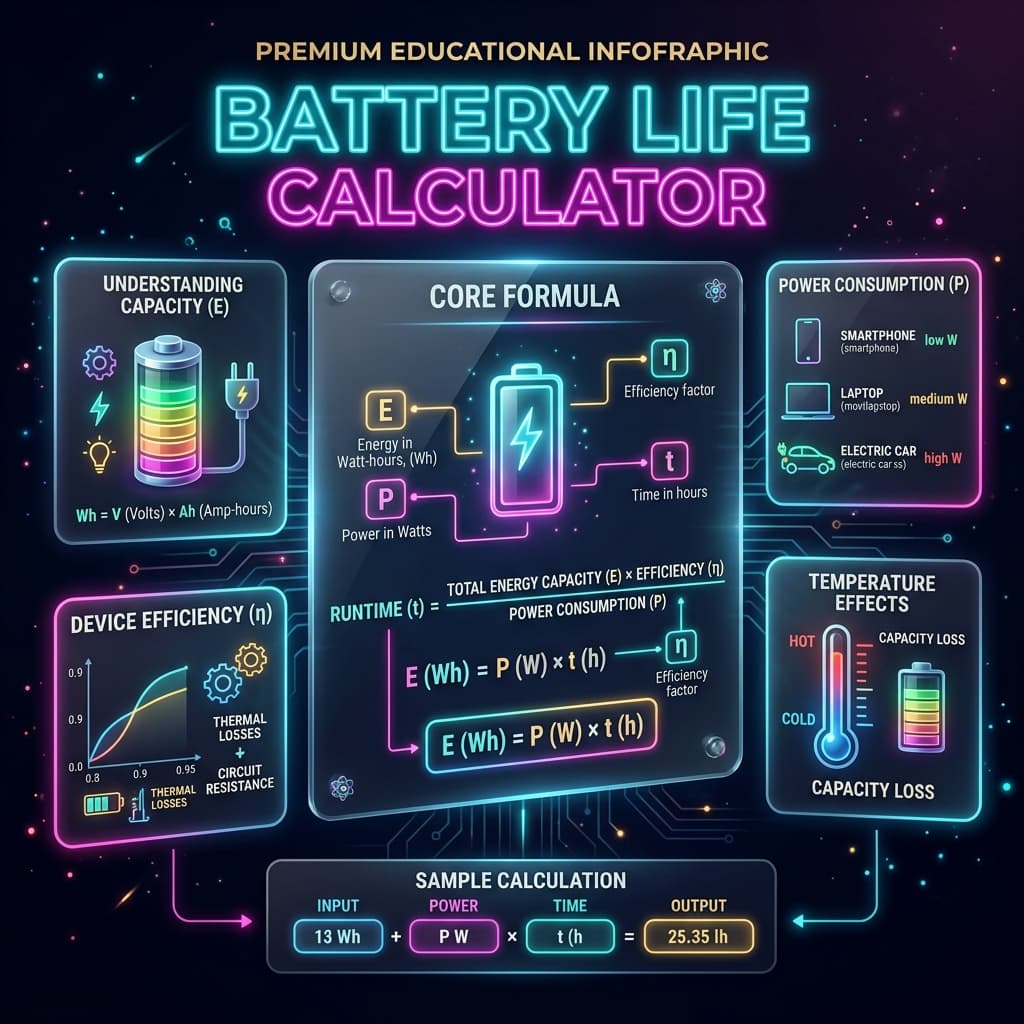
Battery Life Formulas
Runtime in hours
Battery energy
Duty-cycle average
Factors Affecting Battery Life
| Factor | Effect |
|---|---|
| Higher current | Shorter runtime, reduced effective capacity |
| Lower efficiency | More energy lost, shorter runtime |
| Deeper DoD | More capacity used, fewer charge cycles |
| Cold temperature | Reduced effective capacity |
| Battery age | Capacity degradation over charge cycles |
How to Use
- 1Select a calculation mode.
- 2Enter battery capacity (mAh/Ah) or energy (Wh).
- 3Enter current draw or power consumption.
- 4Adjust efficiency and DoD for realistic results.
- 5Click Calculate.
Examples
Smartphone Battery
3000 mAh, 150 mA average, 90% eff, 80% DoD. Runtime = (3 × 0.8 × 0.9) / 0.15 = 14.4 hours.
IoT Sensor with Duty Cycle
500 mAh, active 20 mA, sleep 5 μA, 10% duty. I_avg = 20×0.1 + 0.005×0.9 = 2.0045 mA. Runtime ≈ 200 hours.
Applications
Smartphone and laptop battery estimation, IoT device power budgeting, wearable electronics design, UPS backup time, solar battery system sizing, electric vehicle range estimation, and emergency equipment battery planning.
Common Mistakes
- Ignoring system efficiency (converters are not 100% efficient).
- Using rated capacity without DoD derating.
- Not accounting for sleep current in battery-powered devices.
- Assuming constant current draw (real loads vary).
- Confusing mAh (capacity) with mA (current).
Accuracy and Limitations
This calculator provides estimates based on ideal conditions. Real battery performance varies with temperature, discharge rate (Peukert effect), age, and battery chemistry. Use manufacturer datasheets for precise specifications.
Frequently Asked Questions
How do I calculate battery life?›
Divide the battery capacity (in Ah) by the average current draw (in A). For more accuracy, multiply capacity by DoD and efficiency first: Runtime = (Ah × DoD × η) / I.
What is depth of discharge (DoD)?›
DoD is the percentage of the battery’s capacity that is actually used before recharging. Using 80% DoD means you use 80% and keep 20% in reserve, which extends battery cycle life.
Why include efficiency?›
No battery system is 100% efficient. DC-DC converters, voltage regulators, and internal resistance cause losses. Typical system efficiency is 85–95%.
What is a duty cycle?›
The duty cycle is the fraction of time a device is actively drawing power vs sleeping. A 10% duty cycle means the device is active 10% of the time and sleeping 90%.
Should I use mAh or Wh?›
mAh compares batteries at the same voltage. Wh (= V × Ah) is better for comparing batteries at different voltages since it represents actual energy.
Does discharge rate affect capacity?›
Yes. Higher discharge rates reduce effective capacity (Peukert effect). A battery rated at 3000 mAh may deliver less at high currents.
How does temperature affect battery life?›
Cold temperatures reduce chemical reaction rates, lowering effective capacity. Very hot temperatures accelerate degradation.
Sources / References

Author & technical reviewer
Manish Kumar
PhysicsCalcs tools are reviewed with an educational focus: clear formulas, transparent assumptions, and practical context for students and science learners.
Learn more about Manish