
What Is Power Factor?
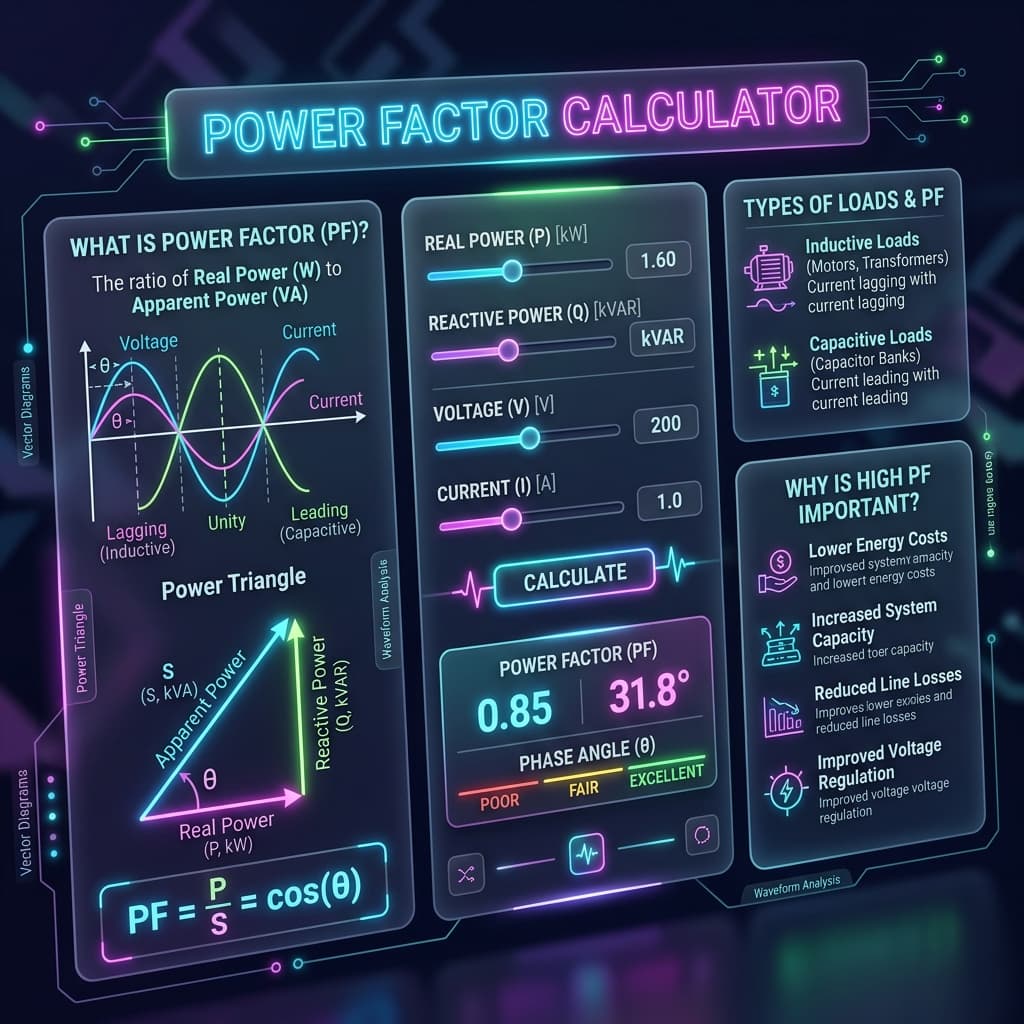
Power factor (PF) measures how effectively electrical power is converted into useful work. It is the ratio of real power (P, in watts) to apparent power (S, in volt-amperes). A PF of 1 (unity) means all supplied power is doing useful work. A PF less than 1 means some power is wasted as reactive power.
Power Factor Formulas
Power factor definition
Apparent power
Single-phase
Three-phase
The Power Triangle
The power triangle is a right triangle where: the horizontal side is real power P (watts), the vertical side is reactive power Q (VAr), and the hypotenuse is apparent power S (VA). The angle θ between P and S is the power factor angle, and PF = cos(θ).
Leading vs Lagging Power Factor
| Type | Cause | Correction |
|---|---|---|
| Lagging | Inductive loads (motors, transformers) | Add capacitors |
| Leading | Capacitive loads (capacitor banks, cables) | Add inductors |
Typical Industrial Power Factor Values
Power factor varies widely by load type. Use this table as a starting point when the nameplate PF is unknown or for preliminary system design.
| Load Type | Typical PF | Type | Notes |
|---|---|---|---|
| Induction motors (loaded) | 0.75–0.85 | Lagging | PF drops significantly at light load |
| Induction motors (no load) | 0.15–0.30 | Lagging | Mostly magnetizing current |
| Arc welders | 0.50–0.70 | Lagging | Highly variable with arc conditions |
| Fluorescent lighting (magnetic ballast) | 0.50–0.65 | Lagging | Electronic ballasts improve to 0.90+ |
| LED lighting (with PFC) | 0.90–0.99 | Near unity | Built-in PFC driver |
| Resistive heaters | 1.00 | Unity | Purely resistive load |
| Variable frequency drives (VFD) | 0.95–0.98 | Near unity | Active front-end rectifier; produces harmonics |
| Transformers (no load) | 0.10–0.20 | Lagging | Core magnetizing current only |
| Transformers (full load) | 0.85–0.95 | Lagging | PF depends on connected load |
Many utilities penalize commercial and industrial customers with PF below 0.85–0.90, typically adding a 1–2% surcharge per 0.01 below the threshold. Correcting PF with capacitor banks reduces penalties and frees transformer/cable capacity.
How to Use
- 1Select a calculation mode.
- 2Choose lagging or leading load type.
- 3Enter known values (power, voltage, current, angle, or PF).
- 4Click Calculate.
- 5View results and power triangle visualization.
Example Calculations
PF from P and S
P = 800 W, S = 1000 VA. PF = 800/1000 = 0.80. θ = arccos(0.80) = 36.87°. Q = √(1000² − 800²) = 600 VAr.
Three-Phase Power
V_L = 400 V, I_L = 50 A, PF = 0.85. S = √3 × 400 × 50 = 34,641 VA. P = 29,445 W. Q = 18,275 VAr.
Applications
Industrial power distribution, motor sizing, transformer loading, power factor correction, utility billing calculations, generator sizing, UPS specification, and electrical system design.
Common Mistakes
- Confusing kW (real) with kVA (apparent).
- Adding powers directly instead of using the power triangle.
- Using single-phase formula for three-phase systems.
- Forgetting the √3 factor in three-phase calculations.
Accuracy and Limitations
This calculator assumes sinusoidal waveforms. Non-linear loads (variable frequency drives, LED drivers, switching supplies) produce harmonics that affect true power factor. Total power factor includes both displacement and distortion components. For harmonic analysis, use dedicated power quality tools.
Frequently Asked Questions
What is power factor?›
Power factor is the ratio of real (useful) power to apparent (total) power in an AC circuit. It indicates how efficiently electrical power is being used.
What is a good power factor?›
A power factor of 0.95 or above is generally considered good. Many utilities penalize industrial customers with PF below 0.85–0.90.
What causes poor power factor?›
Inductive loads like motors, transformers, and fluorescent lighting cause lagging power factor. Lightly loaded motors and certain electronic loads can make it worse.
How do you correct power factor?›
Adding capacitor banks (for lagging PF) or inductors (for leading PF) to compensate reactive power. This is called power factor correction (PFC).
What is the difference between leading and lagging?›
Lagging PF means current lags voltage (inductive loads). Leading PF means current leads voltage (capacitive loads). Most industrial loads are lagging.
What is the power triangle?›
The power triangle shows the geometric relationship: S² = P² + Q², where P is real power (W), Q is reactive power (VAr), and S is apparent power (VA). The angle θ between P and S is the power factor angle.
Does power factor affect my electricity bill?›
For residential users, usually not directly. For commercial and industrial users, many utilities impose penalties for low power factor, typically below 0.85–0.95.
How do three-phase calculations differ?›
Three-phase apparent power is S = √3 × V_line × I_line, compared to S = V × I for single-phase.
How do I size capacitor banks for power factor correction?›
Calculate the reactive power to compensate: Q_c = P × (tan(θ_old) − tan(θ_new)), where θ = arccos(PF). For example, correcting 100 kW from PF 0.70 to 0.95 requires Q_c = 100 × (1.020 − 0.329) = 69.1 kVAr of capacitor banks. Always install with contactors and fuses per NEC/IEC.
What is the difference between displacement and distortion power factor?›
Displacement power factor (DPF) is cos(θ) between the fundamental voltage and current. Distortion power factor accounts for harmonic content: DPF_total = DPF × 1/√(1 + THD²). Non-linear loads like VFDs and LED drivers can have high DPF but low total PF due to harmonic distortion. This calculator assumes sinusoidal waveforms (displacement PF only).
Sources / References

Author & technical reviewer
Manish Kumar
PhysicsCalcs tools are reviewed with an educational focus: clear formulas, transparent assumptions, and practical context for students and science learners.
Learn more about Manish