
What Is Coulomb’s Law?
Coulomb's Law describes the electrostatic force between two stationary point charges. It is one of the fundamental laws of electrostatics, first published by Charles-Augustin de Coulomb in 1785.
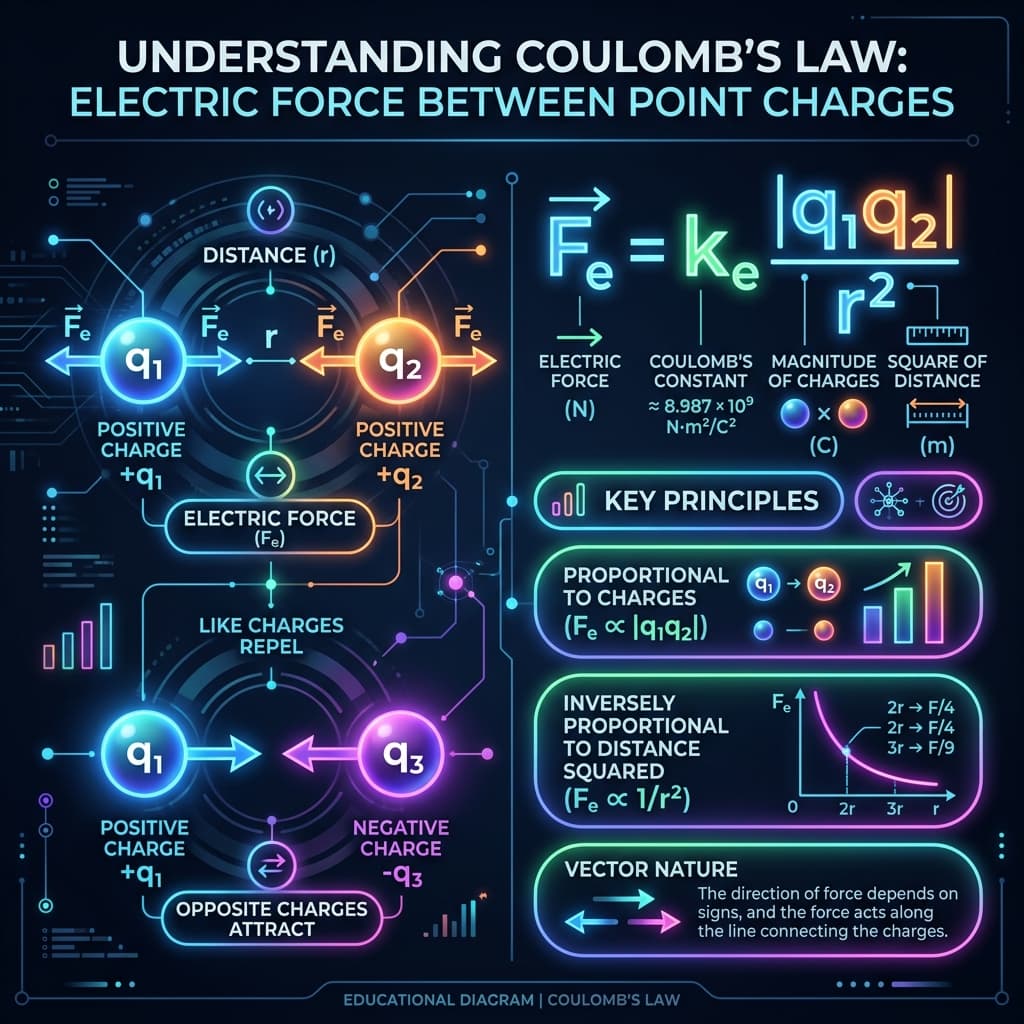
The law states that the force is directly proportional to the product of the charge magnitudes and inversely proportional to the square of the distance between them. Like charges repel, and opposite charges attract.
Charge & Force Diagram
Two positive point charges separated by distance r. The electrostatic force pushes them apart (repulsion). If one charge were negative, the arrows would point inward (attraction). The magnitude is given by Coulomb's Law below.
Coulomb’s Law Formula
The magnitude of the electrostatic force between two point charges.
Where F is force (N), k is Coulomb's constant (≈ 8.99 × 10&sup9; N·m²/C²), q₁ and q₂ are the charges (C), and r is the distance (m).
In a medium other than vacuum, divide by the relative permittivity εr:
Adjusted for a dielectric medium.
How to Use the Coulomb’s Law Calculator
- 1Select whether to calculate force, charge, or distance.
- 2Enter the known values with their units.
- 3For charges, enter negative values if the charge is negative.
- 4Relative permittivity is optional (leave blank for vacuum/air).
- 5Click Calculate and review the result.
Example Calculations
Force between two charges
q₁ = +2 μC, q₂ = -3 μC, r = 0.1 m. F = 8.99×10&sup9; × |2×10−&sup6; × 3×10−&sup6;| / (0.1)² ≈ 5.39 N (attractive).
Distance for a given force
q₁ = q₂ = 1 μC, F = 0.9 N. r = √(8.99×10&sup9; × 10−¹² / 0.9) ≈ 0.1 m.
Attraction vs Repulsion
The sign of the product q₁ × q₂ determines the interaction type. If both charges have the same sign, the force is repulsive and pushes them apart. If the charges have opposite signs, the force is attractive and pulls them together.
The calculator automatically detects whether the interaction is attractive or repulsive based on the signs of the entered charges.
Why Distance Matters
Coulomb's Law follows an inverse-square relationship. Doubling the distance reduces the force to one-quarter. Halving the distance quadruples the force. This strong distance dependence is why electrostatic effects are most noticeable at short range.
Coulomb’s Constant
Coulomb's constant k relates the force to the charges and distance in SI units. Its value is approximately 8.9876 × 10&sup9; N·m²/C². It can also be expressed as k = 1/(4πε₀), where ε₀ is the permittivity of free space.
Relative Permittivity of Materials
The relative permittivity (εr) of a medium reduces the electrostatic force compared to vacuum. Use these values in the calculator to model charges in different environments.
| Material | εr (approx.) |
|---|---|
| Vacuum | 1 (exact) |
| Air (STP) | 1.0006 |
| Paper | 2–4 |
| Glass | 4–10 |
| Silicon | 11.7 |
| Ethanol | 24 |
| Water (20 °C) | 80 |
| Barium titanate | 1,200–10,000 |
Accuracy and Limitations
This calculator uses the classical point-charge form of Coulomb's Law in electrostatics.
Limitations include: applies to point charges only, assumes electrostatic conditions, does not handle moving charges or magnetic effects, and does not account for quantum effects at atomic scales. For extended charge distributions, use integration or superposition.
Frequently Asked Questions
What is Coulomb’s Law?›
Coulomb’s Law describes the electrostatic force between two point charges. The force magnitude is proportional to the product of the charge magnitudes and inversely proportional to the square of the distance between them.
What is the formula for Coulomb’s Law?›
F = k|q₁q₂| / r², where k is Coulomb’s constant (≈ 8.99 × 10⁹ N·m²/C²).
What is Coulomb’s constant?›
Coulomb’s constant k ≈ 8.9876 × 10⁹ N·m²/C². It relates the force to the charges and distance in SI units.
How do I know if the force is attractive or repulsive?›
If both charges have the same sign (both positive or both negative), the force is repulsive. If they have opposite signs, it is attractive.
What is relative permittivity?›
Relative permittivity (εᵣ) describes how a medium weakens the electric force compared to vacuum. For vacuum or air, εᵣ ≈ 1. Water has εᵣ ≈ 80.
Does Coulomb’s Law work for more than two charges?›
Coulomb’s Law gives the force between one pair. For multiple charges, calculate each pair separately and add the forces as vectors (superposition principle).
Why does force increase so much at small distances?›
Force is inversely proportional to r². Halving the distance quadruples the force.
Is the Coulomb force related to gravity?›
Both follow an inverse-square law, but the Coulomb force acts on charges while gravity acts on masses. The Coulomb force is vastly stronger for elementary particles.
Can charges be negative?›
Yes. Electrons carry negative charge, protons carry positive charge. The sign affects whether the force is attractive or repulsive.
Does this calculator handle non-point charges?›
No. Coulomb’s Law as implemented here applies to point charges or sufficiently small charged objects.
Sources / References

Author & technical reviewer
Manish Kumar
PhysicsCalcs tools are reviewed with an educational focus: clear formulas, transparent assumptions, and practical context for students and science learners.
Learn more about Manish