
What Is a Watt?
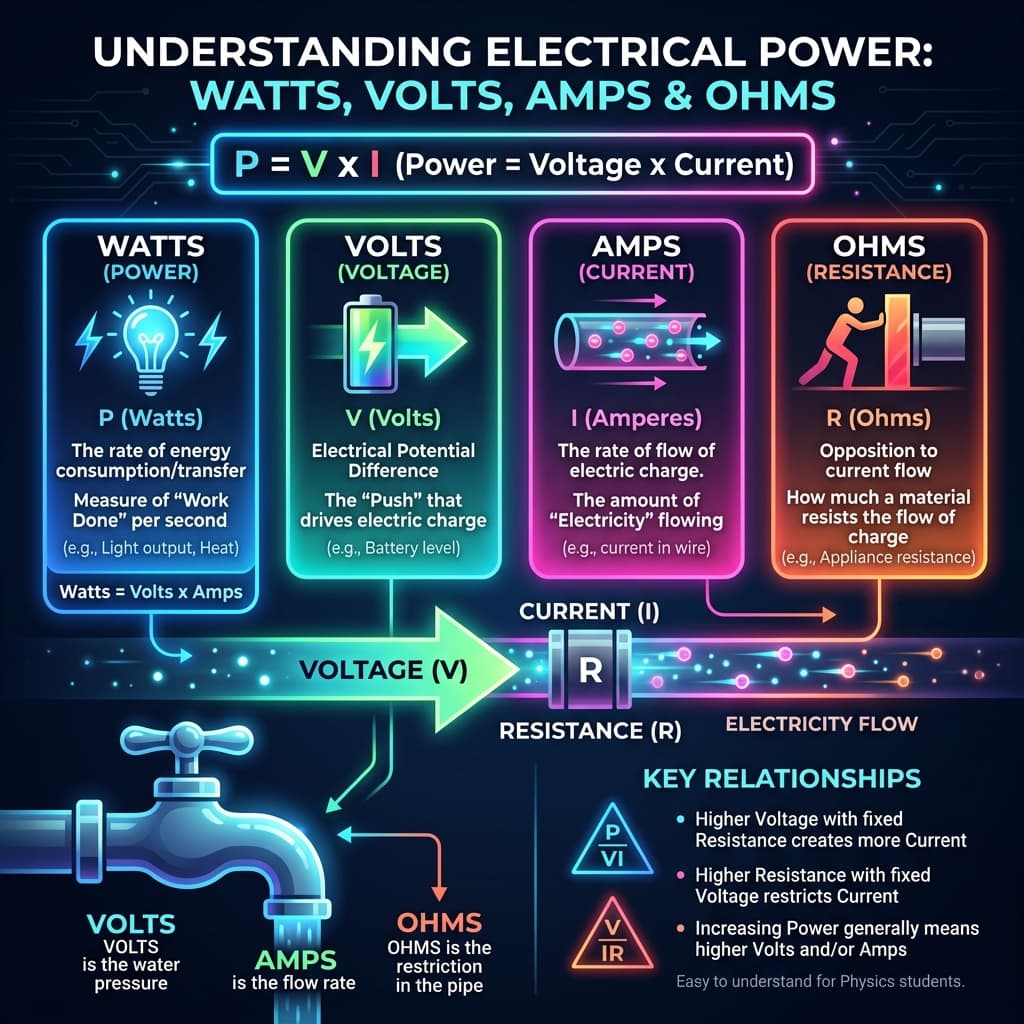
A watt is the SI unit of power. It measures the rate at which electrical energy is transferred or used. One watt means one joule of energy is transferred every second.
In electrical circuits, watts describe how much power a device consumes or delivers. A 60 W light bulb uses 60 joules of electrical energy per second. A 1,000 W (1 kW) heater uses energy ten times faster than a 100 W bulb.
One watt equals one joule per second.
The unit is named after James Watt, the Scottish inventor who improved the steam engine. Today, the watt is used across physics, engineering, and everyday life to quantify power.
Power Triangle
The power triangle is a visual memory aid. Cover the quantity you want to find: if P is covered, multiply V × I. If V is covered, divide P / I. If I is covered, divide P / V.
Watts Formula
Electrical power can be calculated using three equivalent formulas. Each uses a different pair of known quantities.
Power from voltage and current. The most widely used form.
Power from current and resistance. Useful when voltage is unknown.
Power from voltage and resistance. Useful when current is unknown.
Where P is power in watts, V is voltage in volts, I is current in amperes, and R is resistance in ohms. These formulas are connected through Ohm's Law (V = I × R), so knowing any two of V, I, and R lets you find the third and then calculate power.
How to Use the Watts Calculator
- 1Select what you want to calculate from the dropdown.
- 2Enter the two known values in the input fields.
- 3Choose the correct unit for each value (V, mV, kV, etc.).
- 4Click Calculate to see the result.
- 5Review the formula, substituted values, and explanation below the result.
Example Calculations
Watts from voltage and current
A 12 V battery powers a circuit drawing 2 A. P = V × I = 12 × 2 = 24 W.
Watts from current and resistance
A current of 3 A flows through a 4 Ω resistor. P = I²R = 3² × 4 = 36 W.
Watts from voltage and resistance
120 V is applied across 60 Ω. P = V²/R = 120²/60 = 240 W.
Current from watts and voltage
A 60 W bulb at 12 V. I = P/V = 60/12 = 5 A.
Watts vs Volts vs Amps vs Ohms
These four quantities each describe a different aspect of an electrical circuit.
| Quantity | Symbol | Unit | Meaning |
|---|---|---|---|
| Power | P | Watt (W) | Rate of energy transfer |
| Voltage | V | Volt (V) | Electrical potential difference |
| Current | I | Ampere (A) | Rate of charge flow |
| Resistance | R | Ohm (Ω) | Opposition to current |
Common Appliance Wattages
Reference table of typical power consumption for household and electronics devices.
| Appliance | Typical Wattage |
|---|---|
| LED bulb | 7–15 W |
| Laptop | 30–65 W |
| Desktop PC | 200–500 W |
| Refrigerator | 100–250 W |
| Microwave oven | 600–1,200 W |
| Electric kettle | 1,500–2,400 W |
| Space heater | 750–1,500 W |
| Hair dryer | 800–1,800 W |
| Washing machine | 350–500 W |
| Air conditioner (window) | 500–1,500 W |
Where a Watts Calculator Is Useful
Power calculations appear wherever electrical energy is used or transferred. Common applications include physics homework and exam problems, choosing resistors that can handle the heat, estimating battery life and power-supply requirements, understanding appliance power ratings, sizing solar panels and DC power systems, and practising Ohm's Law and Watt's Law relationships.
Accuracy and Limitations
This calculator uses standard DC power formulas for ideal ohmic circuits. Results are accurate for educational problems and simple resistive circuits.
Real systems may involve AC power factor, RMS values, efficiency losses, heat effects, non-ohmic loads, and safety regulations. For household wiring, high voltage, or professional electrical work, consult a qualified professional. Important calculations should be independently verified.
Frequently Asked Questions
What is a watt?›
A watt is the SI unit of power. One watt equals one joule of energy transferred per second. In electrical terms, 1 W = 1 V × 1 A.
How do you calculate watts?›
The most common formula is P = V × I. You can also use P = I²R when you know current and resistance, or P = V²/R when you know voltage and resistance.
What is the formula for watts?›
The three standard formulas are P = V × I, P = I²R, and P = V²/R. Each lets you calculate power from different combinations of known values.
How many watts are in a volt?›
Watts and volts measure different things, so there is no direct conversion. You need current or resistance as well. For example, 12 V at 2 A equals 24 W.
Are watts and amps the same?›
No. Watts measure power (energy per second), while amps measure current (charge per second). They are related through P = V × I.
Can I calculate watts from resistance?›
Yes. If you know current and resistance, use P = I²R. If you know voltage and resistance, use P = V²/R.
What is the difference between watts and kilowatts?›
1 kW = 1,000 W. Kilowatts are used for larger power values such as household appliances and solar panels.
Can this calculator be used for AC circuits?›
This calculator uses DC-style formulas. AC circuits involve power factor, RMS values, and reactive power. Results are educational estimates for simple resistive AC loads.
Why does power increase when current increases?›
Power is proportional to the square of current in a resistive circuit (P = I²R). Doubling current quadruples the power dissipation.
Is this calculator the same as an Ohm’s Law calculator?›
They overlap. The Watts Calculator focuses on power, while the Ohm’s Law Calculator focuses on voltage, current, and resistance. Both use the same underlying relationships.
Sources / References

Author & technical reviewer
Manish Kumar
PhysicsCalcs tools are reviewed with an educational focus: clear formulas, transparent assumptions, and practical context for students and science learners.
Learn more about Manish