
What Is an LED Resistor Calculator?
An LED resistor calculator determines the resistance needed to limit current through a light-emitting diode (LED) to a safe operating level. LEDs are current-sensitive semiconductor devices that can be damaged by excessive current, so a series resistor is typically used to control the current flow.
The calculator applies Ohm's Law to find the resistor value, then recommends the nearest standard resistor and an appropriate power rating for practical circuit building.
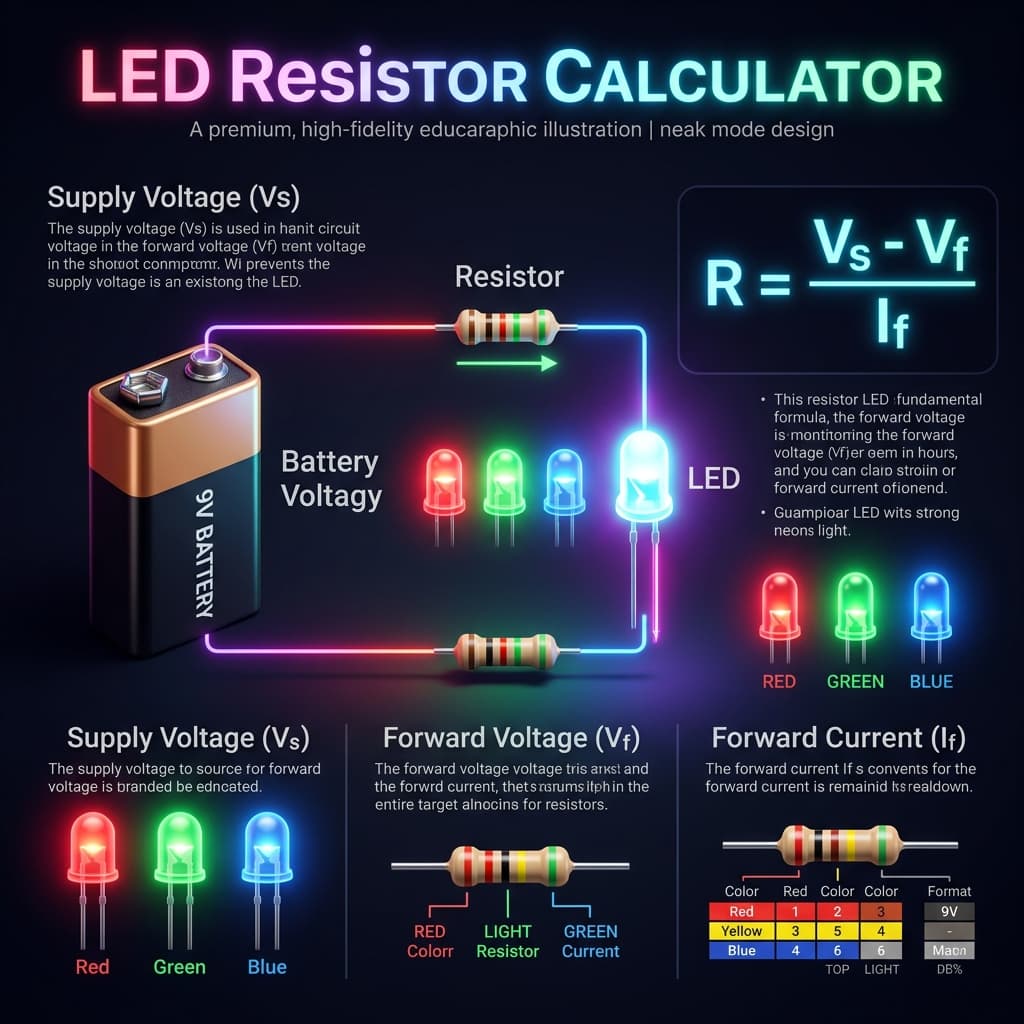
LED Resistor Formula
R = resistor value, Vs = supply voltage, Vf = LED forward voltage, N = number of LEDs in series, If = desired LED current.
Resistor power dissipation:
Power dissipated by the resistor. Use this to select an appropriate wattage rating.
How to Use the LED Resistor Calculator
- 1Choose a calculation mode: Calculate Resistor, Calculate Current, or Max LEDs.
- 2Select an LED color preset or enter the forward voltage manually.
- 3Enter the supply voltage.
- 4Enter the desired LED current (or resistor value for current mode).
- 5Set the number of LEDs in series.
- 6Click Calculate and review the exact resistor, standard recommendation, and power rating.
LED Forward Voltage by Color
Forward voltage varies by LED color due to different semiconductor materials. These are typical ranges; always check the datasheet for your specific LED.
| LED Color | Typical Vf | Typical If | Notes |
|---|---|---|---|
| Infrared | 1.2–1.5 V | 20 mA | Not visible; remote controls |
| Red | 1.8–2.2 V | 10–20 mA | Most common indicator LED |
| Orange | 2.0–2.2 V | 10–20 mA | AlGaInP material |
| Yellow | 2.0–2.4 V | 10–20 mA | Slightly higher Vf than orange |
| Green | 2.0–3.2 V | 10–20 mA | Standard vs high-brightness |
| Blue | 3.0–3.4 V | 20 mA | GaN/InGaN material |
| White | 3.0–3.4 V | 20 mA | Blue LED + phosphor coating |
| UV | 3.2–4.0 V | 20 mA | GaN; used in curing, sterilization |
Example Calculations
5 V supply, red LED
Vs = 5 V, Vf = 2.0 V, If = 20 mA. R = (5 − 2)/0.02 = 150 Ω. Power: P = 0.02² × 150 = 0.06 W. A 0.25 W resistor is a good choice.
12 V supply, three white LEDs in series
Vf total = 3 × 3.2 = 9.6 V. R = (12 − 9.6)/0.02 = 120 Ω.
Low voltage headroom warning
Vs = 3.3 V, blue LED Vf = 3.2 V. Only 0.1 V remains for the resistor, making current control unreliable. Use a higher supply voltage or a different LED.
Why LEDs Need a Resistor
An LED does not behave like a simple resistor. Once the forward voltage threshold is reached, the current through the LED can increase rapidly with only small voltage changes. Without a current-limiting resistor, the LED draws excessive current that generates heat and can destroy the device within seconds.
The resistor drops the excess voltage (Vs − Vf) and limits current to a safe value. This is the simplest and most common current-limiting method for low-power indicator LEDs.
Choosing a Standard Resistor Value
Calculated resistor values often do not match available standard values. Standard resistors follow the E-series (E12, E24, etc.) with specific preferred values per decade. The calculator recommends the nearest higher E12 value, which slightly reduces current and provides a safety margin.
Resistor tolerance (typically 1–5%) can cause the actual resistance to differ from the labeled value. For critical applications, measure the actual resistor or use tighter-tolerance components.
Resistor Power Rating
The resistor converts excess voltage into heat. Power dissipation is P = I²R. A resistor should be rated for at least twice the calculated power dissipation to prevent overheating.
Common ratings are 0.125 W (1/8 W), 0.25 W (1/4 W), 0.5 W, 1 W, and 2 W. Enclosed or high-temperature environments may require additional derating.
LED Circuit Diagram
A basic LED circuit consists of a supply voltage source, a current-limiting resistor, and one or more LEDs connected in series. The resistor drops the excess voltage so the LED receives only its forward voltage at the desired current.
The resistor is placed in series with the LED. Current flows from Vs through R and the LED to ground. The resistor power is P = I²R.
Common Mistakes
- • No resistor at all — the LED draws unlimited current and burns out instantly.
- • Using the same resistor for parallel LEDs — each parallel LED branch needs its own current-limiting resistor because forward voltage varies between LEDs.
- • Ignoring power rating — a resistor that dissipates more than its rated power will overheat and eventually fail.
- • Not accounting for battery voltage drop — as a battery discharges, supply voltage decreases and LED brightness drops.
- • Using color presets for final designs — LED Vf varies by manufacturer. Always use the datasheet value for production circuits.
Accuracy and Limitations
LED forward voltage changes with current, temperature, and LED type. Datasheet values are more reliable than color presets. High-power LEDs often require constant-current drivers, not a simple resistor. Battery voltage decreases over time, changing the LED current.
This calculator is for educational use and basic low-power LED circuits. For mains voltage, high-power LEDs, or safety-critical systems, use qualified electrical design guidance.
Frequently Asked Questions
What does an LED resistor calculator do?›
It calculates the resistance needed to limit current through an LED to a safe level, based on supply voltage, LED forward voltage, and desired current.
What resistor do I need for an LED?›
Use R = (Vs − Vf) / If. For a 5 V supply, red LED (2 V), 20 mA: R = (5 − 2) / 0.02 = 150 Ω.
Why does an LED need a resistor?›
LEDs are current-sensitive devices. Once forward voltage is reached, current can rise rapidly and damage the LED. A resistor limits the current.
What happens if I use no resistor with an LED?›
Without current limiting, the LED may draw excessive current, overheat, and burn out quickly. The power supply may also be damaged.
How do I calculate LED resistor value?›
R = (Vs − Vf × N) / If, where Vs is supply voltage, Vf is LED forward voltage, N is the number of series LEDs, and If is the desired current.
Should I choose a higher or lower standard resistor value?›
Choose the next higher standard value. This slightly reduces current below the target, which is safer for the LED.
What is LED forward voltage?›
It’s the voltage needed across an LED for it to conduct and emit light. It depends on the LED color and semiconductor material.
What current should I use for an LED?›
Typical indicator LEDs run at 5–20 mA. Check the LED datasheet for the recommended operating current and maximum rating.
Can I connect multiple LEDs in series?›
Yes, but the total forward voltage of all LEDs must be less than the supply voltage. You need enough voltage headroom for the resistor.
Can I use this calculator for high-power LEDs?›
This calculator is designed for standard indicator LEDs. High-power LEDs typically require constant-current drivers rather than simple resistors.
How do I calculate a resistor for a 12 V automotive LED circuit?›
Use the same formula. For a 12 V supply with a typical 2 V red LED at 20 mA: R = (12 - 2) / 0.02 = 500 Ω. The nearest E12 standard value is 560 Ω. Automotive systems can spike to 14.4 V, so designing for the higher voltage adds a safety margin.
Why should I derate the resistor power rating?›
Resistor datasheets specify maximum power at 25 °C in free air. In enclosed spaces or near heat sources, the safe dissipation is lower. Using a resistor rated at 2× the calculated power provides margin for elevated temperatures.
Sources / References

Author & technical reviewer
Manish Kumar
PhysicsCalcs tools are reviewed with an educational focus: clear formulas, transparent assumptions, and practical context for students and science learners.
Learn more about Manish