
What Is an Electric Field?
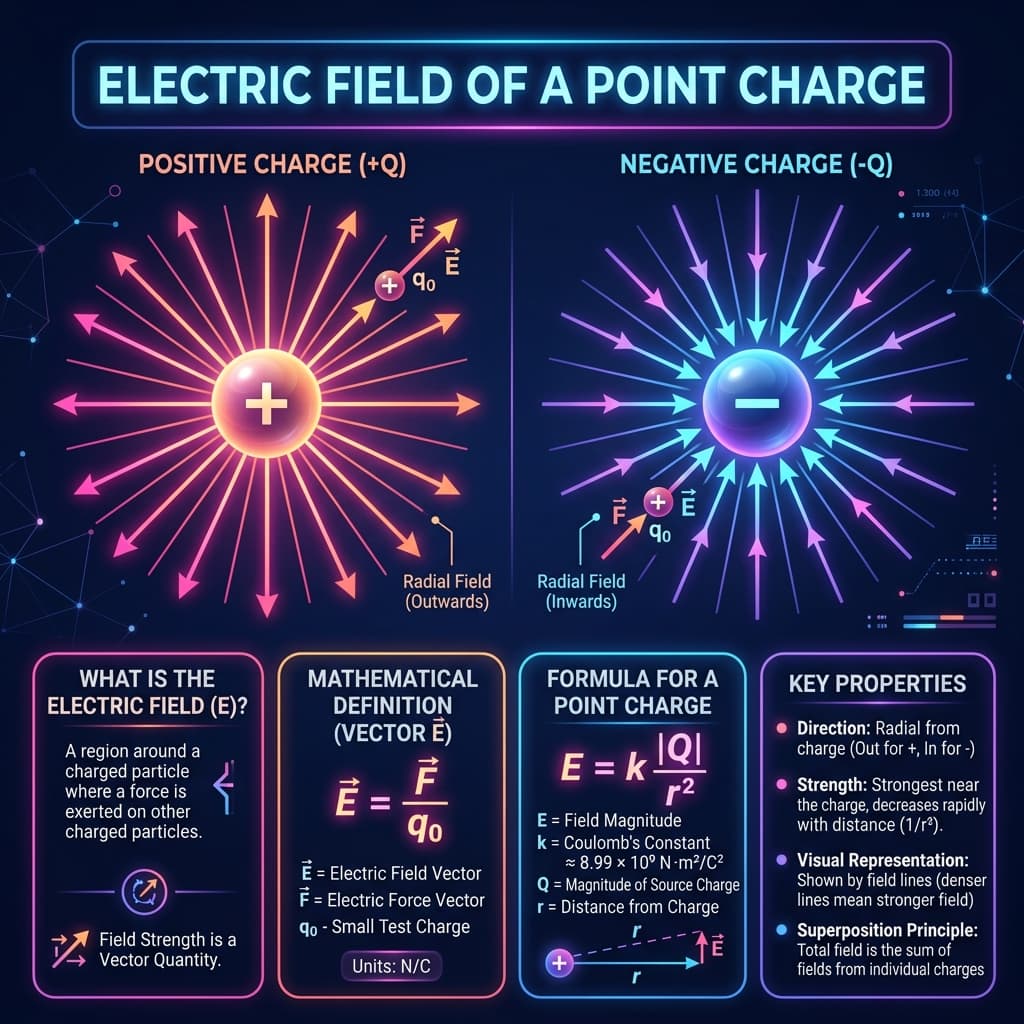
An electric field is a vector field surrounding an electric charge that describes the force a positive test charge would experience at each point in space. It is a fundamental concept in electrostatics and electromagnetism.
The strength of the electric field at a point tells you how strong the electrostatic force would be on a unit positive charge placed there. Stronger fields mean stronger forces.
Electric Field Lines Diagram
Electric field lines visualise the direction and relative strength of the field around point charges. Lines point away from positive charges and toward negative charges. Denser lines indicate a stronger field.
Electric Field Formulas
Field from force and test charge. The defining relationship.
Field from a point source charge at distance r.
Force on a charge in an electric field.
Distance at which a given field strength occurs.
How to Use the Electric Field Calculator
- 1Select what to calculate from the dropdown.
- 2Enter the known values.
- 3Choose units.
- 4Click Calculate.
- 5Review the result and direction note.
Example Calculations
Field from force and charge
F = 0.5 N on a 2 μC test charge. E = 0.5 / 2×10−&sup6; = 250,000 N/C = 250 kV/m.
Field from point charge
Q = +1 μC at r = 0.5 m. E = 8.99×10&sup9; × 10−&sup6; / 0.25 = 35,960 N/C. Field points away from Q.
Electric Field Direction
The electric field points away from positive source charges and toward negative source charges. A positive test charge placed in the field accelerates in the field direction; a negative test charge accelerates opposite to it.
The calculator shows the direction note alongside the magnitude.
Electric Field vs Electric Force
The electric field is a property of space created by a source charge. The force is what happens when a second charge is placed in that field. The relationship is F = qE. The field exists regardless of whether a test charge is present.
Where This Calculator Is Useful
Electric field calculations are used in physics education, electrostatics problems, capacitor design, understanding charge distributions, electronics, and fields-based engineering analysis.
Dielectric Breakdown Field Strengths
| Medium | Breakdown E (V/m) |
|---|---|
| Air (1 atm, dry) | ∼3 × 10&sup6; |
| SF₆ gas | ∼8.9 × 10&sup6; |
| Transformer oil | ∼1.2 × 10&sup7; |
| Glass (Pyrex) | ∼1.4 × 10&sup7; |
| Mica | ∼1 × 10&sup8; |
| Vacuum (ideal) | ∞ (no breakdown) |
Breakdown field is the minimum E-field at which a material becomes conducting. Values are approximate and depend on conditions.
Common Mistakes
- • Confusing electric field (E, a vector per unit charge) with electric force (F = qE, force on a specific charge).
- • Forgetting that E = k|Q|/r² gives magnitude only — direction depends on the sign of Q.
- • Adding electric fields as scalars instead of as vectors when multiple charges are present.
- • Using the wrong sign convention for the test charge: E is defined for a positive test charge.
- • Ignoring relative permittivity when the charges are in a dielectric medium (water, glass, etc.).
- • Applying the point-charge formula inside a conductor — the field inside a conductor in equilibrium is zero.
Accuracy and Limitations
This calculator uses classical electrostatics formulas for point charges.
Limitations: applies to point charges only, no dynamic or magnetic effects, no quantum corrections at atomic scales, and no vector addition for multiple charges.
Frequently Asked Questions
What is an electric field?›
An electric field is a region around a charged object where other charges experience a force. It is defined as the force per unit positive test charge: E = F/q.
What are the units of electric field?›
N/C (newtons per coulomb) or equivalently V/m (volts per metre). Both describe the same quantity.
What is the formula for electric field?›
For force-based: E = F/q. For a point charge source: E = k|Q|/r².
Which direction does the electric field point?›
Away from positive charges, toward negative charges. A positive test charge accelerates in the direction of the field.
How is electric field related to Coulomb’s Law?›
Coulomb’s Law gives the force between two charges. The electric field E = k|Q|/r² is the force per unit charge that Q creates, regardless of the test charge.
What is the difference between electric field and electric force?›
The electric field exists at every point in space around a charge. The force is what a specific charge experiences when placed in that field: F = qE.
Does permittivity affect the field?›
Yes. In a dielectric medium with relative permittivity εᵣ, the field is reduced by a factor of εᵣ.
Can the electric field be zero between two charges?›
Yes. For two like charges, there is a point between them where the fields cancel. For opposite charges, the cancellation point is outside the pair.
Does this calculator handle multiple charges?›
Not directly. For multiple source charges, calculate each field separately and add them as vectors.
Is this calculator useful for capacitors?›
Yes. The E = V/d mode calculates the uniform field inside a parallel-plate capacitor from the voltage and plate separation.
What is the electric field inside a conductor?›
In electrostatic equilibrium, the electric field inside a conductor is zero. Any excess charge resides on the surface.
How do I find the field from multiple charges?›
Calculate the field from each charge separately, then add them as vectors. This calculator handles one source charge at a time.
What is dielectric breakdown?›
When the electric field exceeds a material’s breakdown strength (about 3 MV/m for air), the material becomes conducting. This is the physics behind sparks and lightning.
What is the dielectric breakdown strength of air?›
Dry air breaks down at approximately 3 MV/m (30 kV/cm). This means a 1 mm gap can withstand about 3 kV before arcing occurs. Humidity, pressure, and electrode geometry all affect the actual breakdown voltage.
How is the electric field used in coaxial cable design?›
In a coaxial cable, the electric field between the inner and outer conductors is E = V/(r·ln(b/a)), where r is the radial distance, a is the inner radius, and b is the outer radius. Engineers use this to ensure the field stays below the dielectric breakdown limit of the insulator.
Sources / References

Author & technical reviewer
Manish Kumar
PhysicsCalcs tools are reviewed with an educational focus: clear formulas, transparent assumptions, and practical context for students and science learners.
Learn more about Manish