
What Is Capacitance?
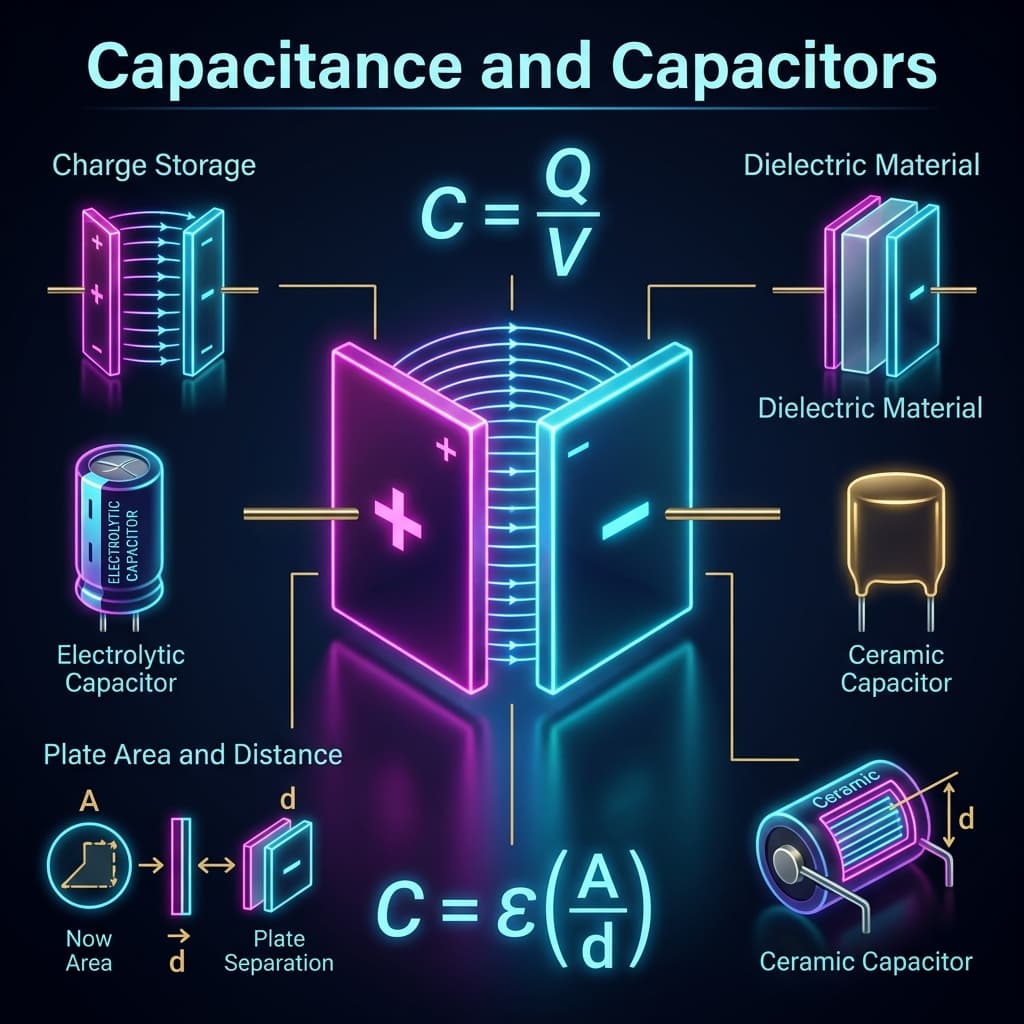
Capacitance is the ability of a device to store electric charge. A capacitor consists of two conducting surfaces separated by an insulating material (dielectric). When voltage is applied, charge accumulates on the plates, creating an electric field.
Capacitance is measured in farads (F). One farad means one coulomb of charge is stored per volt. Since a farad is very large, most practical capacitors are rated in picofarads (pF), nanofarads (nF), or microfarads (μF).
Capacitance Formulas
Basic capacitance from charge and voltage.
Energy stored in a capacitor.
Parallel-plate capacitance.
How to Use the Capacitance Calculator
- 1Choose what to calculate: C, Q, V, Energy, or Parallel-plate.
- 2Enter the required values with appropriate units.
- 3Click Calculate.
- 4Review the formula, substitution, and explanation.
Capacitor Diagram
A capacitor stores charge on two conducting plates separated by a dielectric. When voltage is applied, positive charge accumulates on one plate and negative charge on the other, creating an electric field between them.
Energy Stored in a Capacitor
Three equivalent forms for capacitor energy. All yield the same result.
Energy increases with the square of voltage. Doubling the voltage quadruples the stored energy. This is why capacitors can deliver sudden bursts of power.
Parallel Plate Capacitance
The simplest capacitor model: two parallel conducting plates of area A separated by distance d. The dielectric between them has relative permittivity εr.
Capacitance increases with area and permittivity, decreases with separation.
Dielectric Materials
| Material | εr | Notes |
|---|---|---|
| Vacuum | 1.0000 | Reference value |
| Air | 1.0006 | Practically same as vacuum |
| Paper | 2.5–3.5 | Used in early capacitors |
| Glass | 4–7 | Good insulator |
| Mica | 5–7 | Precision capacitors |
| PTFE (Teflon) | 2.1 | Low loss, stable |
| Ceramic (high-K) | 200–14000 | Very high C in small size, less stable |
Example Calculations
Basic C = Q/V
Q = 5 μC, V = 10 V. C = 5×10⁻⁶ / 10 = 0.5 μF.
Energy stored
C = 100 μF, V = 12 V. E = 0.5 × 100×10−6 × 144 = 7.2 mJ.
Parallel plate
A = 10 cm², d = 1 mm, εr = 1 (vacuum). C = 1 × 8.854×10−12 × 10×10−4 / 10−3 ≈ 8.85 pF.
Types of Capacitors
Common types include ceramic (small, cheap), electrolytic (high capacitance, polarized), film (stable, accurate), tantalum (compact, polarized), mica (precision), and supercapacitors (very high capacitance, low voltage).
Capacitor vs Inductor
| Feature | Capacitor | Inductor |
|---|---|---|
| Stores | Electric field energy | Magnetic field energy |
| Formula | C = Q/V | L = Φ/I |
| Unit | Farad (F) | Henry (H) |
Capacitance Units
1 F = 10³ mF = 10&sup6; μF = 10&sup9; nF = 10¹² pF. Most electronics use pF to μF. Supercapacitors reach farads or even kilofarads.
Where Capacitance Calculations Are Used
Capacitance calculations are used in filter design, energy storage, timing circuits, sensor interfaces, power supply smoothing, decoupling, physics education, and electronics engineering.
Accuracy and Limitations
This calculator uses ideal capacitor formulas. Real capacitors have tolerance, voltage-dependent capacitance (ceramic), equivalent series resistance (ESR), leakage current, and temperature effects. The parallel-plate formula assumes uniform field and infinite plates. This tool is for educational and basic circuit analysis.
Capacitor Types Comparison
Different capacitor technologies suit different applications. Choose based on required capacitance range, voltage, frequency, stability, and cost.
| Type | Range | Max V | Polarised | Typical Use |
|---|---|---|---|---|
| Ceramic (MLCC) | 1 pF–100 μF | 6.3–250 V | No | Decoupling, filtering, RF |
| Aluminium electrolytic | 0.1–100,000 μF | 6.3–500 V | Yes | Power supply filtering |
| Tantalum | 0.1–1500 μF | 4–50 V | Yes | Compact, stable bypass |
| Film (polyester) | 1 nF–100 μF | 50–2000 V | No | Audio, timing, coupling |
| Film (polypropylene) | 100 pF–10 μF | 63–2000 V | No | Snubber, resonant circuits |
| Supercapacitor (EDLC) | 0.1–3000 F | 2.5–2.7 V | Yes | Energy storage, backup power |
Common Mistakes
- • Confusing capacitance with charge — capacitance is the ratio C = Q/V, not the charge itself. A larger capacitor stores more charge at the same voltage.
- • Exceeding voltage rating — applying voltage above the rated maximum can permanently damage the capacitor or cause it to explode (especially electrolytics).
- • Ignoring polarity on electrolytic capacitors — reversing polarity causes gas generation and potential failure. Ceramic and film capacitors are non-polarised.
- • Using the parallel-plate formula for real capacitors — the ideal formula ignores fringing fields, lead inductance, ESR, and dielectric losses present in real components.
- • Mixing up nF and μF — 1 μF = 1000 nF. A factor-of-1000 error can cause circuits to malfunction.
Frequently Asked Questions
What is capacitance?›
Capacitance is the ability of a component to store electric charge. It’s defined as C = Q/V, the ratio of charge stored to voltage applied.
What is the unit of capacitance?›
The farad (F). Practical values range from picofarads (pF) to millifarads (mF). One farad stores one coulomb per volt.
How do you calculate capacitance?›
Use C = Q/V if charge and voltage are known, or C = εᵣε₀A/d for a parallel-plate capacitor.
What is a parallel-plate capacitor?›
Two flat conducting plates separated by a dielectric. Capacitance depends on plate area, separation, and the dielectric’s permittivity.
How does a dielectric increase capacitance?›
The dielectric reduces the electric field between plates for the same charge, allowing more charge at the same voltage, thus increasing capacitance by factor εᵣ.
What is ε₀?›
ε₀ (epsilon naught) is the permittivity of free space: 8.854 × 10⁻¹² F/m. It defines how much electric field a vacuum permits.
How much energy does a capacitor store?›
E = ½CV². Energy increases with the square of voltage, so doubling voltage quadruples energy.
Can capacitors replace batteries?›
Supercapacitors can store enough energy for short bursts, but they have lower energy density than batteries. They excel at delivering quick power pulses.
Why are large capacitance values rare?›
Achieving large capacitance requires large plate area, small separation, or high-permittivity dielectrics, all of which are physically or practically limited.
What happens if capacitor voltage is exceeded?›
Exceeding the rated voltage can cause dielectric breakdown, permanent damage, leakage, or catastrophic failure. Always observe voltage ratings.
What is the time constant of an RC circuit?›
The time constant τ = R×C. After one time constant, a charging capacitor reaches about 63.2% of the supply voltage. After 5τ, it is considered fully charged (>99%).
Why do engineers place capacitors in parallel with power supply rails?›
Decoupling capacitors absorb transient current demands from ICs, reducing voltage noise on the power rail. Typical values are 100 nF ceramic close to each IC plus bulk electrolytics (10–100 µF) at the supply entry.
Sources / References

Author & technical reviewer
Manish Kumar
PhysicsCalcs tools are reviewed with an educational focus: clear formulas, transparent assumptions, and practical context for students and science learners.
Learn more about Manish