
What Is This Calculator?
This calculator finds the total (equivalent) capacitance of capacitors connected in series or parallel. It also breaks down charge, voltage, and energy for each capacitor when an applied voltage is provided.
Parallel Capacitance Formula
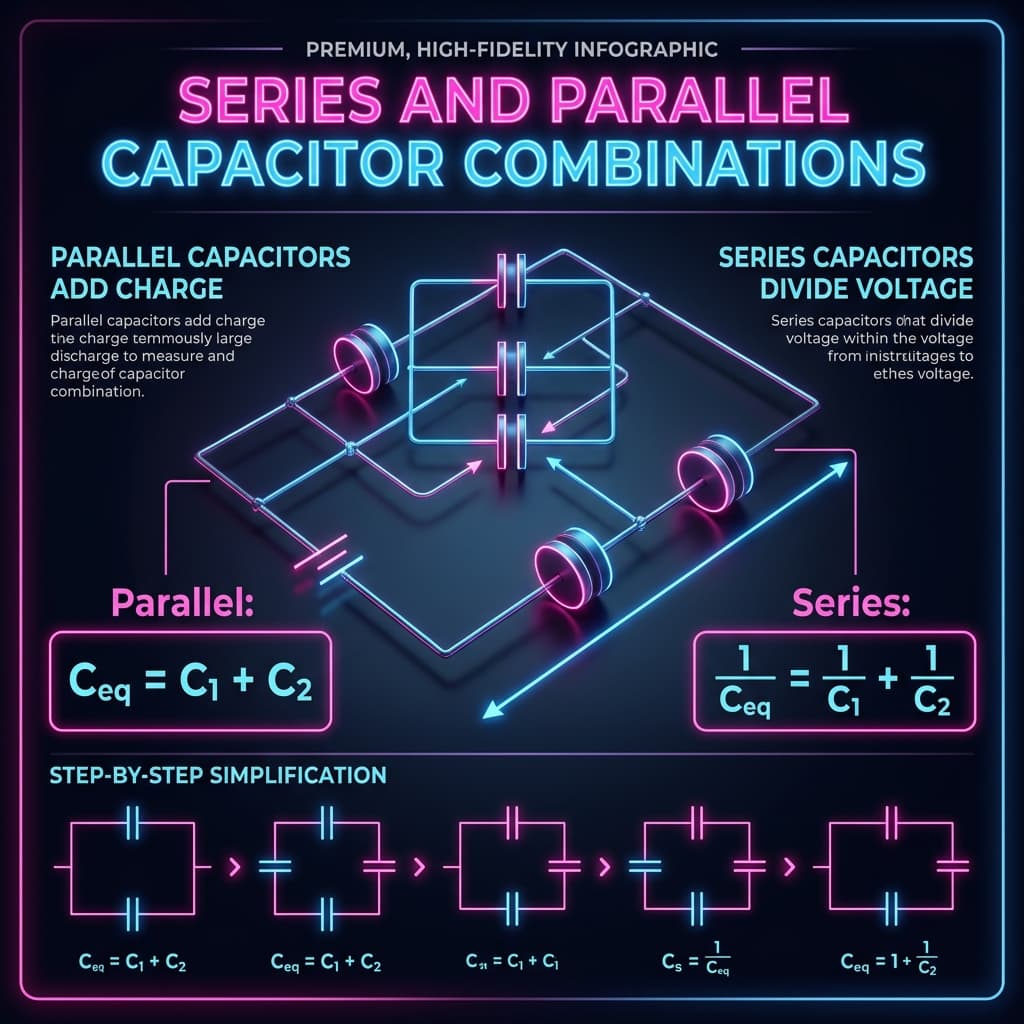
In parallel, capacitances add directly. All capacitors share the same voltage.
Series Capacitance Formula
In series, the reciprocals add. All capacitors share the same charge.
For two capacitors: Ceq = (C1 × C2)/(C1 + C2).
How to Use the Calculator
- 1Choose Series or Parallel.
- 2Enter at least two capacitor values.
- 3Select units for each capacitor.
- 4Optionally enter an applied voltage for charge/energy details.
- 5Click Calculate.
- 6Review the equivalent capacitance and breakdown table.
Example Calculations
Two capacitors in parallel
C1 = 10 μF, C2 = 22 μF. Ceq = 10 + 22 = 32 μF.
Two capacitors in series
C1 = 10 μF, C2 = 22 μF. Ceq = (10×22)/(10+22) = 220/32 = 6.875 μF.
Series with voltage
C1 = 100 μF, C2 = 100 μF, V = 12 V. Ceq = 50 μF, Q = 50×12 = 600 μC. Each capacitor: V1 = V2 = 6 V.
Capacitor Network Diagrams
Understanding the physical arrangement helps avoid confusion between series and parallel connections.
Parallel
Series
Series vs Parallel Capacitor Comparison
| Feature | Series | Parallel |
|---|---|---|
| Capacitance formula | Reciprocals add | Add directly |
| Charge | Same on all | Splits by capacitance |
| Voltage | Divides inversely to C | Same across all |
| Effect of adding more | Decreases C | Increases C |
| Common purpose | Higher voltage rating | More total capacitance |
Charge and Voltage Distribution
In series, all capacitors carry the same charge Q = Ceq × Vtotal. Voltage across each is Vn = Q/Cn. Smaller capacitors have larger voltage across them.
In parallel, all capacitors see the same voltage. Charge on each is Qn = Cn × V. Larger capacitors store more charge.
Capacitors vs Resistors in Combinations
Capacitor rules are the reverse of resistor rules. Parallel capacitors add directly (like series resistors). Series capacitors use the reciprocal formula (like parallel resistors). This duality often confuses students but becomes intuitive with practice.
Energy in Combined Capacitors
Total energy stored is E = ½CeqV². Individual capacitor energies can also be computed: En = ½CnVn² = ½Q²/Cn. The sum of individual energies equals the total.
Common Mistakes
- • Using series resistor rules for capacitors — capacitors are the opposite of resistors: series capacitance decreases (reciprocal sum), parallel capacitance increases (direct sum).
- • Ignoring voltage across series capacitors — in a series string, the smallest capacitor gets the highest voltage. Always check that individual voltage ratings are not exceeded.
- • Assuming equal voltage sharing in series — voltage divides inversely with capacitance. Unequal capacitors share voltage unequally.
- • Mixing capacitor types with different ESR — in parallel, low-ESR ceramic and high-ESR electrolytic caps handle different frequency ranges. This is intentional in power supply design but can cause issues if not understood.
- • Forgetting leakage current in series strings — different leakage currents cause the voltage to redistribute unevenly over time. Balancing resistors are often needed.
Where These Calculations Are Used
Series and parallel capacitor calculations are essential in filter design, power supply smoothing, timing circuits, energy storage systems, physics education, electronics prototyping, and voltage balancing.
Accuracy and Limitations
This calculator assumes ideal capacitors. Real capacitors have tolerance (typically 10–20%), ESR, leakage, and voltage-dependent capacitance. Series capacitors may need balancing resistors. This tool is for educational and basic circuit analysis.
Frequently Asked Questions
How do capacitors combine in parallel?›
Capacitances add directly: Ceq = C1 + C2 + C3 + … All parallel capacitors share the same voltage.
How do capacitors combine in series?›
Reciprocals add: 1/Ceq = 1/C1 + 1/C2 + … All series capacitors have the same charge.
Why is series capacitance less than the smallest?›
Series reduces effective plate area while increasing effective separation, lowering total capacitance.
Why is parallel capacitance greater than the largest?›
Parallel effectively increases plate area, storing more charge at the same voltage.
Do series capacitors share the same voltage?›
No. They share the same charge. Voltage divides inversely proportional to capacitance.
Do parallel capacitors share the same charge?›
Not necessarily. They share the same voltage. Charge on each capacitor equals C × V.
Can I mix pF, nF, and μF?›
Yes. The calculator converts all values to farads internally before calculating.
How is this different from resistor combinations?›
Capacitor combination rules are the inverse of resistor rules. Parallel capacitors add directly (like series resistors), and series capacitors use the reciprocal formula (like parallel resistors).
What is the two-capacitor series shortcut?›
For two capacitors in series: Ceq = (C1 × C2)/(C1 + C2). Same form as two parallel resistors.
Why would you connect capacitors in series?›
To increase voltage rating. Each capacitor shares a fraction of the total voltage. The trade-off is reduced total capacitance.
Do I need balancing resistors for series capacitors?›
In practice, yes. Electrolytic capacitors have different leakage currents, causing uneven DC voltage distribution. Balancing resistors (same value across each cap) ensure equal voltage sharing.
Can I combine series and parallel capacitor networks?›
Yes. Solve each sub-network step by step: first reduce series groups to their equivalent, then combine parallel groups, and repeat until you have a single equivalent capacitance.
How do I choose between series and parallel for a capacitor bank?›
Use parallel to increase total capacitance (e.g., power supply filtering). Use series to increase the combined voltage rating, accepting reduced capacitance. In high-voltage applications, series strings with balancing resistors are common.
Do I need balancing resistors for series electrolytic capacitors in a power supply?›
Yes. Electrolytic capacitors have unequal leakage currents that cause uneven DC voltage sharing over time. Place identical high-value resistors (e.g., 100–470 kΩ) across each capacitor so steady-state voltage divides equally.
Sources / References

Author & technical reviewer
Manish Kumar
PhysicsCalcs tools are reviewed with an educational focus: clear formulas, transparent assumptions, and practical context for students and science learners.
Learn more about Manish