
What Is a Capacitor Charge and Time Constant Calculator?
This calculator determines how a capacitor’s voltage, charge, and current change over time in an RC (resistor-capacitor) circuit. It covers charging, discharging, and the time needed to reach any target voltage.
It is useful for timing circuits, RC filters, physics homework, electronics labs, and understanding capacitor behavior in DC circuits.
How is this different from the RC Time Constant Calculator? This tool gives detailed transient analysis — voltage, charge, current, energy at any time t. For quick τ calculation, cutoff frequency, and component selection, use the RC Time Constant Calculator.
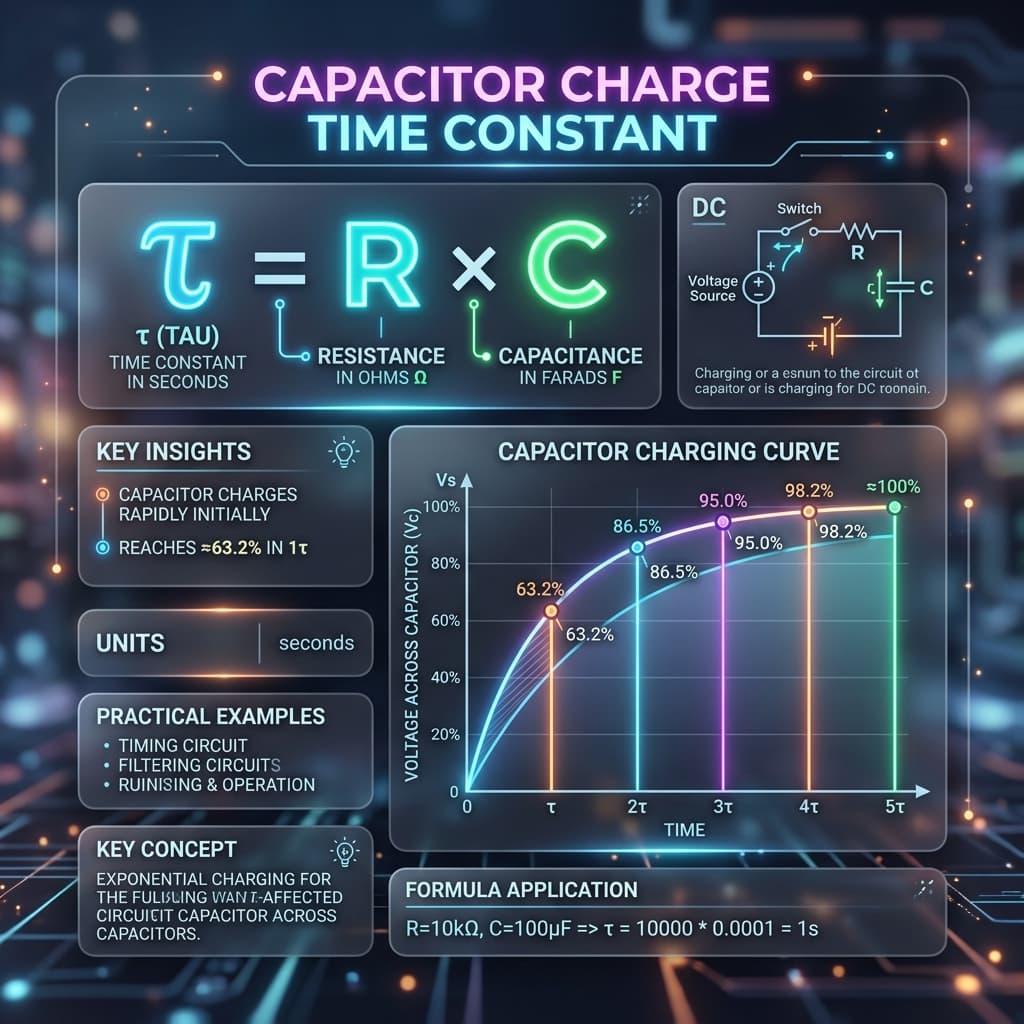
RC Time Constant Formula
The time constant equals resistance multiplied by capacitance. Larger R or C means slower charging.
τ has units of seconds when R is in ohms and C is in farads. It sets the time scale for all exponential charging and discharging behavior in the circuit.
Capacitor Charging Formulas
Voltage rises toward supply.
Charge accumulates on plates.
Current decreases over time.
Voltage rises quickly at first, then slows as it approaches the supply voltage. Current is highest at t = 0 and falls exponentially.
Capacitor Discharging Formulas
Voltage decays exponentially.
Charge decreases over time.
Discharge current magnitude.
During discharge, voltage falls exponentially. After 5τ, very little charge remains in the ideal model.
Time to Reach a Target Voltage
Charging: time to reach V_target.
Discharging: time to fall to V_target.
The target must be physically possible. Reaching exactly 100% charge takes infinite time in the ideal equation, so 5τ is the practical approximation for “nearly complete.”
Time Constant Table: 1τ to 5τ
| Time | Charging % | Discharging % Remaining |
|---|---|---|
| 1τ | 63.2% | 36.8% |
| 2τ | 86.5% | 13.5% |
| 3τ | 95.0% | 5.0% |
| 4τ | 98.2% | 1.8% |
| 5τ | 99.3% | 0.7% |
How to Use the Calculator
- 1Choose a calculation mode.
- 2Enter resistance and capacitance.
- 3Enter voltage and time where required.
- 4Select appropriate units.
- 5Click Calculate.
- 6Review voltage, charge, current, energy, and percent progress.
Example Calculations
RC Time Constant
R = 10 kΩ, C = 100 μF. τ = 10,000 × 0.0001 = 1 s. After 5τ = 5 s, the capacitor is about 99.3% charged.
Charging Voltage at 1 s
Vs = 5 V, τ = 1 s, t = 1 s. Vc = 5(1 − e−1) ≈ 3.16 V (63.2%).
Discharging Voltage
V0 = 12 V, τ = 2 s, t = 4 s. Vc = 12 × e−2 ≈ 1.62 V (13.5% remaining).
Time to 90% Charge
t = −RC × ln(1 − 0.9) = −τ × ln(0.1) ≈ 2.303τ.
Common Mistakes
- Thinking a capacitor reaches exactly 100% after 5τ.
- Confusing milliseconds and seconds.
- Mixing μF and nF without converting.
- Forgetting that resistance affects timing.
- Ignoring capacitor leakage and tolerance in real circuits.
- Assuming ideal behavior applies to all real components.
- Touching charged capacitors without discharging safely.
Where RC Time Constant Calculations Are Used
RC timing is used in timing circuits, RC filters, power supply smoothing, delay circuits, sensor circuits, capacitor discharge timing, microcontroller reset circuits, electronics labs, and physics homework.
Accuracy and Limitations
This calculator assumes an ideal RC circuit. Real capacitors have tolerance, leakage, ESR, and dielectric absorption. Real resistors have tolerance and temperature effects. Supply voltage and switch behavior may affect results. High-voltage capacitors can remain dangerous after power is removed. This tool is educational and should not replace professional electrical design or safety checks.
Frequently Asked Questions
What does a capacitor charge and time constant calculator do?›
It calculates how a capacitor’s voltage, charge, and current change over time in an RC circuit, including the time constant, charging/discharging voltages, and time to reach a target voltage.
What is the RC time constant?›
The RC time constant τ = R × C is the time it takes a charging capacitor to reach about 63.2% of the supply voltage, or a discharging capacitor to fall to about 36.8%.
What does τ = RC mean?›
It means the time constant equals resistance multiplied by capacitance. Larger R or C means a slower circuit response.
How long does it take a capacitor to charge?›
A capacitor is considered nearly fully charged after 5τ (about 99.3%). Theoretically, it never reaches exactly 100% in finite time.
Why is 5τ considered nearly fully charged?›
After 5 time constants, only 0.67% remains to be charged. For most practical purposes this is close enough to full charge.
Does a capacitor ever reach exactly 100% charge?›
In the ideal exponential model, no. The voltage approaches the supply asymptotically and never reaches it exactly in finite time.
How do you calculate capacitor discharge time?›
Use t = −RC × ln(V_target / V_0). The target voltage must be between 0 and the initial voltage.
What is the formula for capacitor charging voltage?›
V_c(t) = V_s(1 − e^(−t/RC)), where V_s is supply voltage and t is time.
How does resistance affect charging time?›
Higher resistance slows charging because it limits the current that can flow into the capacitor.
How does capacitance affect charging time?›
Higher capacitance slows charging because more charge must be stored to reach the same voltage.
What happens to current during charging?›
Current is highest at the start and decreases exponentially as the capacitor charges.
Can a charged capacitor be dangerous?›
Yes. Charged capacitors can retain dangerous energy, especially at high voltage. Always follow proper discharge and safety procedures.
How do I design a simple RC delay circuit?›
Choose the target delay time, then pick R and C so that τ = RC gives the desired timing. For example, a 1-second delay needs τ = 1 s, achievable with R = 10 kΩ and C = 100 µF. The trigger threshold determines the exact delay (e.g., 1τ for 63.2%, 2.3τ for 90%).
Why does my real RC circuit charge faster or slower than calculated?›
Common causes include capacitor tolerance (±10–20%), ESR reducing effective charging resistance, source impedance adding to R, leakage current in electrolytic capacitors, and stray capacitance on the PCB. Temperature also affects both resistance and capacitance values.
Sources / References

Author & technical reviewer
Manish Kumar
PhysicsCalcs tools are reviewed with an educational focus: clear formulas, transparent assumptions, and practical context for students and science learners.
Learn more about Manish