
What Is a Capacitor Energy Calculator?
This calculator computes the energy stored in a capacitor and can also solve for capacitance, voltage, or charge. It is useful for physics homework, electronics design basics, RC circuits, energy storage, and capacitor safety awareness.
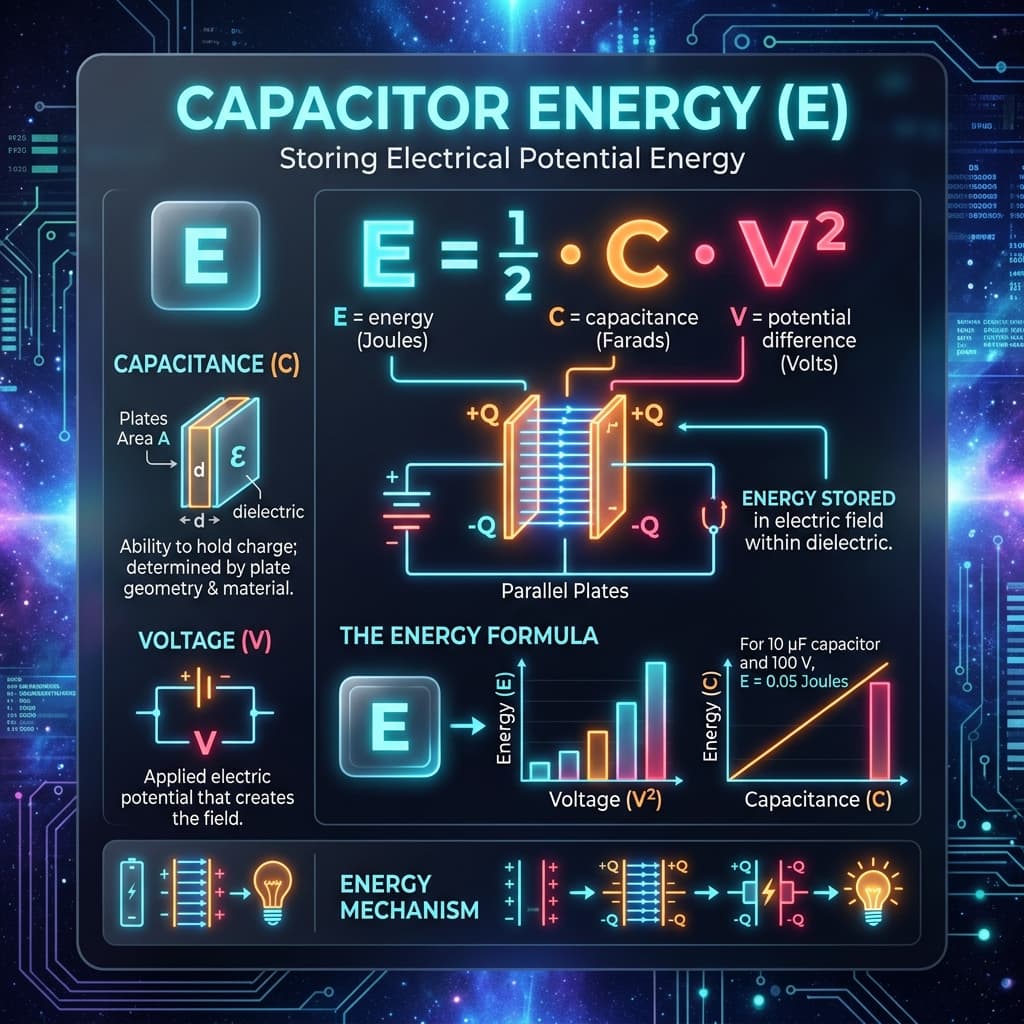
Capacitor Energy Formulas
From capacitance and voltage.
From charge and voltage.
From charge and capacitance.
Why Energy Depends on Voltage Squared
In E = ½CV², voltage is squared. Doubling voltage quadruples stored energy, and tripling voltage gives nine times the energy.
| Voltage Change | Energy Change |
|---|---|
| V | 1× |
| 2V | 4× |
| 3V | 9× |
Charge, Voltage, and Capacitance Relationship
Charge stored depends on capacitance and voltage.
Larger capacitance stores more charge at the same voltage. Higher voltage stores more charge for the same capacitance.
How to Use the Capacitor Energy Calculator
- 1Choose what you want to calculate.
- 2Enter the known values.
- 3Select units.
- 4Click Calculate.
- 5Review energy, formula, converted units, and related values.
Example Calculations
E from C & V
C = 100 μF, V = 12 V. E = ½ × 100×10−6 × 144 = 7.2 mJ.
E from Q & V
Q = 2 mC, V = 10 V. E = ½ × 0.002 × 10 = 10 mJ.
V from E & C
E = 1 J, C = 1000 μF. V = √(2/0.001) ≈ 44.7 V.
Large capacitor
C = 1000 μF, V = 50 V. E = ½ × 0.001 × 2500 = 1.25 J.
Capacitor Energy vs Capacitor Charge
| Concept | Formula | Unit | Meaning |
|---|---|---|---|
| Energy | ½CV² | Joule | Work the capacitor can deliver |
| Charge | CV | Coulomb | Electric charge stored |
| Voltage | Q/C | Volt | Potential difference |
| Capacitance | Q/V | Farad | Charge storage ability |
Where Capacitor Energy Calculations Are Used
Capacitor energy calculations apply to physics homework, RC circuits, power supply smoothing, camera flash circuits, pulsed circuits, energy storage, capacitor banks, filters, electronics labs, and safety checks.
Common Mistakes
- Forgetting the ½ factor.
- Mixing μF and F.
- Using voltage instead of voltage squared.
- Ignoring capacitor voltage rating.
- Confusing energy with power.
- Assuming a discharged capacitor has no risk without checking.
Accuracy and Limitations
This calculator assumes ideal capacitors. Real capacitors have tolerance, leakage, ESR, dielectric absorption, and voltage ratings. Energy calculations do not guarantee safe handling. High-voltage capacitors can remain charged after power is removed. This tool is educational and should not replace professional electrical design or safety checks.
Frequently Asked Questions
What does a capacitor energy calculator do?›
It calculates the energy stored in a capacitor and can solve for capacitance, voltage, or charge when energy is known.
What is the formula for energy stored in a capacitor?›
E = ½CV². Alternative forms are E = ½QV and E = Q²/(2C).
Why is there a ½ in the capacitor energy formula?›
Because energy is the integral of voltage times charge. As the capacitor charges, voltage rises linearly, so the average is half the final voltage.
Why does capacitor energy depend on voltage squared?›
Doubling voltage stores four times the energy because both charge and voltage double simultaneously.
How do you calculate charge on a capacitor?›
Q = CV. Charge equals capacitance times voltage.
What is the unit of capacitor energy?›
Joules (J). Small capacitor energies are often in millijoules (mJ) or microjoules (μJ).
Is capacitor energy the same as power?›
No. Energy is stored work (joules), while power is the rate of energy transfer (watts).
Can a small capacitor be dangerous?›
At high voltage, even small-capacitance capacitors can store harmful energy and deliver painful or dangerous shocks.
How do I calculate voltage from energy and capacitance?›
V = √(2E/C). Take the square root of twice the energy divided by capacitance.
Does capacitor tolerance affect stored energy?›
Yes. A 10% capacitance tolerance can shift actual stored energy by about 10% from the calculated value.
Sources / References

Author & technical reviewer
Manish Kumar
PhysicsCalcs tools are reviewed with an educational focus: clear formulas, transparent assumptions, and practical context for students and science learners.
Learn more about Manish