
What Is an RC Time Constant Calculator?
This calculator determines the time constant of an RC circuit, the cutoff frequency, and individual component values. It includes a 1τ–5τ reference table and optional voltage-at-time mode.
How is this different from the Capacitor Charge & Time Constant Calculator? This tool focuses on finding τ, cutoff frequency, and component selection. For detailed voltage, charge, current, and energy at any time t during charging or discharging, use the Capacitor Charge & Time Constant Calculator.
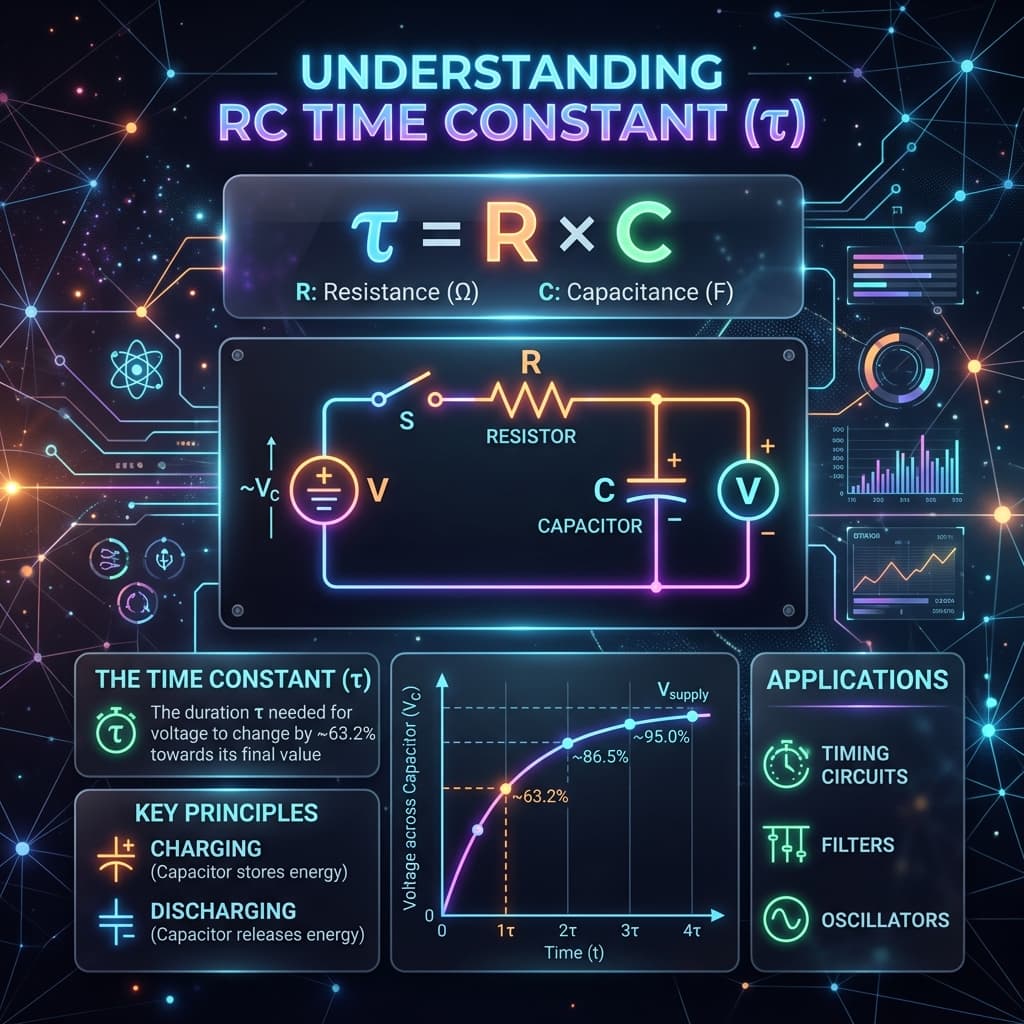
RC Time Constant Formula
Time constant in seconds, resistance in ohms, capacitance in farads.
Cutoff Frequency
At the cutoff frequency, a first-order RC filter output is −3 dB (~70.7%) of input.
1τ to 5τ Reference Table
| Time | Charging % | Discharging % |
|---|---|---|
| 1τ | 63.2% | 36.8% |
| 2τ | 86.5% | 13.5% |
| 3τ | 95.0% | 5.0% |
| 4τ | 98.2% | 1.8% |
| 5τ | 99.3% | 0.7% |
How to Use
- 1Choose what to calculate.
- 2Enter R and C, or τ and one component.
- 3Select units.
- 4Click Calculate.
- 5Review τ, cutoff frequency, and τ table with actual times.
Examples
τ from R & C
R = 10 kΩ, C = 100 μF. τ = 10,000 × 0.0001 = 1 s. f_c = 1/(2π) ≈ 0.159 Hz.
R from τ & C
τ = 1 ms, C = 100 nF. R = 0.001 / 10−7 = 10 kΩ.
Cutoff frequency
R = 1 kΩ, C = 1 μF. f_c = 1/(2π × 1000 × 10−6) ≈ 159.15 Hz.
RC vs RL Time Constants
| Circuit | Formula | Energy Storage |
|---|---|---|
| RC | τ = RC | Electric field (capacitor) |
| RL | τ = L/R | Magnetic field (inductor) |
Applications
RC filters, timing circuits, signal smoothing, debouncing, coupling and decoupling capacitors, phase-shift oscillators, and physics homework.
Common Mistakes
- Mixing kΩ and Ω.
- Confusing μF and nF.
- Forgetting 5τ is not exactly 100%.
- Mixing up RC and RL formulas.
- Ignoring component tolerance.
Accuracy and Limitations
This calculator assumes ideal resistors and capacitors. Real components have tolerances, ESR, leakage, and temperature dependence. This tool is educational and should not replace professional circuit design.
Frequently Asked Questions
What does an RC time constant calculator do?›
It calculates the RC time constant, cutoff frequency, and related values for a resistor-capacitor circuit.
What is the RC time constant formula?›
τ = R × C, where R is in ohms and C is in farads.
What is the unit of the RC time constant?›
Seconds (s). Common values are in μs, ms, or s.
What is the cutoff frequency of an RC filter?›
f_c = 1/(2πRC). At this frequency, the output is −3 dB (≈70.7%) of the input.
How long does it take to charge an RC circuit?›
Approximately 5τ to reach ~99.3% of the supply voltage.
What does a larger R or C do to the time constant?›
It increases τ, making the circuit respond more slowly.
Can I find R or C from a known τ?›
Yes. R = τ/C or C = τ/R.
Is this the same as the capacitor charge calculator?›
The capacitor charge calculator focuses on voltage/charge at time t. This calculator focuses on the time constant value, cutoff frequency, and component selection.
What is the relationship between τ and cutoff frequency?›
τ = 1/(2πf_c). They are inversely related.
Does the RC time constant apply to AC circuits?›
Yes. The cutoff frequency determines the filter’s −3 dB point.
Is the RC time constant exact for real components?›
Component tolerances and parasitic effects cause real behavior to differ from ideal calculations.
What practical circuits use the RC time constant?›
RC filters, timing circuits, signal smoothing, debouncing, coupling, and decoupling.
Sources / References

Author & technical reviewer
Manish Kumar
PhysicsCalcs tools are reviewed with an educational focus: clear formulas, transparent assumptions, and practical context for students and science learners.
Learn more about Manish