
What Is a Capacitive Reactance Calculator?
This calculator determines how strongly a capacitor opposes alternating current. It can solve for reactance, capacitance, frequency, current, or voltage, and is useful for AC circuits, filters, audio circuits, and physics homework.
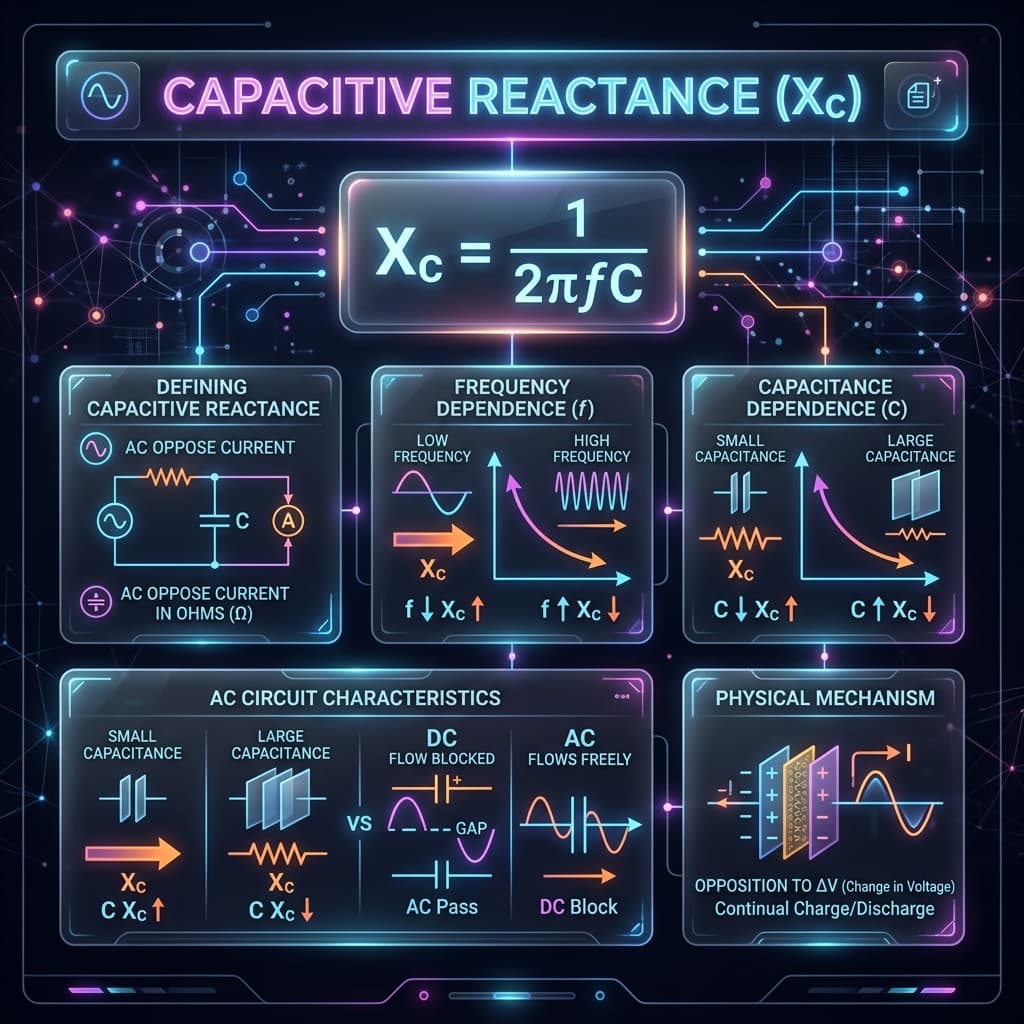
Capacitive Reactance Formula
Reactance in ohms, frequency in Hz, capacitance in farads.
Unlike resistance, reactance changes with signal frequency. It is measured in ohms but represents frequency-dependent opposition.
How Frequency and Capacitance Affect Xc
| Change | Effect on Xc |
|---|---|
| Frequency increases | Xc decreases |
| Frequency decreases | Xc increases |
| Capacitance increases | Xc decreases |
| Capacitance decreases | Xc increases |
Capacitive Reactance and AC Current
Use RMS voltage and current for standard AC calculations.
Higher reactance means lower current for the same voltage. Use RMS values unless otherwise specified.
Capacitive Reactance vs Resistance
| Feature | Resistance | Capacitive Reactance |
|---|---|---|
| Symbol | R | Xc |
| Frequency dependence | None | Decreases with frequency |
| Energy | Dissipates as heat | Stores and returns |
| Phase | V and I in phase | Current leads by 90° |
Phase Relationship in a Capacitor
In an ideal capacitor, current leads voltage by 90°. This occurs because capacitor current depends on how quickly voltage changes. Real capacitors are not perfectly ideal due to ESR and other losses.
How to Use the Capacitive Reactance Calculator
- 1Choose what you want to calculate.
- 2Enter frequency and capacitance or other known values.
- 3Select units.
- 4Click Calculate.
- 5Review reactance, formula, and explanation.
Example Calculations
Xc at 1 kHz
f = 1 kHz, C = 1 μF. Xc = 1/(2π × 1000 × 10−6) ≈ 159.15 Ω.
Xc at 60 Hz
f = 60 Hz, C = 10 μF. Xc ≈ 265.26 Ω.
Find capacitance
Xc = 100 Ω, f = 1 kHz. C = 1/(2πfXc) ≈ 1.59 μF.
AC current
V = 10 V RMS, Xc = 159.15 Ω. I = 10/159.15 ≈ 62.8 mA RMS.
Where Capacitive Reactance Calculations Are Used
AC circuit analysis, RC filters, high-pass and low-pass filters, audio circuits, coupling and bypass capacitors, impedance calculations, signal frequency analysis, and physics homework.
Common Mistakes
- Using DC formulas for AC reactance.
- Forgetting to convert μF to F.
- Mixing Hz and kHz.
- Treating reactance as constant with frequency.
- Using peak voltage when RMS is expected.
Accuracy and Limitations
This calculator assumes ideal capacitive reactance. Real capacitors have ESR, leakage, tolerance, and frequency-dependent behavior. At high frequencies, parasitic inductance can matter. RMS and peak values should not be mixed. This tool is educational and should not replace professional circuit design.
Frequently Asked Questions
What does a capacitive reactance calculator do?›
It calculates how strongly a capacitor opposes alternating current and can solve for reactance, capacitance, frequency, current, or voltage.
What is the formula for capacitive reactance?›
Xc = 1/(2πfC), where f is frequency in Hz and C is capacitance in farads.
What is the unit of capacitive reactance?›
Ohms (Ω), the same as resistance, but reactance is frequency-dependent.
Why does reactance decrease as frequency increases?›
At higher frequencies, the capacitor charges and discharges faster, allowing more current to flow, which means less opposition.
What happens to capacitive reactance at DC?›
At DC (f = 0), ideal capacitive reactance is infinite — the capacitor blocks steady-state DC current.
Is capacitive reactance the same as resistance?›
No. Resistance dissipates energy as heat; an ideal capacitor stores and returns energy without loss.
How do I calculate AC current through a capacitor?›
I = V/Xc, using RMS voltage and the calculated reactance.
Does a larger capacitor have lower reactance?›
Yes. Larger capacitance means lower reactance at any given frequency.
What is the phase relationship in a capacitor?›
In an ideal capacitor, current leads voltage by 90°.
Can this calculator be used for real capacitors?›
It provides ideal values. Real capacitors have ESR, leakage, and frequency-dependent behavior.
Sources / References

Author & technical reviewer
Manish Kumar
PhysicsCalcs tools are reviewed with an educational focus: clear formulas, transparent assumptions, and practical context for students and science learners.
Learn more about Manish