
What Is a Low-Pass Filter?
A low-pass filter is a circuit that allows signals with frequencies lower than a certain cutoff frequency to pass through while attenuating signals at higher frequencies. A first-order RC low-pass filter uses a resistor in series and a capacitor to ground, with output taken across the capacitor.
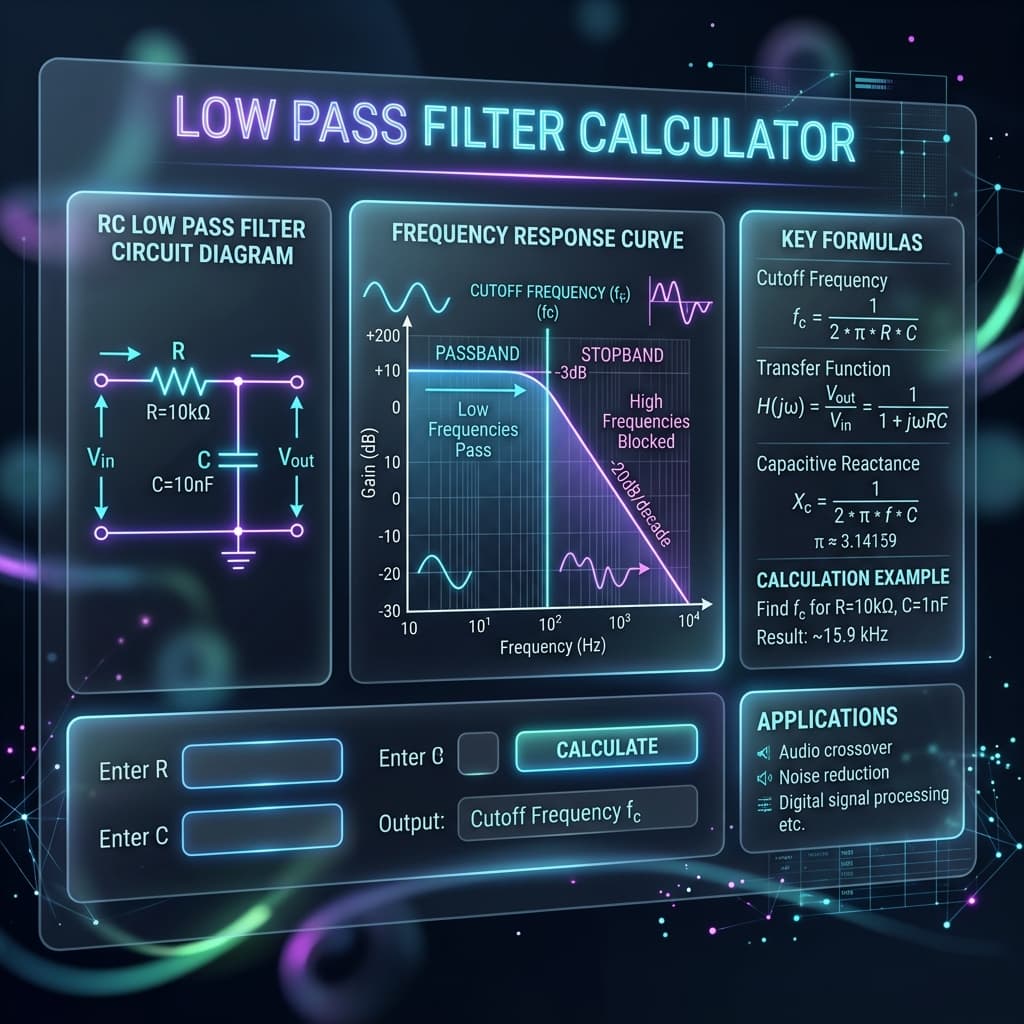
Low-Pass Filter Formulas
Cutoff frequency (−3 dB)
Voltage gain ratio
Frequency Response
| Frequency | Gain | Phase |
|---|---|---|
| ≪ fc | 0 dB | 0° |
| fc | −3 dB | −45° |
| 10 fc | −20 dB | −84.3° |
| 100 fc | −40 dB | −89.4° |
How to Use
- 1Select a mode.
- 2Enter R and C for cutoff, or add frequency and voltage for output.
- 3Click Calculate.
- 4Review cutoff, gain, phase, and component values.
Example Calculations
Cutoff Frequency
R = 1 kΩ, C = 0.1 μF. fc = 1/(2π × 1000 × 10−7) ≈ 1.59 kHz.
Output at 10 kHz
fc = 1.59 kHz, Vin = 5 V, f = 10 kHz. Gain ≈ 0.157 (−16.1 dB). Vout ≈ 0.787 V.
Applications
Anti-aliasing before ADC, power supply ripple filtering, audio treble control, smoothing PWM signals, removing high-frequency noise from sensor signals, and signal reconstruction.
Common Mistakes
- Measuring output across the resistor instead of the capacitor.
- Confusing low-pass and high-pass configurations.
- Forgetting that gain at fc is −3 dB, not 0 dB.
- Ignoring loading effects on filter output.
Accuracy and Limitations
Assumes ideal components. Real capacitors have ESR and frequency-dependent behavior. Loading by downstream circuits affects the actual cutoff. For steeper rolloff, use higher-order filter designs.
Frequently Asked Questions
What does a low-pass filter do?›
A low-pass filter allows frequencies below its cutoff frequency to pass through while attenuating higher frequencies. It is commonly used to remove noise and high-frequency interference.
Where is the output measured?›
In a first-order RC low-pass filter, the output is measured across the capacitor.
What is the rolloff rate?›
A first-order RC low-pass filter rolls off at −20 dB/decade (or −6 dB/octave) above the cutoff frequency.
What is the gain at the cutoff frequency?›
The gain at fc is 1/√2 ≈ 0.707, which is −3 dB. This means the output power is halved at the cutoff frequency.
Can I use an RL circuit as a low-pass filter?›
Yes. An RL low-pass filter has the output across the resistor with cutoff fc = R/(2πL). Use the Cutoff Frequency Calculator for RL filters.
How do I get a steeper rolloff?›
Cascade multiple first-order stages or use a second-order (or higher) filter design like Butterworth, Chebyshev, or Bessel filters.
How do I choose between Butterworth, Chebyshev, and Bessel filters?›
Butterworth gives maximally flat passband (no ripple) and moderate rolloff. Chebyshev allows passband ripple for a steeper rolloff. Bessel has the most linear phase response, preserving waveform shape. Use Butterworth for general purpose, Chebyshev when sharp cutoff matters more than flatness, and Bessel for pulse and timing circuits.
What is the anti-aliasing filter requirement before an ADC?›
An anti-aliasing low-pass filter must attenuate frequencies above half the sampling rate (Nyquist frequency) to prevent aliasing artifacts. The filter order and cutoff depend on the required attenuation at the Nyquist frequency. For 12-bit ADCs, plan for at least 72 dB attenuation, which requires a 4th-order or higher filter.
Sources / References

Author & technical reviewer
Manish Kumar
PhysicsCalcs tools are reviewed with an educational focus: clear formulas, transparent assumptions, and practical context for students and science learners.
Learn more about Manish