
What Is an Inductive Reactance Calculator?
This calculator determines how strongly an inductor opposes alternating current and can solve for reactance, inductance, frequency, current, or voltage.
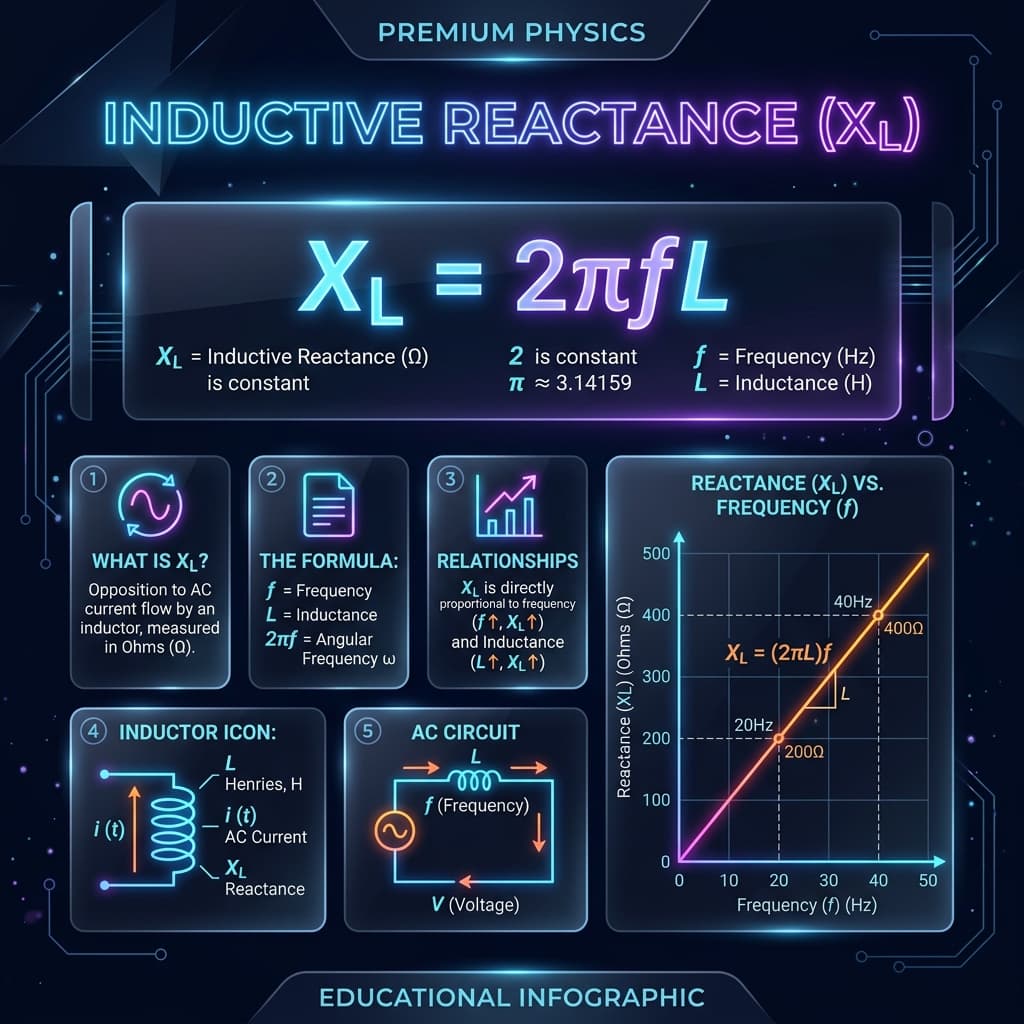
Inductive Reactance Formula
Reactance in ohms, frequency in Hz, inductance in henries.
Unlike capacitive reactance, XL increases with frequency. This makes inductors block high frequencies and pass low frequencies.
How Frequency and Inductance Affect XL
| Change | Effect on XL |
|---|---|
| Frequency increases | XL increases |
| Frequency decreases | XL decreases |
| Inductance increases | XL increases |
| Inductance decreases | XL decreases |
Inductive Reactance and AC Current
Use RMS voltage and current for standard AC calculations.
Inductive Reactance vs Resistance
| Feature | Resistance | Inductive Reactance |
|---|---|---|
| Symbol | R | XL |
| Frequency dependence | None | Increases with frequency |
| Energy | Dissipates as heat | Stores and returns |
| Phase | V and I in phase | Voltage leads by 90° |
Phase Relationship in an Inductor
In an ideal inductor, voltage leads current by 90°. This is the opposite of a capacitor, where current leads voltage. The mnemonic “ELI the ICE man” helps: in inductors (L), E leads I; in capacitors (C), I leads E.
XL vs Xc: Opposite Frequency Behavior
| Property | XL (Inductor) | Xc (Capacitor) |
|---|---|---|
| Formula | 2πfL | 1/(2πfC) |
| With increasing f | Increases | Decreases |
| Phase | V leads I by 90° | I leads V by 90° |
How to Use
- 1Choose what to calculate.
- 2Enter the known values.
- 3Select units.
- 4Click Calculate.
- 5Review reactance, formula, and phase notes.
Example Calculations
XL at 1 kHz
f = 1 kHz, L = 10 mH. XL = 2π × 1000 × 0.01 ≈ 62.83 Ω.
XL at 60 Hz
f = 60 Hz, L = 100 mH. XL = 2π × 60 × 0.1 ≈ 37.70 Ω.
AC current
V = 10 V RMS, XL = 62.83 Ω. I = 10/62.83 ≈ 159 mA RMS.
Applications
AC circuit analysis, RL filters, power systems, radio circuits, motor design, transformer analysis, frequency-dependent circuits, and physics homework.
Common Mistakes
- Using DC formulas for AC reactance.
- Forgetting to convert mH to H.
- Confusing XL with Xc.
- Mixing Hz and kHz.
- Using peak voltage when RMS is expected.
Accuracy and Limitations
This calculator assumes ideal inductive reactance. Real inductors have winding resistance, parasitic capacitance, core losses, and frequency-dependent behavior. This tool is educational and should not replace professional circuit design.
Frequently Asked Questions
What does an inductive reactance calculator do?›
It calculates how strongly an inductor opposes AC current and can solve for reactance, inductance, frequency, current, or voltage.
What is the formula for inductive reactance?›
XL = 2πfL, where f is frequency in Hz and L is inductance in henries.
What is the unit of inductive reactance?›
Ohms (Ω), the same unit as resistance, but reactance varies with frequency.
Why does XL increase with frequency?›
At higher frequencies, current changes faster, and inductors oppose rapid changes more strongly.
What happens to XL at DC?›
At DC (f = 0), XL = 0 — an ideal inductor acts as a short circuit for steady-state DC.
Is inductive reactance the same as resistance?›
No. Resistance dissipates energy; an ideal inductor stores and returns energy without loss.
How is XL different from Xc?›
XL increases with frequency; Xc decreases with frequency. They are opposites in AC behavior.
What is the phase relationship in an inductor?›
In an ideal inductor, voltage leads current by 90° (opposite to a capacitor).
How do I calculate AC current through an inductor?›
I = V/XL, using RMS values.
Does a larger inductor have more reactance?›
Yes. Larger inductance means higher reactance at any given frequency.
Can real inductors differ from ideal calculations?›
Yes. Real inductors have winding resistance, core losses, and parasitic capacitance.
Sources / References

Author & technical reviewer
Manish Kumar
PhysicsCalcs tools are reviewed with an educational focus: clear formulas, transparent assumptions, and practical context for students and science learners.
Learn more about Manish