
What Is Cutoff Frequency?
The cutoff frequency (also called corner frequency or −3 dB frequency) is the frequency at which a filter’s output power drops to half of its maximum value. For first-order RC and RL filters, this is determined solely by the component values and represents the transition between the passband and the stopband.
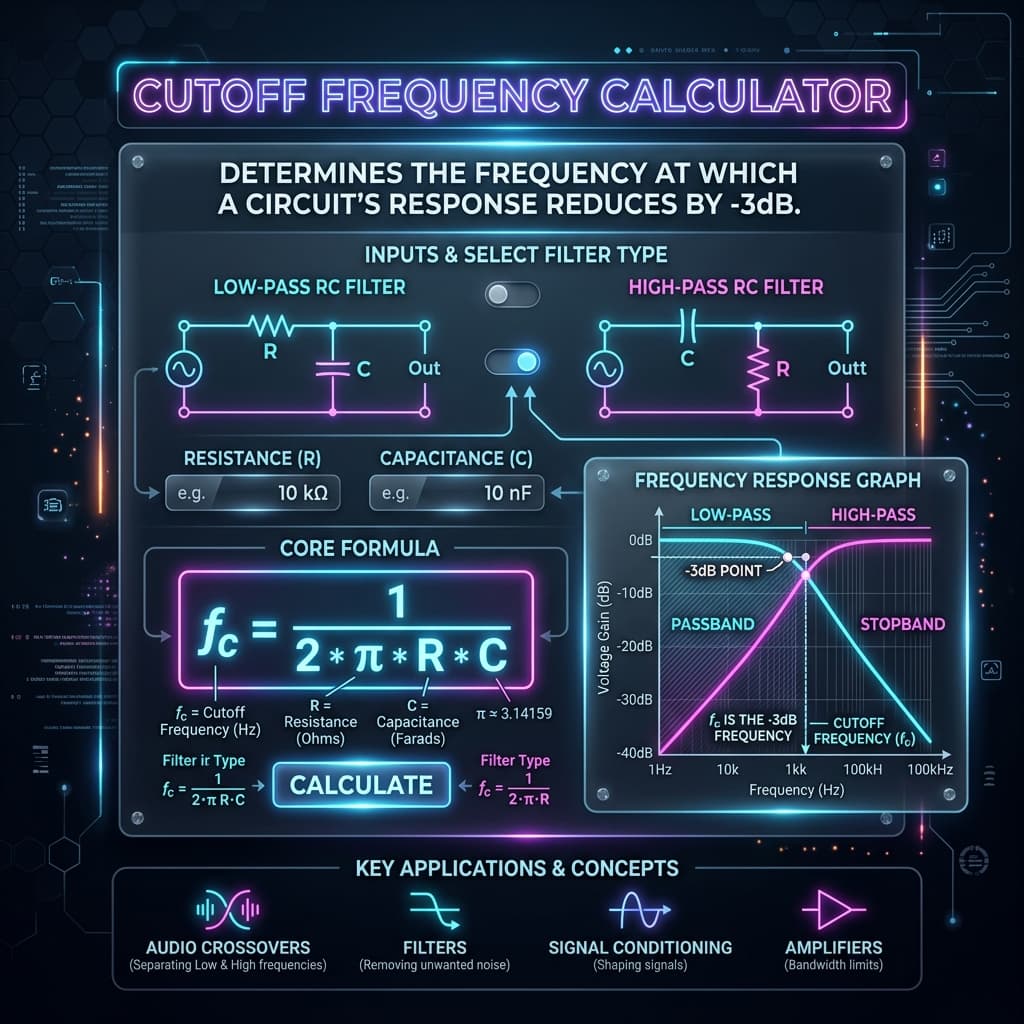
Cutoff Frequency Formulas
RC filter cutoff
RL filter cutoff
From time constant
RC vs RL Filters
| Feature | RC Filter | RL Filter |
|---|---|---|
| Cutoff formula | fc = 1/(2πRC) | fc = R/(2πL) |
| Time constant | τ = RC | τ = L/R |
| Low-pass output | Across C | Across R |
| Common use | Audio, signal processing | Power, EMI filtering |
Cutoff Frequency vs Resonant Frequency
These are often confused but fundamentally different. Cutoff frequency is the −3 dB point of a first-order filter (fc = 1/(2πRC)). Resonant frequency is where XL = Xc in a second-order LC/RLC circuit (f₀ = 1/(2π√LC)). They apply to different circuit types and have different physical meanings.
Filter Type Comparison
When a first-order RC/RL filter does not provide sufficient rolloff, higher-order filter topologies are used. Each type offers a different trade-off between passband flatness, rolloff steepness, and phase linearity.
| Filter Type | Passband Ripple | Stopband Rolloff | Phase Response | Best For |
|---|---|---|---|---|
| Butterworth | None (maximally flat) | −20n dB/decade | Moderate nonlinearity | General purpose, audio |
| Chebyshev Type I | Equiripple in passband | Steeper than Butterworth | Poor (sharp transitions) | Sharp cutoff needed |
| Bessel (Thomson) | None | Gentlest rolloff | Most linear (constant group delay) | Pulse, timing, data signals |
| Elliptic (Cauer) | Ripple in both bands | Steepest for a given order | Worst (sharp nulls) | Minimum order for tight spec |
n = filter order. A first-order filter (this calculator) is always a simple RC or RL regardless of topology. The distinctions above apply to 2nd-order and higher designs. Butterworth is the most common starting point for most applications.
How to Use
- 1Choose the calculation mode.
- 2Enter component values (R, C, L, or τ).
- 3Click Calculate.
- 4Review cutoff frequency, time constant, and output comparison.
Example Calculations
RC Cutoff
R = 10 kΩ, C = 10 nF. fc = 1/(2π × 10000 × 10−8) ≈ 1.59 kHz.
RL Cutoff
R = 100 Ω, L = 10 mH. fc = 100/(2π × 0.01) ≈ 1.59 kHz.
τ to fc
τ = 1 ms. fc = 1/(2π × 0.001) ≈ 159.15 Hz.
Applications
Audio crossover networks, anti-aliasing before ADC, EMI filtering, sensor signal conditioning, communications band selection, and RC/RL filter design for any first-order filtering application.
Common Mistakes
- Confusing cutoff frequency with resonant frequency.
- Using RC formula for RL circuits or vice versa.
- Forgetting unit conversions (kΩ to Ω, mH to H).
- Assuming −3 dB means zero output (it means 70.7% voltage).
Accuracy and Limitations
Assumes ideal first-order filters. Real components have tolerances, parasitic effects, and temperature dependencies. Higher-order filter behavior requires more complex analysis.
Frequently Asked Questions
What is cutoff frequency?›
Cutoff frequency is the frequency at which the filter’s output power drops to half (−3 dB) of its passband value. It marks the boundary between passed and attenuated frequencies.
Is cutoff frequency the same for low-pass and high-pass?›
Yes. For the same R and C values, both RC low-pass and high-pass filters have the same cutoff frequency fc = 1/(2πRC). The difference is which frequencies are passed vs attenuated.
How is cutoff frequency related to time constant?›
They are inversely related: fc = 1/(2πτ). A longer time constant means a lower cutoff frequency.
What is the difference between cutoff and resonant frequency?›
Cutoff frequency is the −3 dB point in a first-order RC or RL filter. Resonant frequency is where XL = Xc in an LC/RLC circuit. They use different formulas and apply to different circuit types.
Can I use this for RL filters?›
Yes. The RL cutoff mode calculates fc = R/(2πL). RL filters have the same −3 dB behavior as RC filters but use an inductor instead of a capacitor.
Does the output node change the cutoff?›
No. For a given RC or RL pair, the cutoff is the same regardless of whether you configure it as low-pass or high-pass. Only the frequency response shape changes.
Why is cutoff frequency defined at −3 dB specifically?›
The −3 dB point corresponds to the frequency where output power drops to exactly half (−3.01 dB = 10×log₁₀(0.5)). In voltage terms, this is 1/√2 ≈ 0.707 of the passband voltage. It is a natural mathematical breakpoint of the transfer function where the reactive impedance equals the resistive impedance.
How does source impedance affect the actual cutoff frequency?›
A non-zero source impedance adds to the filter resistance, lowering the actual cutoff frequency. For example, if R_filter = 10 kΩ and R_source = 1 kΩ, the effective R is 11 kΩ, reducing fc by about 9%. Always include source impedance in your design calculations.
Sources / References

Author & technical reviewer
Manish Kumar
PhysicsCalcs tools are reviewed with an educational focus: clear formulas, transparent assumptions, and practical context for students and science learners.
Learn more about Manish