
What Is a High-Pass Filter?
A high-pass filter is a circuit that allows signals with frequencies higher than a certain cutoff frequency to pass through while attenuating signals with lower frequencies. A first-order RC high-pass filter uses a capacitor in series and a resistor to ground, with the output taken across the resistor.
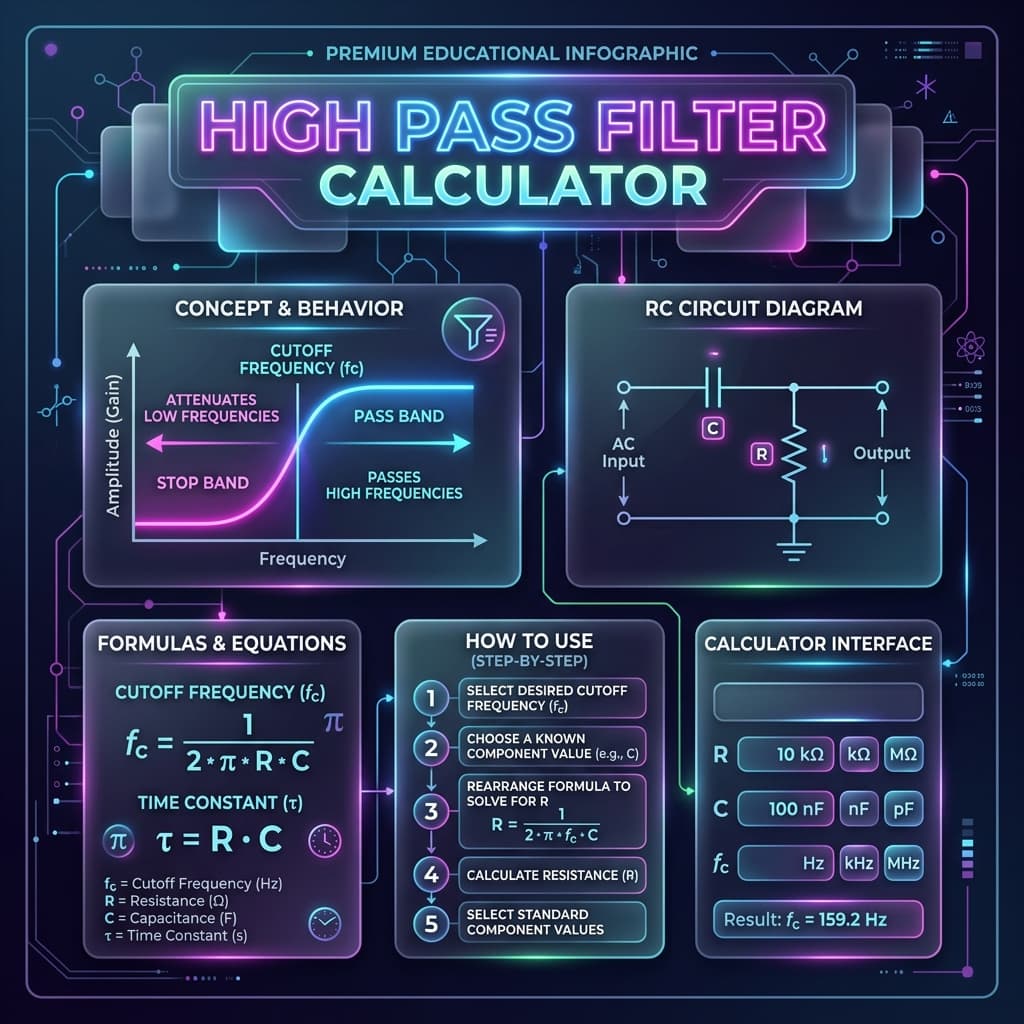
High-Pass Filter Formulas
Cutoff frequency (−3 dB)
Voltage gain ratio
Frequency Response
| Frequency | Gain | Phase |
|---|---|---|
| 0.1 fc | −20 dB | +84.3° |
| fc | −3 dB | +45° |
| 10 fc | −0.04 dB | +5.7° |
| ≫ fc | 0 dB | 0° |
How to Use
- 1Select a mode.
- 2Enter R and C for cutoff, or add frequency and voltage for output.
- 3Click Calculate.
- 4Review cutoff, gain, phase, and component values.
Example Calculations
Cutoff Frequency
R = 10 kΩ, C = 10 nF. fc = 1/(2π × 10000 × 10−8) ≈ 1.59 kHz.
Output at 500 Hz
fc = 1.59 kHz, Vin = 1 V, f = 500 Hz. Gain = 0.3 (−10.5 dB). Vout ≈ 0.3 V.
Applications
Audio bass removal, DC blocking, AC coupling between amplifier stages, removing baseline drift in sensor signals, differentiator circuits, and pre-emphasis in audio/communication systems.
Common Mistakes
- Measuring output across the capacitor instead of the resistor.
- Confusing high-pass and low-pass configurations.
- Forgetting that gain at fc is −3 dB, not 0 dB.
- Using peak voltage when RMS is needed.
Accuracy and Limitations
Assumes ideal components. Real capacitors have ESR and real resistors have parasitic capacitance. For steeper rolloff, use higher-order filters. Loading effects are not modeled.
Frequently Asked Questions
What does a high-pass filter do?›
A high-pass filter allows frequencies above its cutoff frequency to pass while attenuating lower frequencies. It blocks DC and low-frequency signals.
Where is the output measured?›
In a first-order RC high-pass filter, the output is measured across the resistor. The capacitor is in series with the signal path.
What is the rolloff rate?›
A first-order RC high-pass filter has a rolloff of +20 dB/decade (or +6 dB/octave) below the cutoff frequency.
How is this different from a low-pass filter?›
A low-pass filter passes low frequencies and attenuates high ones (output across C). A high-pass filter does the opposite (output across R). Both use the same cutoff formula.
Can I cascade high-pass filters?›
Yes, but cascading changes the overall response. Two identical first-order stages give −6 dB at fc instead of −3 dB, with a steeper rolloff.
What is the phase at the cutoff frequency?›
At fc, the phase shift is +45°. Phase ranges from +90° at very low frequencies to 0° at very high frequencies.
How do I design an AC coupling capacitor using a high-pass filter?›
An AC coupling cap and the downstream input impedance form a high-pass filter. Choose C so the cutoff fc = 1/(2πRC) is at least 10× below your lowest signal frequency. For example, with 10 kΩ input impedance and a 20 Hz lower limit, C ≥ 1/(2π × 10000 × 2) ≈ 8 µF; a 10 µF cap provides margin.
What happens when I cascade two first-order high-pass stages?›
Two identical RC high-pass stages in series give −40 dB/decade rolloff below the cutoff. However, the combined −3 dB point shifts higher by a factor of about 1.55× compared to a single stage. Buffer the stages with an op-amp follower to prevent loading.
Sources / References

Author & technical reviewer
Manish Kumar
PhysicsCalcs tools are reviewed with an educational focus: clear formulas, transparent assumptions, and practical context for students and science learners.
Learn more about Manish