
What Is kVA to kW Conversion?
Converting kVA (kilovolt-amperes) to kW (kilowatts) tells you how much of the apparent power is actually doing useful work. The relationship depends on the power factor of the load: kW = kVA × PF.
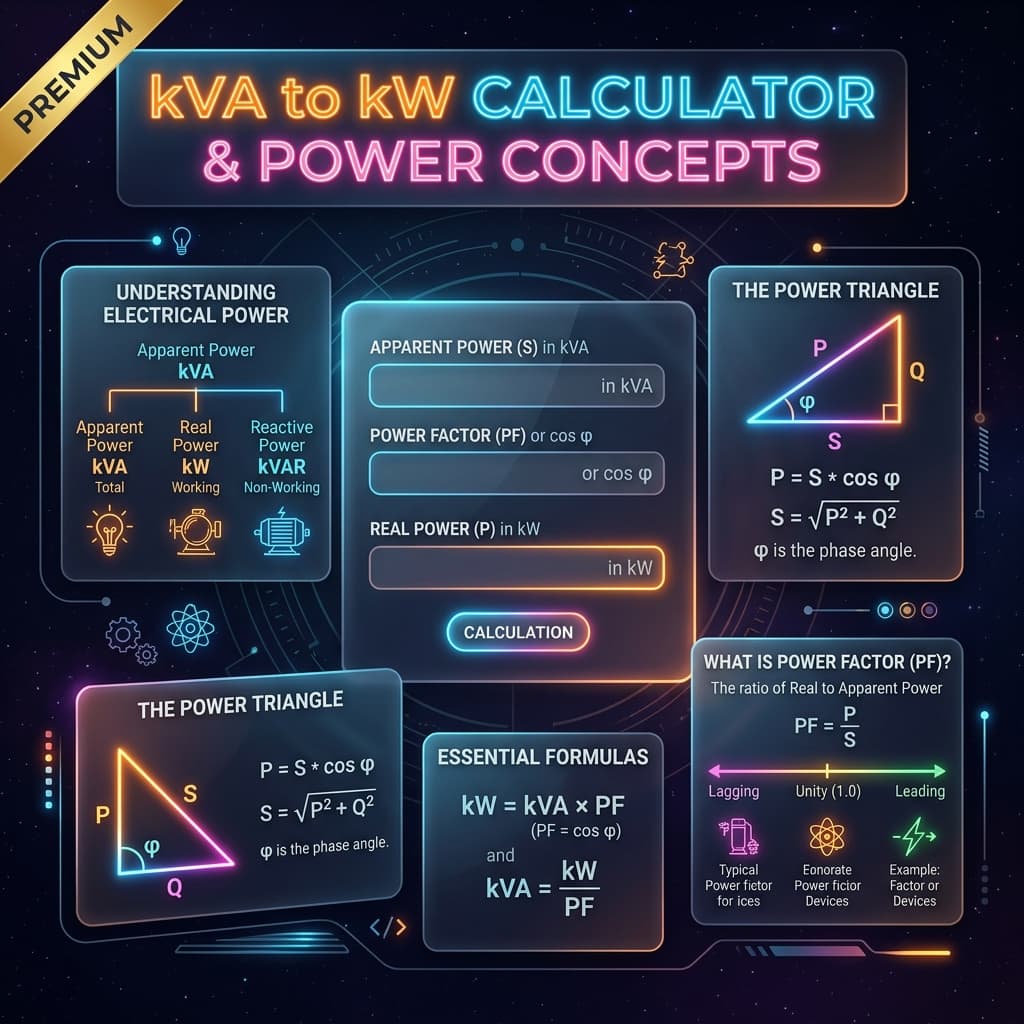
Conversion Formulas
kVA to kW
kW to kVA
kVA to kW Conversion Table
| kVA | PF 0.7 | PF 0.8 | PF 0.85 | PF 0.9 | PF 1.0 |
|---|---|---|---|---|---|
| 10 | 7 | 8 | 8.5 | 9 | 10 |
| 25 | 18 | 20 | 21.3 | 23 | 25 |
| 50 | 35 | 40 | 42.5 | 45 | 50 |
| 100 | 70 | 80 | 85.0 | 90 | 100 |
| 250 | 175 | 200 | 212.5 | 225 | 250 |
| 500 | 350 | 400 | 425.0 | 450 | 500 |
| 1000 | 700 | 800 | 850.0 | 900 | 1000 |
Common Equipment Ratings
Electrical equipment is typically rated in kVA (apparent power). Use the expected power factor to estimate the real power (kW) the equipment can deliver or consume.
| Equipment Type | Typical kVA Range | Expected PF | Approx. kW |
|---|---|---|---|
| Small office UPS | 1–3 kVA | 0.6–0.8 | 0.6–2.4 kW |
| Server rack UPS | 10–30 kVA | 0.9–1.0 | 9–30 kW |
| Standby generator | 20–500 kVA | 0.8 | 16–400 kW |
| Distribution transformer | 25–2500 kVA | 0.85 (load-dependent) | 21–2125 kW |
| Industrial motor (3-phase) | 5–500 kVA | 0.75–0.85 | 3.75–425 kW |
kVA ratings represent the maximum apparent power the equipment can handle. The actual real power (kW) depends on the connected load’s power factor. Always verify nameplate data for specific equipment.
How to Use
- 1Select a conversion mode.
- 2Enter apparent power (kVA) or real power (kW).
- 3Enter the power factor.
- 4Click Calculate.
- 5Review real power, apparent power, and reactive power.
Examples
kVA to kW
100 kVA, PF = 0.85. kW = 100 × 0.85 = 85 kW.
kW to kVA
50 kW, PF = 0.8. kVA = 50 / 0.8 = 62.5 kVA.
Applications
Generator sizing, transformer loading, UPS specification, motor starting calculations, electrical panel capacity, utility billing, and power distribution design.
Common Mistakes
- Assuming kVA and kW are the same (they only equal at PF = 1).
- Using wrong power factor for the load type.
- Forgetting the √3 factor for three-phase systems.
Accuracy and Limitations
Assumes sinusoidal waveforms and constant power factor. Real loads may have varying PF with changing conditions. Harmonic distortion from non-linear loads requires total power factor analysis.
Frequently Asked Questions
What is the difference between kVA and kW?›
kVA (kilovolt-amperes) is apparent power — the total power flowing in the circuit. kW (kilowatts) is real power — the useful power doing actual work. They differ by the power factor: kW = kVA × PF.
How do I convert kVA to kW?›
Multiply kVA by the power factor: kW = kVA × PF. For example, 100 kVA at PF = 0.8 gives 80 kW.
Why is kVA higher than kW?›
Because power factor is always ≤ 1. Some apparent power is reactive (stored and returned by inductors/capacitors) rather than doing useful work.
What PF should I use if I don't know it?›
Common assumptions: 0.8 for mixed industrial loads, 0.85–0.9 for corrected systems, 1.0 for resistive loads (heaters, incandescent lamps).
Does this work for DC?›
DC circuits don't have reactive power. For DC, power is simply P = V × I (watts = VA), so the distinction between kVA and kW doesn't apply.
How do I size a generator in kVA for a known kW load?›
Divide the total kW load by the expected power factor: kVA = kW / PF. Add a 20–25% safety margin for motor starting surges and future expansion. For example, 80 kW at PF 0.8 needs 100 kVA minimum; with margin, specify a 125 kVA generator.
Why do UPS systems quote capacity in kVA rather than kW?›
UPS output is limited by both current (which determines kVA) and real power (kW). The kVA rating reflects the maximum current the inverter can supply regardless of load power factor. Older UPS units had output PF of 0.6–0.8; modern units are typically rated at 0.9 or unity (kVA = kW).
Sources / References

Author & technical reviewer
Manish Kumar
PhysicsCalcs tools are reviewed with an educational focus: clear formulas, transparent assumptions, and practical context for students and science learners.
Learn more about Manish