
What Is kW to kVA Conversion?
Converting kW to kVA determines the total apparent power a system must supply to deliver a given real power load. Since generators, transformers, and UPS units are rated in kVA, this conversion is critical for proper equipment sizing.
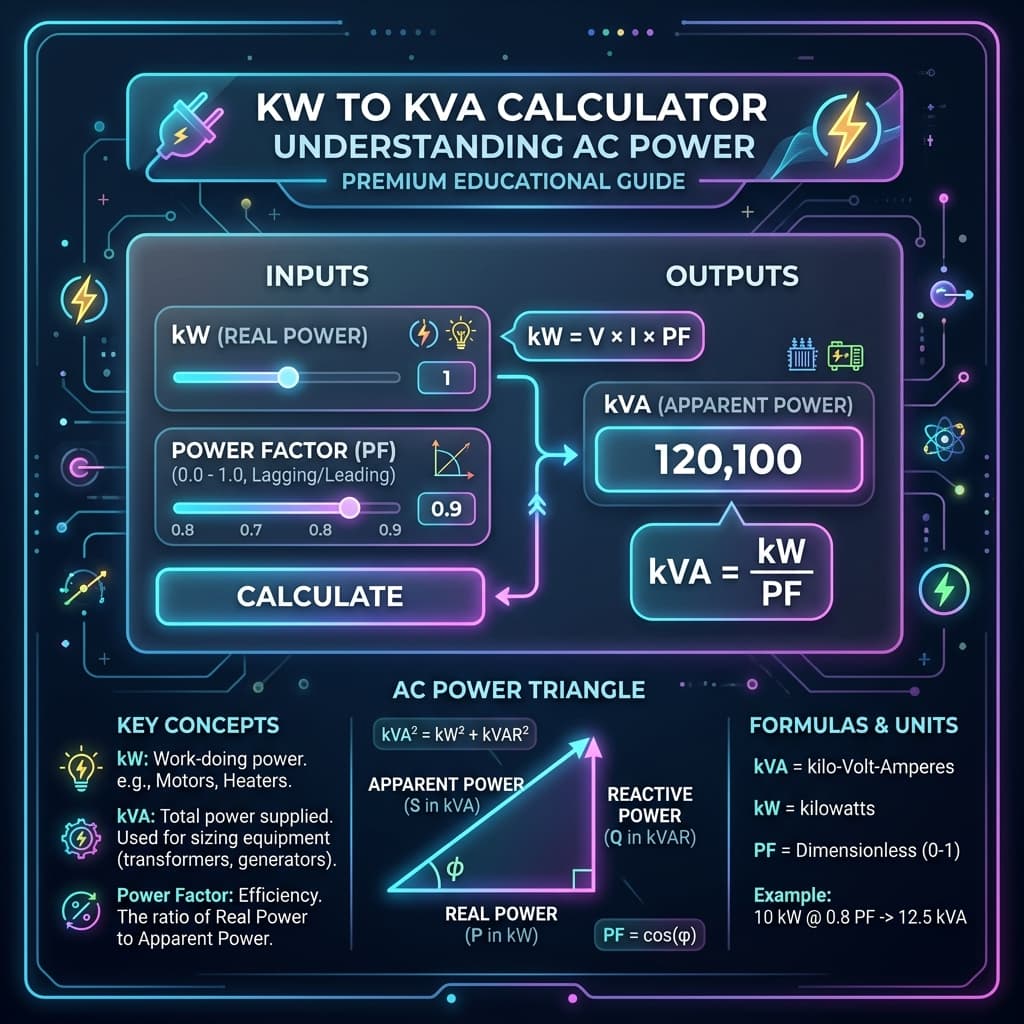
Conversion Formulas
kW to kVA
kVA to kW
kW to kVA Conversion Table
| kW | PF 0.7 | PF 0.8 | PF 0.85 | PF 0.9 | PF 1.0 |
|---|---|---|---|---|---|
| 10 | 14.3 | 12.5 | 11.8 | 11.1 | 10.0 |
| 25 | 35.7 | 31.3 | 29.4 | 27.8 | 25.0 |
| 50 | 71.4 | 62.5 | 58.8 | 55.6 | 50.0 |
| 100 | 142.9 | 125.0 | 117.6 | 111.1 | 100.0 |
| 250 | 357.1 | 312.5 | 294.1 | 277.8 | 250.0 |
| 500 | 714.3 | 625.0 | 588.2 | 555.6 | 500.0 |
How to Use
- 1Select a conversion mode.
- 2Enter real power (kW) and power factor.
- 3Click Calculate.
- 4Review apparent power (kVA) and reactive power (kVAr).
Examples
kW to kVA
80 kW, PF = 0.8. kVA = 80/0.8 = 100 kVA.
Generator Sizing
Need 150 kW, PF = 0.85. kVA = 150/0.85 ≈ 176.5 kVA. Choose a 200 kVA generator.
Applications
Generator sizing, UPS selection, transformer specification, cable sizing, switchgear rating, utility billing, and power distribution planning.
Common Mistakes
- Treating kW and kVA as identical.
- Using an incorrect power factor assumption.
- Forgetting the √3 factor for three-phase systems.
- Not adding a safety margin when sizing equipment.
Accuracy and Limitations
Assumes constant power factor and sinusoidal waveforms. Actual loads may have varying PF and harmonic content. Always apply appropriate derating and safety factors when sizing electrical equipment.
Frequently Asked Questions
Why do I need to convert kW to kVA?›
Generators, transformers, and UPS systems are rated in kVA (apparent power). To properly size this equipment for a kW (real power) load, you must account for the power factor.
How do I convert kW to kVA?›
Divide kW by the power factor: kVA = kW / PF. For example, 80 kW at PF = 0.8 requires 100 kVA.
Why is kVA always higher than kW?›
Because PF ≤ 1, dividing by PF gives a larger number. The difference is the reactive power component.
What is the kW to kVA formula for three-phase?›
First find S (kVA) = √3 × V_L × I_L / 1000, then P (kW) = S × PF, or S = P / PF.
How does this differ from the kVA to kW Calculator?›
They use the same formulas but with different default modes. This tool defaults to kW → kVA conversion, while the kVA to kW Calculator defaults to the reverse.
Sources / References

Author & technical reviewer
Manish Kumar
PhysicsCalcs tools are reviewed with an educational focus: clear formulas, transparent assumptions, and practical context for students and science learners.
Learn more about Manish