
What Is an Inductance Calculator?
This calculator computes inductor-related values including inductance, voltage, current change rate, energy, and solenoid inductance. It is useful for physics homework, electronics learning, magnetism concepts, and basic circuit analysis.
What Is Inductance?
Inductance is the property of a circuit or coil that opposes changes in current. A changing current creates a changing magnetic field, which induces voltage. It is measured in henries (H).
Inductor Voltage Formula
Voltage depends on how quickly current changes. Faster change creates larger induced voltage.
Inductor Energy Formula
Energy stored in the magnetic field. Doubles with current squared.
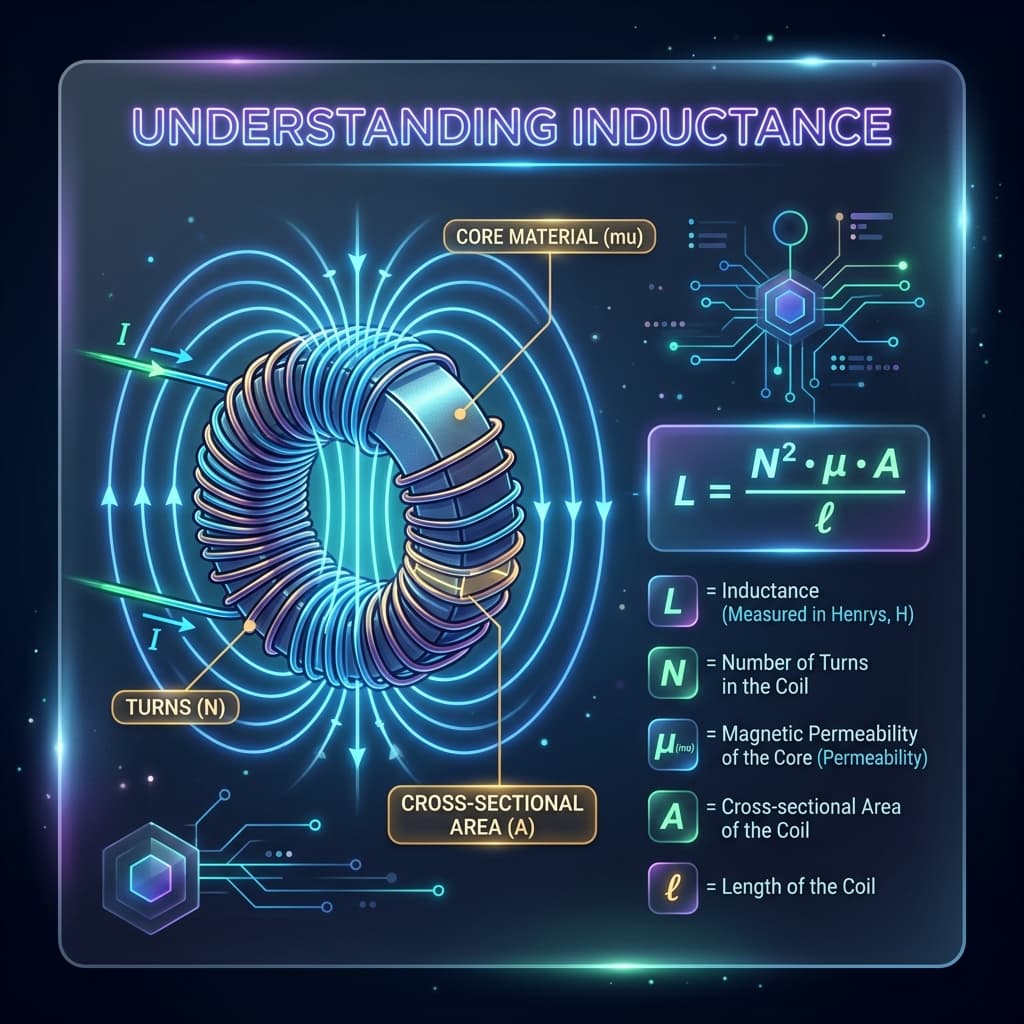
Solenoid Inductance Formula
Inductance increases with turns (N²), area, and permeability; decreases with length.
How to Use the Inductance Calculator
- 1Choose what you want to calculate.
- 2Enter the known values.
- 3Select units.
- 4For solenoid mode, use custom permeability or default air (1).
- 5Click Calculate.
- 6Review result, formula, and limitation notes.
Example Calculations
Inductor voltage
L = 5 mH, dI/dt = 1000 A/s. V = 0.005 × 1000 = 5 V.
Stored energy
L = 10 mH, I = 2 A. E = ½ × 0.01 × 4 = 20 mJ.
Solenoid
N = 200, A = 1 cm², l = 5 cm, μr = 1. L = 4π×10−7 × 40000 × 10−4 / 0.05 ≈ 100.5 μH.
Current from energy
E = 0.5 J, L = 100 mH. I = √(1/0.1) ≈ 3.16 A.
Inductance vs Resistance vs Capacitance
| Quantity | Unit | Opposes / Stores |
|---|---|---|
| Resistance | Ohm | Opposes current, dissipates heat |
| Capacitance | Farad | Stores electric field energy |
| Inductance | Henry | Opposes current change, stores magnetic energy |
Common Mistakes
- Confusing inductance with inductive reactance.
- Forgetting mH and μH conversions.
- Treating real inductors as ideal at all frequencies.
- Ignoring winding resistance and core saturation.
- Using the solenoid formula for non-solenoid geometries.
Where Inductance Calculations Are Used
Coils and solenoids, RL circuits, filters, transformers, motors, relays, switching circuits, energy storage, magnetic field applications, physics homework, and electronics labs.
Accuracy and Limitations
This calculator uses ideal formulas. Real inductors have winding resistance, parasitic capacitance, losses, temperature effects, and frequency dependence. Magnetic cores can saturate. The solenoid formula assumes uniform field. This tool is educational and should not replace professional electrical design.
Frequently Asked Questions
What does an inductance calculator do?›
It calculates inductor-related values such as inductance, voltage, current change rate, energy, and solenoid inductance.
What is the formula for inductance?›
L = V/(dI/dt) from the voltage equation, or L = μ₀μrN²A/l for a solenoid.
What is the unit of inductance?›
The henry (H). Practical values often use mH (μ0.001 H) or μH (10⁻⁶ H).
What does a henry mean?›
One henry means a current change rate of 1 A/s induces 1 V across the inductor.
How do you calculate voltage across an inductor?›
V = L × (dI/dt). Voltage depends on how quickly the current changes.
How do you calculate energy stored in an inductor?›
E = ½LI². Energy is stored in the magnetic field and depends on current squared.
What affects solenoid inductance?›
Number of turns (N²), cross-sectional area, coil length, and core permeability.
Is inductance the same as resistance?›
No. Resistance opposes current flow and dissipates energy. Inductance opposes current changes and stores magnetic energy.
Is inductance the same as inductive reactance?›
No. Inductive reactance (XL = 2πfL) is frequency-dependent opposition in AC circuits. Inductance (L) is a fixed property of the component.
Does an inductor work with DC?›
After transients settle, an ideal inductor acts like a short circuit for DC (zero resistance). Real inductors have winding resistance.
Why does more turns increase inductance?›
Inductance scales with N² because each turn contributes to and is linked by the magnetic flux from all other turns.
Are real inductors ideal?›
No. Real inductors have winding resistance, core losses, parasitic capacitance, and saturation effects.
Sources / References

Author & technical reviewer
Manish Kumar
PhysicsCalcs tools are reviewed with an educational focus: clear formulas, transparent assumptions, and practical context for students and science learners.
Learn more about Manish