
What Is Battery Capacity?
Battery capacity is the total amount of electrical charge a battery can store and deliver. It’s measured in amp-hours (Ah) or milliamp-hours (mAh). Combined with voltage, capacity determines the total energy (Wh) available to power your device.
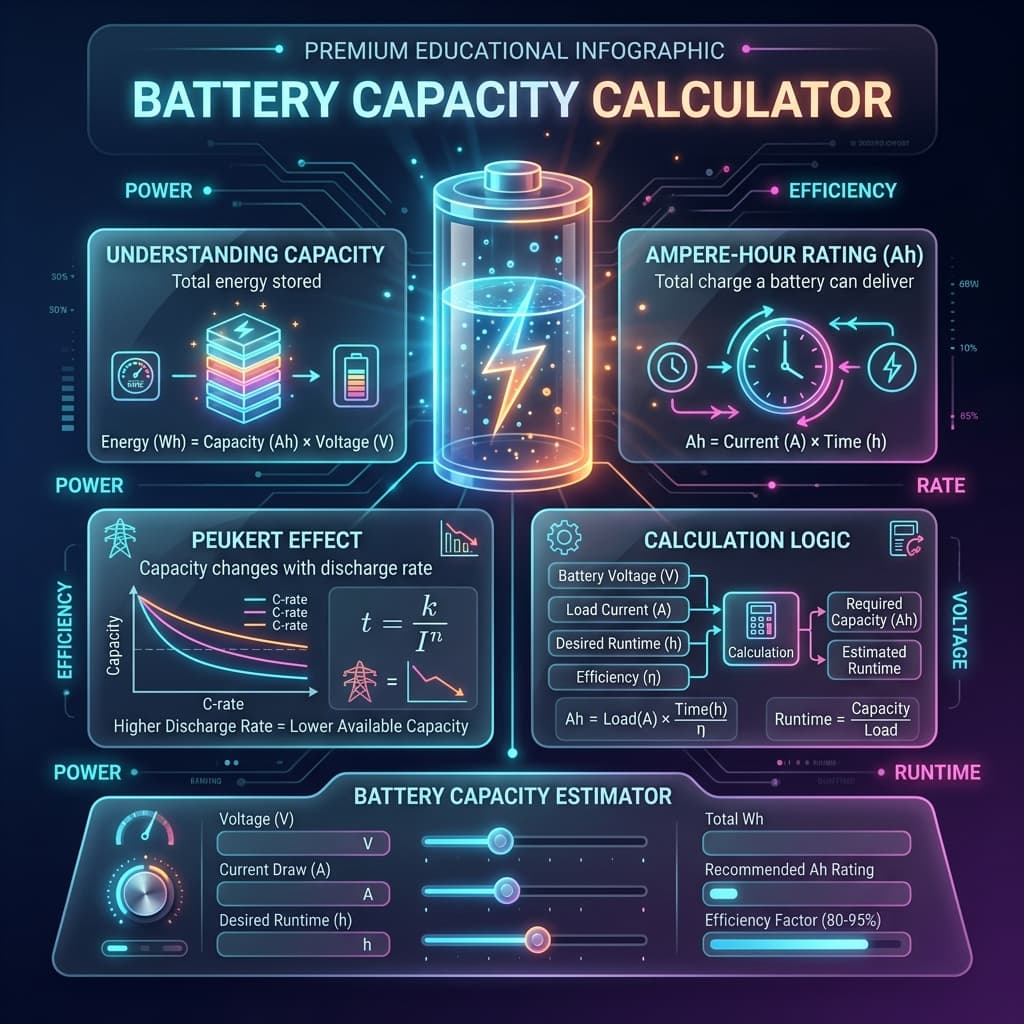
Capacity Formulas
Capacity from current and time
Energy from voltage and capacity
mAh vs Wh: When to Use Which
| Feature | mAh (Capacity) | Wh (Energy) |
|---|---|---|
| Measures | Charge (current × time) | Energy (power × time) |
| Depends on voltage? | No | Yes (Wh = V × Ah) |
| Best for | Same-voltage comparisons | Cross-voltage comparisons |
| Example | 3000 mAh phone battery | 50 Wh laptop battery |
How to Use
- 1Select a calculation mode.
- 2Enter known values (capacity, current, voltage, runtime).
- 3Set DoD and efficiency for sizing modes.
- 4Click Calculate.
- 5Review results and apply safety margins for real designs.
Examples
Required Capacity
200 mA for 24 hours, 80% DoD, 90% eff. Ah = (0.2 × 24) / (0.8 × 0.9) = 6.67 Ah.
mAh to Wh
3000 mAh at 3.7 V. Wh = 3.7 × 3 = 11.1 Wh.
Applications
Battery selection for electronics, UPS sizing, solar battery system design, EV range calculation, portable device design, IoT sensor power budgets, and backup power planning.
Common Mistakes
- Comparing mAh across different voltages without converting to Wh.
- Not accounting for DoD and efficiency in sizing calculations.
- Assuming rated capacity is fully usable.
- Confusing mAh (capacity) with mA (current).
Accuracy and Limitations
This calculator uses ideal formulas. Real battery capacity varies with discharge rate, temperature, age, and chemistry. Always use manufacturer datasheets and add safety margins for critical applications.
Frequently Asked Questions
What is battery capacity?›
Battery capacity is the total charge a battery can deliver, measured in amp-hours (Ah) or milliamp-hours (mAh). A 2000 mAh battery can theoretically deliver 2000 mA for 1 hour, or 200 mA for 10 hours.
What is the difference between mAh and Wh?›
mAh measures charge capacity at the battery voltage. Wh measures energy and accounts for voltage: Wh = V × Ah. Use Wh when comparing batteries at different voltages.
How do I size a battery?›
Determine your average current draw and desired runtime. Calculate: Required Ah = (I × hours) / (DoD × efficiency). Add a safety margin of 10–20%.
Why is actual capacity less than rated?›
Rated capacity assumes ideal conditions. Real capacity is reduced by high discharge rates, cold temperatures, battery age, and internal resistance losses.
What is a good DoD to use?›
For Li-ion: 80–90% DoD. For lead-acid: 50–60% DoD. Lower DoD extends cycle life significantly.
Sources / References

Author & technical reviewer
Manish Kumar
PhysicsCalcs tools are reviewed with an educational focus: clear formulas, transparent assumptions, and practical context for students and science learners.
Learn more about Manish